Tesla Stock Could Be in for a Massive Move. Here’s My 2027 Price Prediction
Tesla's FSD subscriptions are surging, Robotaxi is hitting the streets, and Optimus robots are coming off production lines, yet the stock sits 22% in the red for the year. Here is what bulls and skeptics alike need to see before…

This post may contain links from our sponsors and affiliates, and Flywheel Publishing may receive compensation for actions taken through them.
More and more, Tesla (NASDAQ:TSLA | TSLA Price Prediction) is selling software that happens to come with a car. On the second-quarter call, Elon Musk said “for a lot of people, they’re actually buying Tesla full self driving with a car attached as opposed to a car with FSD.”
Active FSD subscriptions reached 1.48 million, up 56% YoY, and Robotaxi now gives unsupervised rides in 7 U.S. metros. The stock has fell back anyway.
Shares are down 22.9% year-to-date at $346.73, and heavy spending drove free cash flow to negative $1.09 billion last quarter. Let’s look at what Tesla needs to do to hit $550 in 2027.

Analysts See Upside, but Tesla Estimates Have Slipped
Wall Street’s average one-year target is $395.83, which means 14% upside. For 2027, analysts expect EPS of $2.2011, up from $1.7724 this year. That is 24% growth. Revenue is expected to grow 13.9%.
Sentiment has cooled off. The 2027 EPS consensus was $2.5181 ninety days ago. Over the past 30 days, analysts made 19 downward revisions and 4 upward ones.
Tesla beat EPS in Q4 2025 and Q1 2026, then missed in Q2 with $0.33 against $0.5367 expected. Revenue has beaten estimates in each of the last four quarters, most recently at $28.24 billion, 7.10% above forecasts.

Here’s What It Takes for Tesla to Reach $550
Today, Tesla trades at 158x 2027 earnings. At $550, that multiple would rise to 250x. Measured against the highest Street estimate of $3.65, it would be 151x. That is a steep price, so investors would have to value Tesla on autonomy and robotics rather than on car sales.
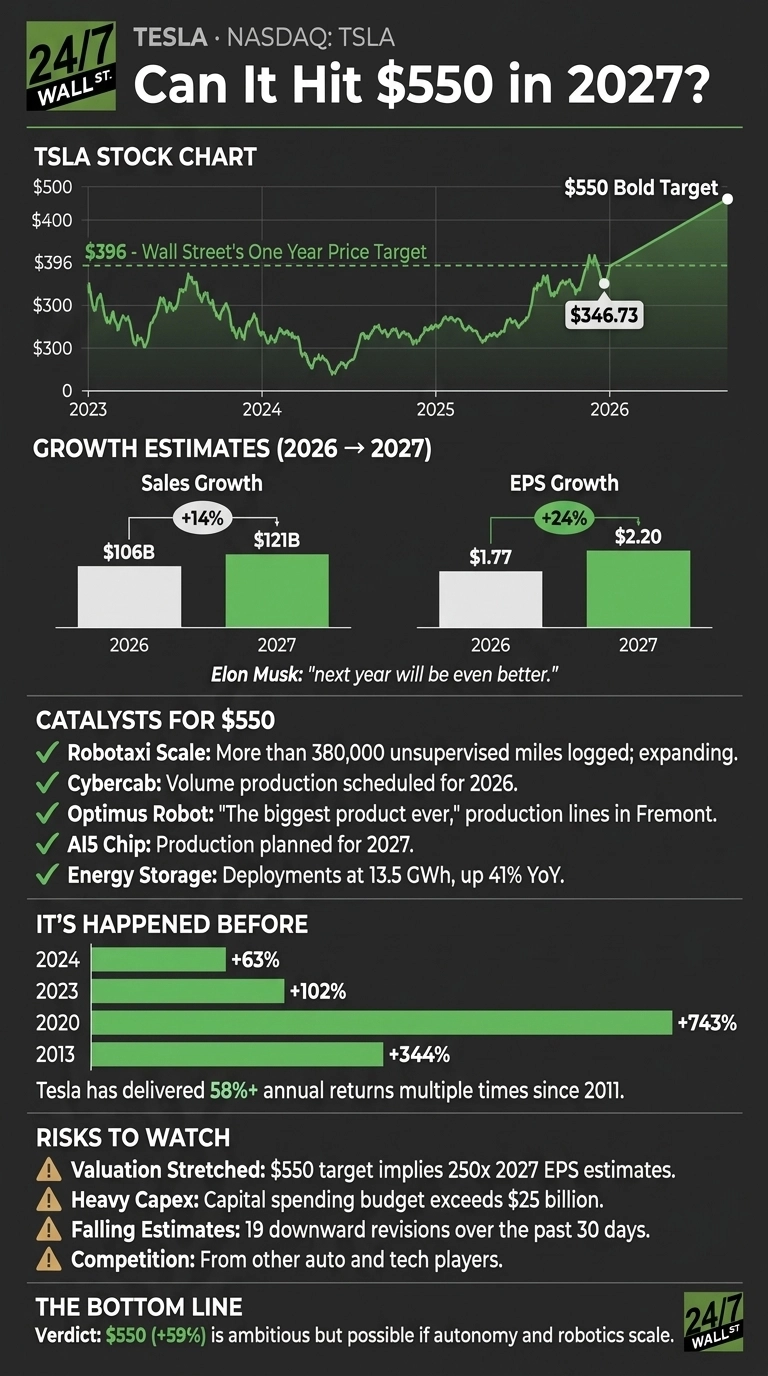
- Robotaxi scale: Musk said Robotaxi miles are growing “more than 10% a week”. The fleet has logged more than 380,000 unsupervised miles.
- New hardware: Cybercab volume production is scheduled for 2026, and production of the AI5 chip is planned for 2027.
- Energy storage: Deployments reached 13.5 GWh, up 41%, and management expects demand from AI data centers.
- Optimus: Musk calls it “the biggest product ever,” and production lines are going in at Fremont.
- Margin recovery: Automotive gross margin hit 21.1% in Q1, while operating margin fell to 1.4% in Q2. That leaves a lot of room to recover.

Tesla’s History Says a 59% Gain Is Possible
To reach $550, shares would need to gain 58.6%. Tesla has topped that bar four times since 2011: 344% in 2013, 743% in 2020, 102% in 2023, and 63% in 2024.
With a $1.37 trillion market cap, $550 stands only 10% above the 52-week high of $498.83.
$550 Is a Stretch, but Here’s Why It’s Possible
Getting to $550 means a gain of about 59%. Analysts already see 14% upside and 24% EPS growth. From there, faster Robotaxi growth, a Cybercab ramp and recovering margins would have to do the rest.
Capital spending above $25 billion and falling estimates are real hurdles. Musk’s view is “next year will be even better.” Returns at this level shouldn’t be expected every year, but we’ve laid out how Tesla could deliver exceptional gains by 2027. The traits that show up early in the biggest tech winners are the same ones we cataloged in a free playbook, which you can get here.
Contact [email protected] for any questions or corrections.
Vandita Jadeja is a financial publisher with over a decade of experience writing about financial topics, including investment, savings, retirement, insurance and banking. Vandita is a Chartered Accountant who loves to debunk financial concepts for readers.
Her work has appeared on sites that include The Motley Fool, InvestorPlace, and Benzinga. She covers investing and focuses on stock picks and price prediction for 24/7 Wall St.
When not looking for the next stock investment opportunity, she can be found traveling, reading, chasing sunsets and enjoying her iced latte.