Self Storage REITs Are Collecting Rent From Americans Who Cannot Let Go
Americans are paying monthly rent on stuff they refuse to give up, and three landlords have built billion-dollar businesses on that reluctance. Which one offers the safest income and which one is closest to the edge?

Self storage makes its money from Americans who would rather pay rent on a 10×10 unit than give up the stuff in it, and those customers are staying longer. At Extra Space Storage (NYSE:EXR), the average in-place customer now stays about one and a half months longer than a year ago. Management says customers who store because they ran out of room stay at least twice as long as customers who are moving. All three of these equity REITs own and operate the buildings. That means they carry property risk. They avoid the loan-related risks that mortgage REITs take on by holding debt.
Public Storage: Largest Landlord With the Widest Dividend Cushion
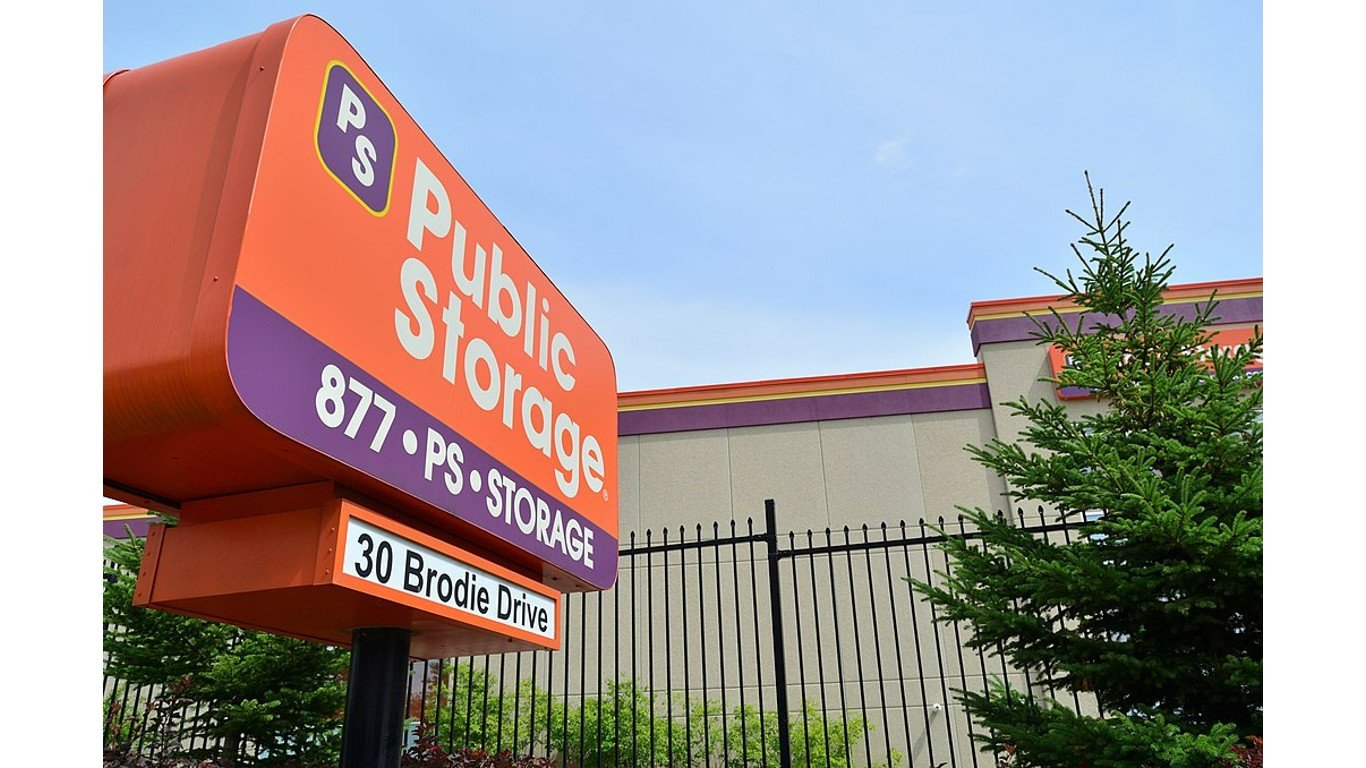
Public Storage (NYSE:PSA) is the largest self-storage REIT in the U.S., and it just got bigger. On July 22, 2026, it closed its $10.5B merger with National Storage Affiliates, which took the portfolio to 4,500+ locations and 327M+ square feet. It also agreed to buy Public Storage Canada for US$1.2B (68 properties).
The core portfolio is still recovering. Same Store revenue fell 0.6% in the second quarter and Same Store operating income fell 2.2%. Average occupancy edged up to 92.5% from 92.3%. Move-in rents rose 1.6%, which management said was the first time since 2021 that both move-in rates and occupancy rose year over year.
Storage leases run month to month, and that works in both directions. Rents can reset up quickly, but realized rent per occupied square foot still fell 0.8%. Regulators can also cap increases: Los Angeles emergency pricing limits cost Public Storage about 70 basis points of same-store revenue growth in 2025 and another 50 net this year.
Yield and coverage: The quarterly dividend is $3, or $12 annualized. At $283.88, that works out to a 4.2% yield. Dividends have been $3 in every quarter since March 2023, up from $2 from 2020 through 2022. To judge dividend safety, use Core FFO instead of net income. Core FFO adds back depreciation on the buildings and removes one-time items, so it shows the cash the business produces to pay dividends. Against the raised Core FFO guidance midpoint of $16.90, the dividend uses about 71% of Core FFO. It has the lowest payout share of the three. Net debt to EBITDA is 2.9 times.
Bull case: Management expects $110M to $130M in run-rate synergies from the merger within three to four years and $0.35 to $0.50 per share of annualized FFO increase at full implementation. The National Storage Affiliates portfolio is only about 85% occupied, with roughly 14,000 units that repairs could bring back online. Management also calls millennials its “largest cohort of customers today” and says they use storage more than earlier generations did at the same age.
Risk: Integrating 1,100 stores costs money and attention, and interest expense has already risen to $84.8M from $71.6M a year earlier. The stock is up 12.66% year to date but has fallen 4.86% over the past month.
Extra Space Storage: Growing on Customers Who Stay Put
Extra Space became the largest self-storage REIT by store count after its 2023 merger with Life Storage. Its platform now covers more than 4,400 stores, including a large third-party management business and a bridge-lending arm.
Extra Space has the best operating numbers of the three. Core FFO per share rose 4.9% to $2.15 in the second quarter. Same-store revenue grew 2.4% and same-store operating income rose 3.5%, while same-store expenses fell 0.5%. Occupancy ended at 94.2%, slightly below 94.4% a year earlier. A frozen housing market is a real drag. The chief executive said, “We haven’t seen any pickup in the housing market,” and the share of customers who are moving has dropped from the low 60s to approximately 55%. People who simply ran out of space have filled that gap.
The model depends on customers not bothering to leave. Raising rents on existing customers is a core revenue driver, and only about 16% of customers who got a rate increase asked for and received some relief, then stayed. In the chief executive’s words, “76% of our customers, when they leave, it’s because they don’t need storage anymore.”
Yield and coverage: Extra Space pays $1.62 per quarter, or $6.48 annualized. At $133.20, that is a 4.9% yield. Dividends have held at $1.62 in every record from 2023-12-14 through 2026-09-15, so it is steady but not growing. Management raised full-year Core FFO guidance to $8.25 to $8.40. At the midpoint, the dividend uses about 78% of Core FFO, which leaves a comfortable margin.
Bull case: Fewer new facilities are opening. The chief executive said “you’re seeing a decline in deliveries in almost all MSAs.” If that continues, management believes revenue growth can return to the historical range of 3% to 4%. The company also raised same-store operating income guidance by 200 basis points.
Risk: Extra Space has about $1.475B in bridge loans outstanding to other storage owners. That book earns interest and supplies future acquisitions, but it adds lender-style credit exposure on top of the property business. Over five years, the stock is down 3.25%.
CubeSmart: Highest Yield of the Three, Thinnest Cushion
CubeSmart (NYSE:CUBE) is the third-largest publicly traded self-storage REIT. Its portfolio leans toward the Northeast, and it manages 872 stores for third-party owners. Management singled out Boston, Stamford, New York and Philadelphia as its best markets.
Same-store revenue growth picked up to 0.8% in the second quarter from 0.6% in the first. Move-in rates for new customers rose 1.7% year over year. As of July 30, same-store physical occupancy was 91.1%, up 30 basis points. July rentals were running 3% higher and vacates were down 3%. The near term still has a soft patch: management does not expect year-over-year growth in asking rents early in the third quarter.
Yield and coverage: CubeSmart pays $0.53 per quarter, or $2.12 annualized. At $37.52, the yield is 5.7%. That makes it a high-yield name, below the 6% threshold for ultra-high-yield, and the highest yield on this list. Treat that yield as a reason to check coverage first. CubeSmart is the only one of the three still raising its dividend: the payout went from $0.52 to $0.53 in 2026, and it was $0.08 in 2012. Using FFO as adjusted (CubeSmart’s version of cash earnings before one-time items), full-year guidance is $2.54 to $2.60 per share. At the midpoint, the dividend uses about 82%, which is covered but the closest of the three.
Bull case: CubeSmart is putting 15 stores valued at $197M into a joint venture with Heitman, keeping a 20% interest and using the proceeds for buybacks. In the second quarter it bought back 1.1M shares at an average of $38.96, above where the stock trades now. The stock is up 10.12% year to date. The chief executive said he does not see “any material increase in supply or its impact certainly in ’27,” and he called supply “the number one, two, three issue for our industry.”
Risk: Costs are rising faster than revenue. Same-store operating expenses rose 4.4% against revenue growth of 0.8%, driven by personnel costs up 7.5% and property taxes up 5.3%. As a result, same-store operating income fell 0.7%. Sunbelt markets also face local supply pressure, and management expects Texas and Southwest markets to recover gradually.
Where the Income Cushion Sits
Self storage has moved from stability into early recovery, and the gains are coming from shrinking new supply and longer customer stays, with little help from housing. Public Storage has the largest FFO margin and a balance sheet built for growth by acquisition. Extra Space has the best same-store momentum, and CubeSmart pays the most with the least room to spare. In the third-quarter earnings reports, watch whether Public Storage’s same-store revenue turns positive as guided and whether CubeSmart’s expense growth starts to slow.
Contact [email protected] for any questions or corrections.
Chris Lange is a financial and geopolitical writer with more than a decade of experience covering a myriad of topics. He has published thousands of articles for 24/7 Wall St., with past coverage focused heavily on stocks, IPOs, healthcare, defense, global affairs, and technology.
His work has been quoted, or referenced by a number of outlets including Business Insider, USA Today, Yahoo Finance, MSN, The Motley Fool, and many other publications. A graduate of Southwestern University, he studied business with a focus on investments and has previous experience in banking and startups.
When not reading or writing the news, he is following his passion for Lacrosse, playing chess, or building solar projects with his dad.