Three Soda Giants Pay Dividends. One Has a Much Stronger Income Story
Coca-Cola, PepsiCo, and Keurig Dr Pepper all pass the basic dividend screen, but their business models tell three very different stories about how safe those payouts actually are and which one can keep growing.

This post may contain links from our sponsors and affiliates, and Flywheel Publishing may receive compensation for actions taken through them.
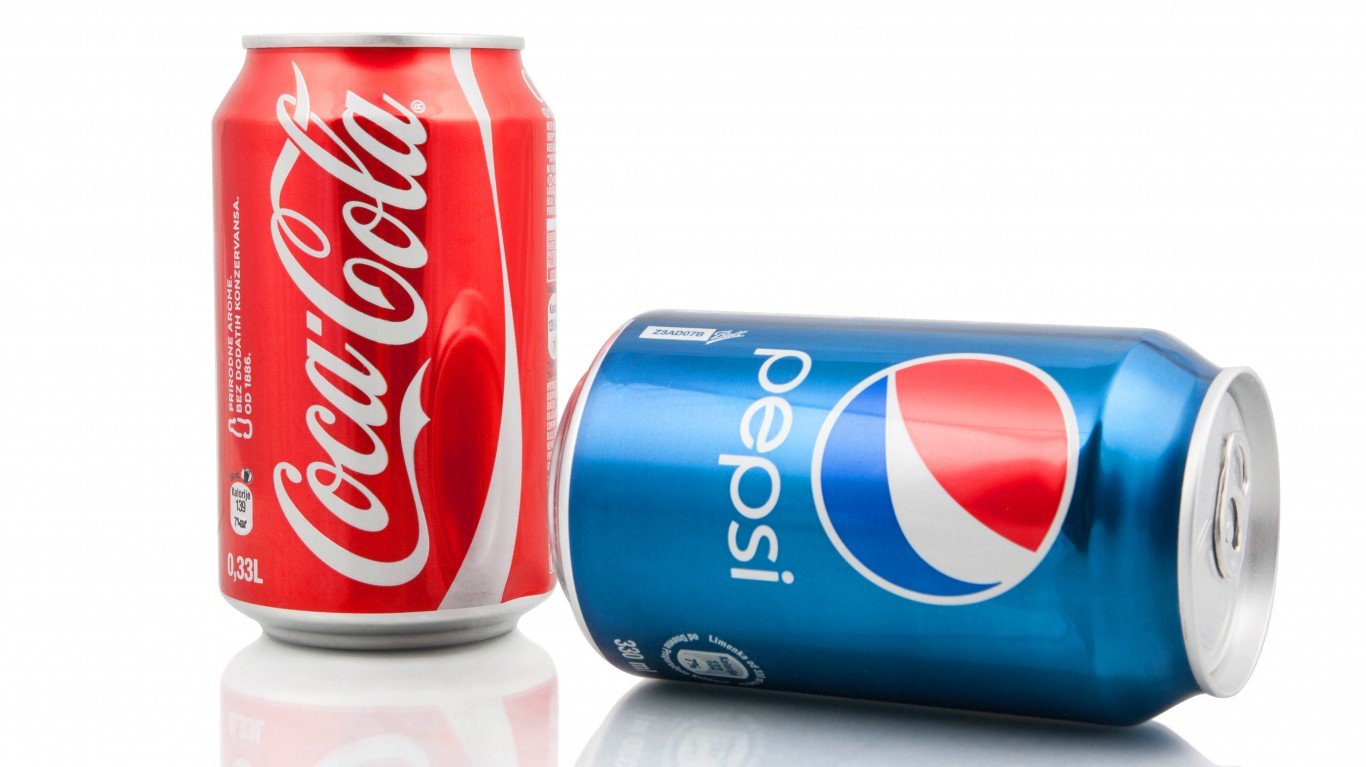
Coca-Cola (NYSE:KO | KO Price Prediction), PepsiCo (NASDAQ:PEP), and Keurig Dr Pepper (NASDAQ:KDP) carry the same industry label. They show up together on most drink dividend screens. Underneath, they run three different business models, and each model shows up in the payout. One licenses syrup. One is a snack company with a soda arm, and one is a debt-funded coffee and soda hybrid preparing to split in two. The gap starts with yield: PepsiCo pays 4.52%, the highest of the three, and the reasons behind that number matter more to your income than the number itself.
Coca-Cola: A Syrup Royalty With a Raise in Every Year on Record
Coca-Cola yields 2.38% with the stock at $86.27, the lowest yield in this group. Investors accept that because of the model behind it. Coca-Cola sells concentrate and licenses its brands, and bottling partners handle the plants, trucks, and labor (a concentrate and licensing model with bottling pushed out to partners). That shows up in a gross margin of 61.6% and a second-quarter operating margin that expanded to 34.9% from 34.1%.
Dividend safety: The quarterly dividend is $0.53, or $2.12 annualized. Against trailing EPS of $3.33, that works out to a payout ratio of roughly 64%. Cash coverage is stronger still. Management raised its full-year free cash flow outlook to about $12.4 billion from $12.2 billion. Across the company’s share count, the annual dividend costs about $9.12 billion, roughly 74% of guided free cash flow. Finances are easy to manage: net debt runs 2.49 times EBITDA, interest coverage is 8.32x, and cash was $12.9 billion at the last report.
Track record: The quarterly payment went from $0.46 in 2023 to $0.485 in 2024, $0.51 in 2025, and $0.53 in 2026. The dividend history on file goes back to 1999, when the quarterly payment was $0.16. Adjusted for the 2012 share split, it shows a higher quarterly payment in every annual cycle since then.
Supporting the bull case, the royalty engine is speeding up. Global unit case volume grew 5% in the second quarter, Coca-Cola Zero Sugar grew 16%, and management guides to comparable EPS growth of 9% to 10% this year. Earnings growing that fast give the board room to keep raising the payout without stretching coverage.
Risk: You pay up for that quality. Coca-Cola trades at 28 times earnings and 70 times trailing free cash flow, and the stock is up 25.8% year to date. That rally has pushed the starting yield down for new buyers.

PepsiCo: Highest Yield, Tightest Cash Cushion
PepsiCo yields 4.52% at $124.74. It is a high-yield payout from a company that is really a snacks business that also sells drinks, where the food side carries much of the profit and the dividend. Owning plants, routes, and inventory across both categories leads to an operating margin of 14.4%, about half of Coca-Cola’s.
Dividend safety: The quarterly dividend rose to $1.48 from $1.4225, for $5.92 annualized. Measured against trailing EPS of $7.51, the payout ratio is about 79%. The cash picture is tighter. PepsiCo’s free cash flow yield of 4.54% is almost the same as its dividend yield, so the dividend uses nearly all trailing free cash flow. This year’s planned shareholder returns of $8.9 billion break down into $7.9 billion in dividends and $1.0 billion in buybacks, which tells you the dividend gets paid first. Debt is manageable: interest coverage is 12.03x and net debt is 2.31 times EBITDA.
Track record: The dividend history runs back to 1999, when PepsiCo paid $0.13 per quarter, and the record shows a higher payment every year from then through the current $1.48.
Supporting the bull case, the price has fallen, and the yield has risen with it. Shares are down 10.44% year to date and sit near the 52-week low of $123.47, at a forward multiple of about 15. Operations are holding up outside the U.S. Third-quarter adjusted EPS of $2.34 came in ahead of the $2.2964 estimate, PepsiCo’s fourth straight beat, and EMEA and Asia Pacific each grew 9% organically.
Risk: The snack engine that funds the dividend is losing power. Core operating profit at PepsiCo Foods North America fell 12%, and management cut core EPS growth guidance to 2.5% to 3.5%, from 5% to 7%. The headline today is that the North American turnaround is taking longer than expected. Almost no free cash flow is left after the dividend. Future increases depend on that turnaround (we noted the seven warning signs that a big yield is about to be cut in a free dividend trap guide).

Keurig Dr Pepper: A Frozen Dividend on a Leveraged Balance Sheet
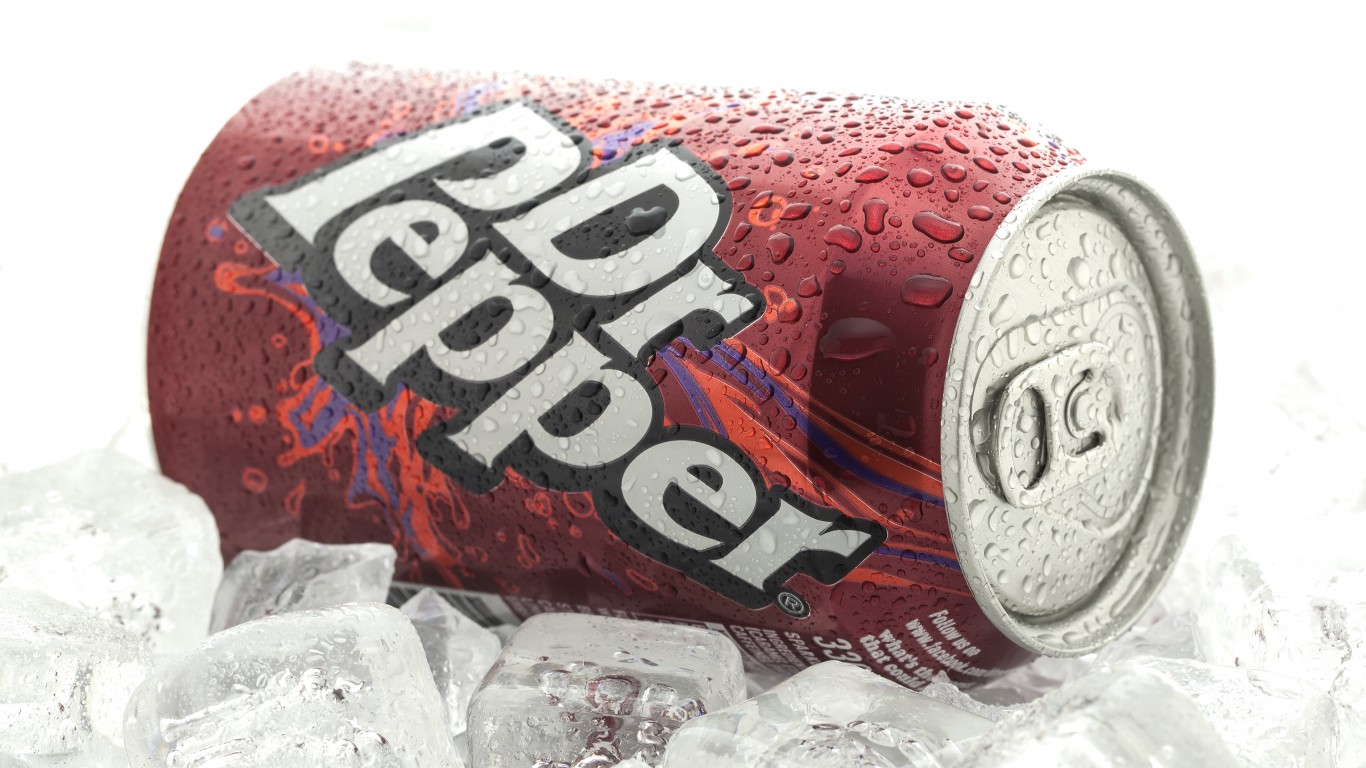
Keurig Dr Pepper yields 2.96% at $30.84. It is a merger-built hybrid of coffee systems and soda brands, and it got bigger again when the JDE Peet’s acquisition closed April 1, 2026.
Dividend safety: Earnings coverage is thin. The $0.92 annual dividend against trailing diluted EPS of $0.99 gives a payout ratio near 93%. Second-quarter GAAP EPS fell to $0.04 from $0.40 because of $850 million in acquisition-related charges. On cash flow, last year’s free cash flow of $1.505 billion covered $1.25 billion in dividends about 120%. Second-quarter free cash flow was $714 million against $366 million in dividends paid. At that quarterly pace, the dividend would use about 59% of management’s full-year free cash flow target of roughly $2.5 billion. Debt principal totals $30.4 billion, with management leverage at 4.4x and a target of about 4.1x by year end. The CFO set the priorities clearly: “investing in our business, maintaining our current dividend, and paying down debt.”
Track record: The regular quarterly dividend rose from $0.15 in 2019 to $0.1875 in 2021, $0.20 in 2022, and $0.215 in 2023. It has stayed at $0.23 since the September 2024 ex-date, with no increase since. The records also include a one-time $103.75 payment in 2018 that sits outside the regular stream.
Supporting the bull case, the stock is the cheapest of the three on forward earnings, at about 12 times. U.S. Refreshment Beverages sales grew 10.0% and International grew 19.6%, and management is working toward a $400 million cost savings program. As debt comes down, the CFO expects “greater capital deployment optionality over the medium to long term.”
Risk: The company plans to separate beverage and coffee into two pure-play companies in early 2027. Management has not said how the current $0.23 quarterly payment would be divided between BeverageCo and Global CoffeeCo, so shareholders have no guarantee their combined income stays the same after the split.

Which Beverage Structure Pays You Best
Currently, Coca-Cola has the most durable dividend structure of the three. Its asset-light royalty model produces the highest margins, a payout near 64% of earnings, and a raise in every year on record. PepsiCo pays more today, but nearly all of its free cash flow goes to the dividend while its main profit engine slows, whereas Keurig Dr Pepper’s dividend has been frozen since 2024 as the company pays down debt and its 2027 separation leaves the future payout unclear.
Contact [email protected] for any questions or corrections.
Chris Lange is a financial and geopolitical writer with more than a decade of experience covering a myriad of topics. He has published thousands of articles for 24/7 Wall St., with past coverage focused heavily on stocks, IPOs, healthcare, defense, global affairs, and technology.
His work has been quoted, or referenced by a number of outlets including Business Insider, USA Today, Yahoo Finance, MSN, The Motley Fool, and many other publications. A graduate of Southwestern University, he studied business with a focus on investments and has previous experience in banking and startups.
When not reading or writing the news, he is following his passion for Lacrosse, playing chess, or building solar projects with his dad.