Credo Technology’s Price Targets Reveal the Size of Its Opportunity
Credo Technology is growing faster than Marvell and Astera Labs yet trades at a fraction of their valuations, which raises a question every AI investor should sit with before the next earnings report.


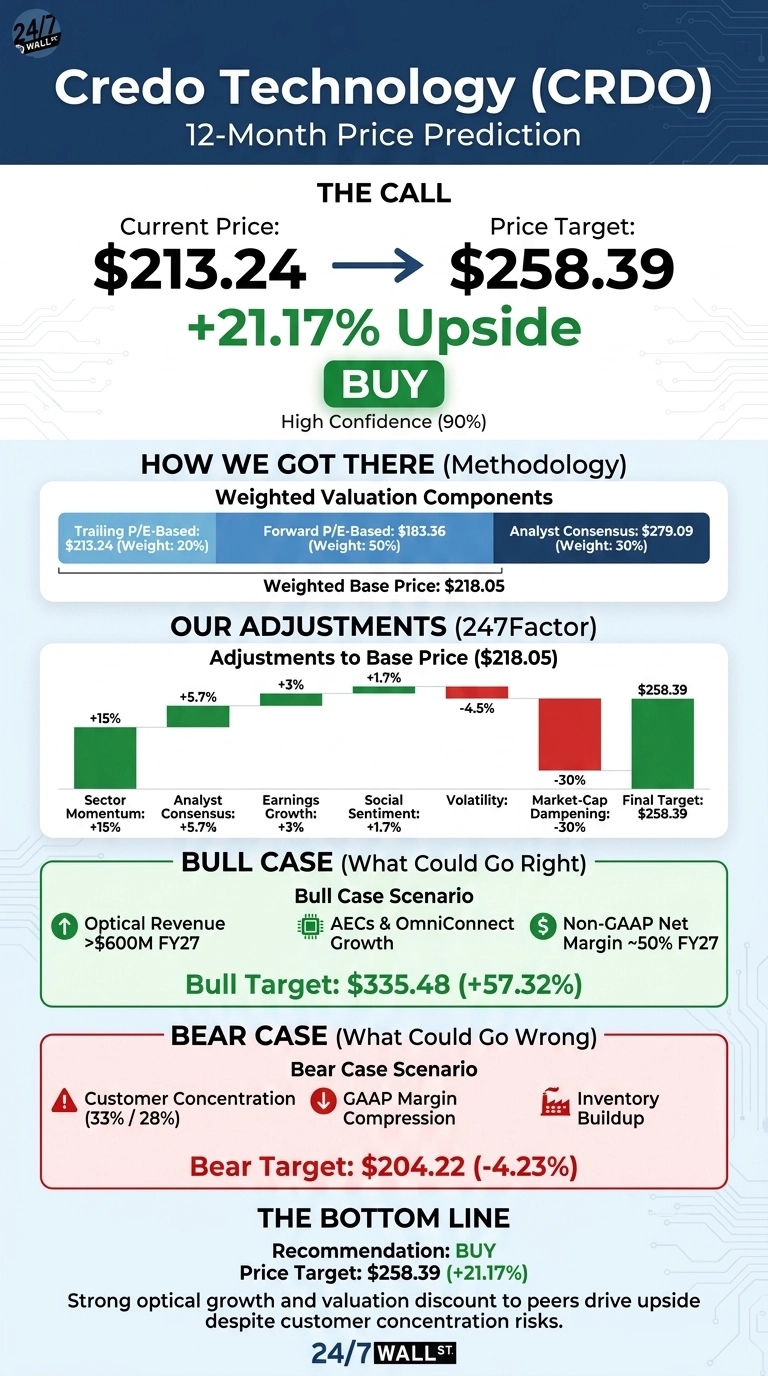
The 24/7 Wall St. price target for Credo Technology (NASDAQ:CRDO | CRDO Price Prediction) is $258.39, which means 21.17% upside from the current $213.24. The model rates the stock a buy with high confidence.
| Metric | Value |
|---|---|
| Current Price | $213.24 |
| Price Target from 24/7 Wall St. | $258.39 |
| Upside/Downside | 21.17% |
| Recommendation | BUY |
| Confidence Level | 90% |

Management expects fiscal 2027 revenue growth of more than 85% and more than $600 million of optical revenue. Even so, Credo trades at a forward P/E of about 31x.
Wall Street sits further out: the consensus target is $279.09, with 5 Strong Buy ratings, 14 Buy ratings and 1 Hold.

Credo Has Recovered From Its Post-Earnings Drop
Shares closed at $227.76 on the day of the fiscal Q1 2027 earnings report, then fell to $170.57 by September 5. The stock has gained back much of that ground, rising 26.76% over the past month and 47.78% year to date. It sits about 30.9% off its 52-week high of $308.67.
Revenue of $479M beat the $470.38M estimate and grew 114.7% year over year. Non-GAAP EPS of $1.20 also came in ahead of the $1.17 estimate.
GAAP EPS of $0.78 missed expectations of $0.93. The gap comes from amortization tied to the Dust Photonics acquisition, which raised goodwill to $986.45M. For fiscal Q2, Credo guides revenue to $525M to $535M.
Optics Could Push Credo Toward $335
The bull case puts Credo at $335.48. Active electrical cables (AECs) remain Credo’s largest business, but its optics portfolio is growing faster. Management expects ZeroFlap optics, silicon photonics chips and optical DSPs to each contribute more than $100 million in fiscal 2027.
OmniConnect could add “thousands of dollars of Credo content per GPU” starting in fiscal 2028. Management also expects non-GAAP net margin in the vicinity of 50% in fiscal 2027.

Customer Concentration Is the Biggest Risk
The bear case is $204.22. Credo’s largest customer accounted for 33% of revenue last quarter, and the second-largest accounted for 28%. GAAP gross margin contracted to 64.5% from 68.2%, and inventory rose by $62.2 million in a single quarter.
There is a reasonable explanation for both: the margin hit comes from acquisition amortization, and the inventory build supports the optical growth. Non-GAAP gross margin held at 68.0%.
Credo Is Cheaper Than Marvell and Astera Labs
Marvell Technology (NASDAQ:MRVL) competes directly with Credo in data center DSPs and interconnect.
Astera Labs (NASDAQ:ALAB) is the closest pure play on AI connectivity. Astera grew revenue 104.5% last quarter, slower than Credo, yet it trades at nearly twice Credo’s sales multiple. Marvell grew revenue 36.5% and carries about twice Credo’s forward P/E.
| Company | Forward P/E | Price/Sales (TTM) |
|---|---|---|
| Credo | 31x | 25.99 |
| Marvell | 62x | 26.12 |
| Astera Labs | 56x | 50.09 |
Compared with these peers, the 24/7 Wall St. price target looks conservative.
Credo’s Growth Outweighs Its Volatility
Our 24/7 Wall St. price target of $258.39 carries a buy rating with 90% confidence. What tips the scale for me is the valuation.
Credo is growing faster than either peer and trades at a lower forward multiple (we reverse-engineered what the biggest tech winners looked like early in a free playbook you can grab here). I’d turn more bullish if 1.6T DSP revenue arrives on schedule. I’d grow cautious if a top hyperscaler pulls back on spending.
Credo Technology Price Prediction 2026-2030
Beyond that, here is where our model projects Credo could trade at the end of each year, based on our base-case scenario:
| Year | Price Target from 24/7 Wall St. |
|---|---|
| 2026 | $236.57 |
| 2027 | $258.64 |
| 2028 | $298.29 |
| 2029 | $313.76 |
| 2030 | $339.58 |
The estimates rest on Credo continuing to execute on its current strategy. The results could land well above or below these figures depending on how fast hyperscalers adopt Active LED Cables and whether AI capital spending slows.
Contact [email protected] for any questions or corrections.
Vandita Jadeja is a financial publisher with over a decade of experience writing about financial topics, including investment, savings, retirement, insurance and banking. Vandita is a Chartered Accountant who loves to debunk financial concepts for readers.
Her work has appeared on sites that include The Motley Fool, InvestorPlace, and Benzinga. She covers investing and focuses on stock picks and price prediction for 24/7 Wall St.
When not looking for the next stock investment opportunity, she can be found traveling, reading, chasing sunsets and enjoying her iced latte.