Vistra Bombed Over The Last Year: One Analyst Says The AI Power Play Will Gain 90% Within a Year
Vistra has shed nearly a fifth of its value over the past year while Wall Street keeps piling on Buy ratings and one analyst sees nearly 90% upside ahead. The disconnect between the stock price and that conviction points to…

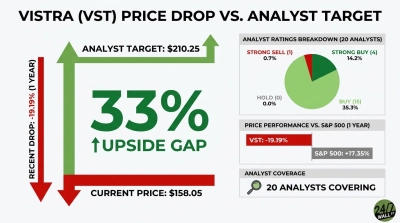
Vistra (NYSE:VST | VST Price Prediction) trades at $158.05. The average analyst price target is $210.25, which means 33% upside.
Vistra runs nuclear and natural gas plants across Texas and the PJM grid, and it has become one of Wall Street’s favorite ways to invest in AI electricity demand. It has signed 20-year PPAs with Meta for more than 2,600 MW at its PJM nuclear plants, plus up to 1,200 MW with AWS at Comanche Peak.
The most bullish call goes well beyond the consensus. Jefferies has the highest analyst target at $298.00, about 88.5% above the current price. A spread that wide shows analysts disagree sharply about what this AI power story is worth.
Cheap Texas Power Pulled Vistra Off Its Highs
Flat Texas wholesale prices did the most damage. On the second-quarter call, the CEO, Jim Burke, said ERCOT prices averaged “$30 a megawatt hour” year to date, matching last year, and admitted “$30 is not going to get new stuff built.” The CFO, Chris Moldovan, said gains in PJM “don’t fully offset the ERCOT headwind” and that 2027 was “trending towards the lower end” of its range before pending deals.
Shares are down 19.19% over the past year and sit 26.8% below the 52-week high of $215.85. GAAP results added to the pressure. Second-quarter revenue fell 5.5% to $4.02B, and net income slipped to $305M from $327M after $472M in unrealized hedging losses. Ongoing Operations Adjusted EBITDA still rose more than 30% to $1.77B.
Nineteen of 20 Analysts Still Back the Nuclear and Gas Moat
Analysts argue that hyperscalers need reliable 24/7 power, and Vistra’s nuclear and gas fleet can lock that supply into premium long-term contracts. Of 20 covering analysts, the split is:
- Strong Buy: 4
- Buy: 15
- Hold: 0
- Strong Sell: 1
Recent moves have been reiterations, including a Buy from Wells Fargo. The Meta PPAs begin contributing to Adjusted EBITDA in 2027, and the 5,500 MW Cogentrix gas portfolio has FERC approval. Moldovan said the two could add “roughly $700 million to our midpoint opportunity.”
Capital returns support the Jefferies case. Buybacks have reduced the share count by ~30% since Nov 2021, with ~$1.2B of authorization left. Management reaffirmed 2026 Adjusted EBITDA guidance of $6.80B to $7.60B. Vistra is also the preferred power provider for Helix Digital Infrastructure, its venture with NVIDIA, KKR, and Kuwait Investment Authority.
AI Power Stocks Fell Together, and NRG Has the Widest Consensus Gap
Vistra fell alongside its peers. Investors have marked down the whole AI power group, even as the buildout behind it keeps growing (we covered seven companies providing that AI infrastructure, from power to cooling, in a free report you can download here).
Constellation Energy (NASDAQ:CEG) is down 22.85% over the past year at $293.89. Its $341.53 target means just 16.2% upside. 19 analysts rate it Buy or Strong Buy and 3 rate it Hold, so its upside is smaller than Vistra’s.
NRG Energy (NYSE:NRG) has dropped 36.97% over the year to $106.37. Its second-quarter adjusted EPS of $1.49 missed the $1.7401 estimate. Its $185.50 target means 74.4% upside, with 13 Buy-side ratings and 3 Holds.
Talen Energy (NASDAQ:TLN) is down 12.86% over the year but up 32.55% in the past month to $379.77. Its $455.65 target means 20% upside, with 16 Buy-side ratings and 2 Holds.
NRG has the largest gap to its consensus target, while Vistra has the single most aggressive individual call. That puts Vistra in the middle of the group on consensus upside.
Vistra Trails the S&P 500 Despite a Sharp Rebound
Vistra trades at $158.05 against a $210.25 consensus target from 20 analysts, means 33% upside. Treat targets as one data point. They are estimates and has no guarantee.
The stock is down 1.54% year to date, while the S&P 500 is up 14.1%. Over one year, Vistra is down 19.19% against a 17.35% gain for the index. Momentum has turned recently, with shares up 9.14% in a week. At a forward P/E of about 13, Vistra costs less than Constellation at 21.
Vistra Looks Mispriced if Texas Power Prices Firm Up
The bull case improves if ERCOT prices move toward new-build economics and the Meta and Cogentrix contributions arrive on schedule in 2027. Downside risks grow if Texas prices stay near $30 a megawatt hour, 2027 EBITDA lands at the low end, and hyperscaler deals slow as grid operators restrict interconnection queues.
The data tilt bullish. Vistra is ~94% hedged for 2027, its core EBITDA is growing, and its valuation is below peers. Those factors make the consensus target reachable. The Jefferies $298.00 target needs everything to go right. Keep an eye on the next earnings report for any change to the 2027 outlook.
Contact [email protected] for any questions or corrections.
Alex Sirois is a financial writer with experience spanning both retail and institutional investing. He has written for InvestorPlace and held roles at BNY Mellon and Bernstein, giving him a perspective that bridges Main Street portfolios and Wall Street analysis.
Alex holds an MBA from George Washington University and has built his career across multiple industries, including e-commerce, education, and translation — a breadth of experience that informs how he breaks down complex financial topics for everyday investors. His writing is conversational, actionable, and grounded in long-term, buy-and-hold investing principles.
At 247 Wall St., Alex focuses on delivering analysis that is both accessible and useful, with a clear emphasis on helping readers make more informed decisions with their money.