Gasoline Alone Drove More Than Half of September’s Inflation Jump
September's inflation report handed energy stocks a gift, but the same force lifting XLE is already working against the investors chasing it for protection.

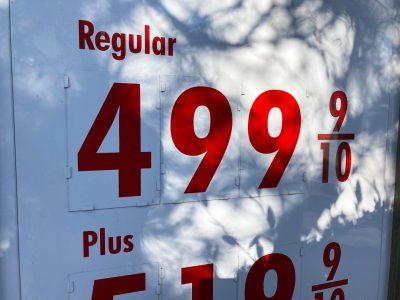
Gasoline prices rose 9.1% in September, and the government’s release spelled out what that meant: the jump was “accounting for over half of the monthly all items increase.”
The Consumer Price Index rose 0.6% on a seasonally adjusted basis in September, up from 0.4% in August. Annual inflation reached 3.7%, against an expected 3.6%. The “over half” share applies to the monthly increase, while the annual rate reflects a wider mix of prices.
Stocks sold off on the report on October 14, 2026. The S&P 500 fell 1.11%, and the Nasdaq fell 1.88%.
Energy moved against the broader market. The State Street Energy Select Sector SPDR ETF (NYSEARCA:XLE) rose 0.64% to $67.63, just under its one-year high of $67.72, after a 61.05% total return over the past year.
That leaves a problem for anyone who holds the fund or is thinking about buying it, as energy stocks worked as a hedge against the very inflation they help create, but that protection has already become expensive.
Energy Carried a Headline That Core Prices Did Not Support
The energy index rose 5.2% in September, while core prices, which exclude food and energy, rose 0.3% for a second straight month.
Over the past year, food rose 2.5%, shelter rose 3.2%, and used cars and trucks fell 1.5%. Those readings point to cooling, so once energy is set aside, the report shows no reacceleration.
Investors sold the headline anyway, because interest-rate expectations respond to headline energy even when core prices hold steady, as energy-driven inflation is the hardest case for a central bank, since higher rates cannot produce more barrels of oil.
Fuel Costs Are Already Reaching Services
Over 12 months, gasoline rose 34.2%, fuel oil rose 74.2%, and airline fares rose 22.4%. Airfares are a service price, so higher fuel costs are already showing up in what travelers pay.
Changes in crude reach the pump with a lag, which means oil has already shaped part of the next report. West Texas Intermediate (WTI), the U.S. benchmark, peaked at $107.02 on September 15 and sat at $95.09 in late trading on October 14, with Brent at $106.06.
The national average for regular gasoline fell from $4.478 on September 21 to $4.331 on October 12. That suggests gasoline will add less to the October report, although prices above $4.00 a gallon still strain household budgets.
What XLE Holders Actually Own
Exxon Mobil (NYSE:XOM | XOM Price Prediction) and Chevron (NYSE:CVX) were the fund’s two largest holdings as of June 30, 2026. Behind them sit producers, refiners, oilfield-service firms and pipeline operators.
That mix undermines the fund’s link to crude. Pipeline operators earn fees tied to volume, and refiners earn margins that can narrow when crude rises faster than pump prices.
Oil is the index input most likely to fall back toward its average. A supply response, demand destruction at current prices, or a production decision from the major exporters would cool CPI and the ETF at the same time.
WTI traded at $76.78 on August 5 before its September run, so today’s oil price has risen quickly and could give back gains just as fast.
Where XLE Stands After the September CPI Jump
XLE looks extended at this level. The fund sits just under its one-year high after a 61.05% run, so the fund now carries a peak price for a hedge that works only while oil stays high. Riding a run like this is fine as long as the exit is planned, which is the whole subject of our free bubble survivor’s handbook.
Core inflation at 0.3% shows the broad price trend is cooler than the headline. That undermines the case for paying extra for inflation protection.
For investors exploring more direct exposure to crude, the State Street SPDR S&P Oil & Gas Exploration & Production ETF (NYSEARCA:XOP) offers a cleaner link. Producer earnings track oil more directly. That sensitivity also means larger losses when crude falls.
Investors can test this view against the CPI release due Tuesday, November 10. If the gasoline index falls and WTI stays below $100, the hedge case is undermined, but a close above $67.72 alongside rising oil would show the market thinks otherwise.
Contact [email protected] for any questions or corrections.
Omor Ibne Ehsan is a writer at 24/7 Wall St. He is a self-taught investor with a focus on growth, cyclical, and dividend equities that have strong fundamentals, value, and long-term potential. He also has an interest in high-risk, high-reward investments such as penny stocks.