Oracle’s Growth to Valuation Mismatch is Less and Less Compelling
Oracle's cloud backlog is surging past $664 billion while free cash flow sits deep in negative territory, and the CFO refused to name a date when that flips. Something has to give, and figuring out which side breaks first changes…


Oracle (NYSE:ORCL | ORCL Price Prediction) trades at $131.14. Its low multiple used to look like a bargain, but now it looks like a fair price for a company that has to borrow and issue stock to build its AI cloud.
Oracle sells databases, enterprise applications and, more and more, AI training and inference capacity. Cloud now makes up 60% of total revenue, up from 48% a year ago. The stock has fallen 52.08% over the past year and sits far below its 52-week high of $283.40.
A Cheap Multiple Attached to Triple-Digit Infrastructure Growth
Bulls point to the price. At about 16x the $8.10 non-GAAP EPS guide for this fiscal year, and roughly 12x the $10.9916 consensus for next year, Oracle costs less than many slower-growing software names. Its PEG ratio is 0.807.
The growth is real. Cloud infrastructure revenue rose 121% to $7.39 billion, and remaining performance obligations reached $664 billion. GPU use was 97.9%, and renewed capacity was repriced at a 20% premium to prior contracts. Analysts made 35 upward and 1 downward full-year EPS revisions over the past 30 days.
Negative Free Cash Flow Is Eating the Growth Story
Free cash flow was negative $5.4 billion last quarter, following negative $23.7 billion in fiscal 2026. Management still expects $90 billion to $95 billion in capex this year. Interest expense rose 55% to $1.4 billion. After completing a $20 billion equity sale, Oracle plans to raise about $40 billion more through debt and equity.
The chief financial officer declined to say when free cash flow turns positive: “We haven’t given a particular timeframe on that yet.” Gross margins are also expected to step down. A CNBC Fast Money panelist put it bluntly: “There are plenty of other ways to play this story with better balance sheets.”
Backlog Conversion Will Decide the Argument
Management expects around half of RPO to convert into sales over the next 36 months. Next quarter’s guide calls for revenue growth of 30% to 34% and EPS of $1.85 to $1.93. If Oracle hits those numbers and gives a free cash flow timeline, today’s price could prove too low. If margins slip or financing costs keep rose, it could still fall further.
Analysts Stay Bullish While Shares Trail the Market Badly
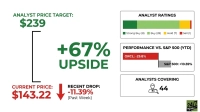
The average analyst target is $237.36, meaning about 81% upside. That figure comes from 43 analysts. Price targets are one data point, and none of them are guarantees:
- Strong Buy: 7
- Buy: 28
- Hold: 7
- Sell: 1
Oracle is down 31.85% year to date, while the S&P 500 is up 12.78%. Over the past month, Oracle fell 10.88% as the index gained 0.97%. Shares trade below both the 50-day ($144.77) and 200-day ($159.87) moving averages.
Oracle’s Valuation Hinges on Cash Flow Catching Up to the Backlog
At $131.14, Oracle’s risks outweigh its cheap multiple.
Oracle beat on growth and the stock still fell, which tells you investors now care more about funding than about bookings. Shares gave up an early post-earnings gain and ended the day down nearly 2% even after Oracle beat estimates. Downside could come within the next two quarters from more dilution, rising interest costs and lower near-term estimates. Analysts already made 23 downward revisions to the February-quarter EPS estimate in 30 days.
A firm free cash flow timeline, or proof that operating margins are expanding as capacity increases, would change this view. Until one of those shows up, the low multiple reflects real balance sheet risk.
A low multiple only pays off if the cash eventually reaches shareholders, and Oracle has yet to show when that happens.
Contact [email protected] for any questions or corrections.
Alex Sirois is a financial writer with experience spanning both retail and institutional investing. He has written for InvestorPlace and held roles at BNY Mellon and Bernstein, giving him a perspective that bridges Main Street portfolios and Wall Street analysis.
Alex holds an MBA from George Washington University and has built his career across multiple industries, including e-commerce, education, and translation — a breadth of experience that informs how he breaks down complex financial topics for everyday investors. His writing is conversational, actionable, and grounded in long-term, buy-and-hold investing principles.
At 247 Wall St., Alex focuses on delivering analysis that is both accessible and useful, with a clear emphasis on helping readers make more informed decisions with their money.