Dylan Field Says Don’t Let AI Think for You. What It Means for Figma Stock
Figma's CEO went on a podcast to warn that AI makes creative work look the same, and investors who wrote off the stock at a 38% loss this year may have missed the part where that warning is actually Figma's…

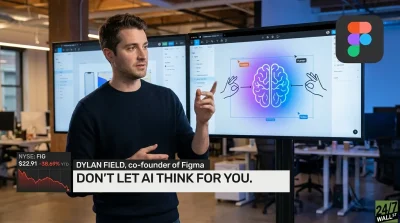
Dylan Field, co-founder and chief executive of Figma (NYSE:FIG), used an All-In podcast appearance on October 19 to say that people who let AI do their thinking end up making generic work. It sounds like philosophy. It also describes how Figma plans to make money. That matters now because the stock trades at $22.91 and is down 38.69% year to date, which tells you investors still fear AI will make design software obsolete.
Field Warns Against Joining the Hive Mind
“As a human in general, pre-AI, post-AI, you have a choice,” Field said. “Do you want to consume or create? Do you want to take the easy path or do you want to climb the mountain?” He said he sees people “letting AI think for them,” less at Figma than in his everyday interactions with the world. “Why would I want something else to think for me? My entire life has been about figuring out how to think,” he added.
He also said AI tools risk making creative output all look the same, and he described Figma’s internal policy of tagging content written by AI. His answer to the sameness problem is Weave, a node-based system that feeds one model’s output into another model’s input. “You need a way to craft that clay, you need a way to mold it,” he said.
Talking about OpenAI’s release of 700+ math papers on famous problems, Dylan Field called it “the greatest day of discovery in human history,” and added that “it felt like we lost something and gained something at the same time.”
Human Control Is Already Figma’s Product Plan
Field made the same argument on the August 5 earnings call. He proposed “a performant professional-grade canvas where humans as well as agents can work side by side” and said of AI models: “These models are trained on what already exists. So what you get back is in distribution. It’s the expected answer.”
Customers are paying for that idea. In Q2 2026, revenue rose 48.3% to $370.08M, ahead of the $351.52M consensus. It was the third consecutive quarter of faster growth. Net dollar retention, which tracks how much more existing customers spend year over year, came in at 136%. More than 80% of paid customers above $10,000 in annual recurring revenue (ARR) used AI credits every week, and more than 50% used the Figma agent weekly. Figma raised its full-year revenue guidance by $40M to $1.463B–$1.467B.
That guidance leaves out some products. The agent, Code Layers, Motion and Make on local code are still in beta and don’t use paid credits yet, so management hasn’t counted them in the outlook.
Margins Are the Price of Keeping Humans in Charge
Running AI models costs money. GAAP gross margin fell to 84% from 89% a year earlier. Stock-based compensation jumped to $147.6M from $7.3M, which helped drive a GAAP operating loss of $117.3M. Free cash flow margin dropped to 14% from 24%. Last week, Reuters reported that the CFO said Figma is willing to put margins on the line to boost AI demand. Third-quarter guidance of $373M–$375M implies growth slowing to about 36%.
What Field’s Comments Mean for Figma Stock
Shares are down 80.16% from their $115.50 close on July 31, 2025. The market cap of about $10.46B is roughly 7 times the midpoint of 2026 revenue guidance. Our earlier look at Figma’s rough debut walked through how that sell-off happened.
We think Field has read the AI shift right, and his numbers support him. If AI models keep making “the expected answer,” teams that want unique work will pay more for tools that let them shape it, and Figma charges for every credit along the way. The current price already reflects the fear that AI replaces designers and misses the upside if beta products start bringing in money. In the next quarterly report, look at two things: whether the agent and Code Layers start using paid credits, and whether gross margin holds near current levels. If both happen, Field’s warning against letting AI think for you becomes Figma’s best case for investors.
Contact [email protected] for any questions or corrections.
Chris Lange is a financial and geopolitical writer with more than a decade of experience covering a myriad of topics. He has published thousands of articles for 24/7 Wall St., with past coverage focused heavily on stocks, IPOs, healthcare, defense, global affairs, and technology.
His work has been quoted, or referenced by a number of outlets including Business Insider, USA Today, Yahoo Finance, MSN, The Motley Fool, and many other publications. A graduate of Southwestern University, he studied business with a focus on investments and has previous experience in banking and startups.
When not reading or writing the news, he is following his passion for Lacrosse, playing chess, or building solar projects with his dad.