The Neocloud Bloodbath: NBIS, IREN, and CRWV Selloff Continues
CoreWeave's bonds are flashing distress signals that analysts say could eventually wipe out shareholders, and the pain is spreading fast to every company that borrowed billions to rent GPUs to AI labs.


CoreWeave (NASDAQ:CRWV) sold bonds due in 2032 at a 9.625% yield. Last week a widely shared chart showed those bonds yielding about 15%, and Reuters reported that the company’s credit default swaps topped 1,000 bps this morning. Think of a homeowner whose mortgage rate jumps. The house is still worth living in, but the monthly payment just got much harder to carry.
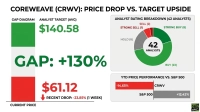
Shares of the three biggest neoclouds took the hit. Over the past month, CoreWeave fell 35.25%, Nebius Group (NASDAQ:NBIS | NBIS Price Prediction) dropped 29.46% and IREN (NASDAQ:IREN) lost 45.92%. All three are down again this morning morning. Nebius was off 8.60% at $159.85, IREN 10.23% at $25.44, and CoreWeave 9.25% at $56.10.
Why a Hot Inflation Report Hit GPU Landlords Hardest
Last week’s Consumer Price Index report set off the selloff. Prices rose 0.6% in September, pushing annual inflation to 3.7%. Treasury yields climbed as traders started pricing in a possible Federal Reserve rate hike. On top of that, Gartner (NYSE:IT) forecast that up to 80% of neoclouds could cease independent operations by 2030. Investors had two reasons on the same day to put a lower value on growth funded by debt.
Interest Bills Are Outrunning Profits
These companies work like landlords for AI chips. They borrow to buy GPUs and build data centers, then rent the capacity to AI labs on multi-year contracts. Demand is real: CoreWeave has a $104 billion revenue backlog. The trouble is the gap between signing a contract and collecting the cash.
At the end of June, CoreWeave had $35.6 billion of debt and $5.5 billion of unrestricted cash. Second-quarter interest expense was $640 million, up from $267 million a year earlier. Adjusted operating income was only $128 million. D.A. Davidson’s Gil Luria estimates that CoreWeave borrows at roughly 9% while earning returns near 1%, and he warned the equity could go to zero if the AI cycle turns. CEO Mike Intrator called the market’s reaction “irrational.”
Nebius and IREN Face Their Own Versions of the Math
Nebius has $8.55 billion of debt against about $8 billion of cash, but it plans $20 to $25 billion of capital spending in 2026. Its convertible notes have a fair value of $20.8 billion, far above their $8.5 billion carrying value. That gap shows how much stock those notes could eventually turn into. Three customers accounted for 24%, 21%, and 14% of second-quarter revenue.
IREN expects $25 billion to $30 billion of capital spending in fiscal 2027 as it finishes exiting crypto mining. It lost $684 million last quarter. Its hyperscaler deployment was financed at about 6%, while its non-investment-grade McKenzie build carries a 9% fixed rate.
Both Nebius and IREN cite contract pricing above $20 million per megawatt with paybacks of about two years. Those returns hold up when money costs 6%. They shrink the closer borrowing costs get to CoreWeave’s 15% bond yield.
What the Next Earnings Reports Will Reveal
CoreWeave guided to third-quarter interest expense of $860 million to $940 million and adjusted operating income of $200 million to $260 million. If that gap stays wide, so will the credit spreads. Analysts expect Nebius to report third-quarter revenue near $905 million. IREN reports in early November, and investors want proof that it will reach $4 billion of contracted annual recurring revenue running by December 31. Keep an eye on CoreWeave’s bond yields. Every new loan in this sector gets priced off them.
Contact [email protected] for any questions or corrections.
After two decades of patrolling the dark corners of suburbia as a police officer, Rich Duprey hung up his badge and gun to begin writing full time about stocks and investing. For the past 20 years, he’s been cruising the markets looking for companies to lock up as long-term holdings in a portfolio while writing extensively on the broad sectors of consumer goods, technology, and industrials. Because his experience isn’t from the typical financial analyst track, Rich is able to break down complex topics into understandable and useful action points for the average investor. His writings have appeared on The Motley Fool, InvestorPlace, Yahoo! Finance, Money Morning, and, of course, 24/7 Wall St. He has been featured in both U.S. and international publications, including MarketWatch, Financial Times, Forbes, Fast Company, and USA Today.