Amazon’s AWS Has Already Sold “a Good Chunk” of 2028 Capacity
Andy Jassy says AWS capacity years out is already spoken for, yet Amazon is burning cash at a pace that raises an uncomfortable question about who exactly is doing the booking and what happens if their funding dries up.


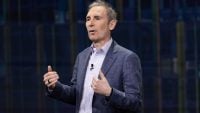
Amazon (NASDAQ:AMZN | AMZN Price Prediction) CEO Andy Jassy said on an Andreessen Horowitz video podcast on Friday, October 23, 2026, that AWS computing capacity for 2027 is largely booked. He spoke with co-founder Ben Horowitz and general partner Erik Torenberg: “2027 is largely sold out. We always leave a certain amount for on-demand and our inference service bedrock, or EC2, but largely sold out all the big chunks.” He wasn’t done. He then added: “A good chunk of 2028 is sold out.”
Amazon closed that day at $248.00, down $2.38 or 0.95%, leaving it with a market cap of about $2.68 trillion. Some of the comments came out during trading and some after the close, so the decline tells you little about how investors will read them.
Shareholders face a tension. The CEO says demand is booked years ahead, while Amazon is spending so heavily to serve it that trailing free cash flow has gone negative.
What Jassy Committed To
“Sold out” is how Jassy described it. Amazon has not disclosed the contracted capacity or backlog figures behind the phrase, so for now it is the CEO’s claim, and neither year is fully sold out.
Bedrock is Amazon’s service for running AI models for customers, a job called inference. EC2 is its core business of renting out servers. Keeping some of that capacity in reserve protects smaller customers and pricing, while the large committed blocks go to AI labs and big enterprises.
He also said Amazon “could invest a lot more and it wouldn’t be a bad use of capital”. He noted that AI labs are using “gobs and gobs of compute unlike anything I’ve seen.”
Supply Now Sets the Ceiling on AWS Growth
Once the big blocks are booked, AWS can only grow as fast as Amazon adds data centers, power, chips and memory. That makes execution the main question for investors. Clips from the podcast that investors passed around carry Jassy saying, “I don’t think that that shortage ends in 2027.”
AWS revenue rose 37% to $42.2 billion in Q2 2026, its fastest growth in 18 quarters. The annualized run rate reached $169 billion, and Jassy, who put growth at 36.7%, called AWS “booming.”
Trainium Is Amazon’s Answer to Costly Inference
Jassy said inference is still “an order of magnitude too expensive in my opinion for it to be used as pervasively as possible,”. That works out to about 10 times too costly. On bringing that cost down, he said, “Our chips business is a big piece of that.”
He has been reported as saying Trainium delivers about 30% to 40% better price-performance than comparable processors. Amazon has disclosed more than $225 billion in future Trainium revenue commitments, including deals with Anthropic and OpenAI. That means its own chips lower its computing costs and already have committed buyers.
Reality Check: Heavy Spending and Concentrated Buyers
Amazon plans to spend about $220 billion on capital expenditure in 2026. Over the trailing 12 months, purchases of property and equipment rose $66.1 billion, which Amazon said “primarily reflects investments in artificial intelligence,” and free cash flow was a $7.6 billion outflow.
Much of the booked capacity goes to AI labs. If their funding tightens or their model economics fall short, those long commitments could be renegotiated, and Jassy did not say how much of 2028 sits with a few buyers.
What Analysts Expect From Amazon Stock
Demand is booked years ahead. Supporters of the stock also point to a chip business that cuts costs as a reason to bear the cash burn, although the concentration of that demand among a few AI labs remains an open question.
The consensus rating is Strong Buy from 60 analysts. Their average 12-month target of $331.46 sits about 33.7% above Friday’s close.


The real test comes with the Q3 report on Thursday, October 29, 2026, with a 5:00 p.m. ET call. Guidance calls for net sales of $197.0 billion to $202.0 billion and operating income of $22.5 billion to $26.5 billion.

Watch whether AWS growth stays near the Q2 pace, whether management puts a number on backlog or contracted capacity, and whether it updates capex. If AWS growth slows sharply or operating income comes in below the low end of guidance, the case that demand is exceeding supply would weaken.
Contact [email protected] for any questions or corrections.
Omor Ibne Ehsan is a writer at 24/7 Wall St. He is a self-taught investor with a focus on growth, cyclical, and dividend equities that have strong fundamentals, value, and long-term potential. He also has an interest in high-risk, high-reward investments such as penny stocks.