Ford Yields Nearly 5%. Is the Dividend Safe With Earnings in the Red?
Ford's trailing earnings show a loss of nearly two dollars per share, yet the automaker keeps writing dividend checks and even raised its forward cash flow guidance. Before assuming the payout is doomed, look at what actually drove those losses.

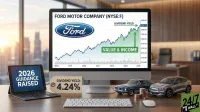
Ford (NYSE:F | F Price Prediction) pays a 4.94% dividend yield on a $0.60 annual payout, while its trailing EPS is -1.88. Shares trade at $11.56. The stock is down 8.87% year to date and 11.76% over the past month. That leaves income investors asking whether the losses put the dividend at risk.

Write-Downs Drive the Losses While Trucks Drive the Cash
Special charges drive the red ink. Ford posted a $1.3 billion net loss in the second quarter, mostly from a charge linked to selling off its BlueOval SK battery joint venture. CFO Sherry House explained it on the earnings call:
“We recognized a one-time special item charge of $3.6 billion, of which approximately $500 million was cash.”
In the same quarter, Ford generated $2.5 billion in adjusted EBIT and $2.1 billion in adjusted free cash flow. Full-year 2025 shows the same split. Ford lost $8.162 billion on paper but produced $21.282 billion in operating cash flow. That easily funded $8.815 billion of capital spending and $2.989 billion in dividends.

Cash Flow Covers the Dividend Nearly Three Times Over
Ford raised its 2026 adjusted free cash flow guidance to $6 billion to $7 billion. The regular dividend costs about $2.35 billion a year, so the guidance covers it roughly 2.6 to 3.0 times. Ford also held $22.3 billion in cash and $43.4 billion in total liquidity. House said:
“We remain committed to our investment grade rating and returning capital to shareholders.”
Ford Credit, the company’s lending arm, adds more support. It made $757 million before taxes, up $112 million, and full-year pretax earnings are expected to top $2.5 billion. On the risk side, debt-to-equity stands at 4.66, Model e is headed for a loss of about $4 billion, and the Novelis aluminum disruption will cost about $1.5 billion.
Ford Has Cut the Dividend When Cornered
Ford paid $0.15 through its January 2020 ex-dividend date and then paid nothing until November 2021. It returned to $0.10 and rose to $0.15 in August 2022. In strong years, Ford added extra payouts. Its first-quarter dividend was $0.33 in 2024 and $0.30 in 2025. In 2026, the February payment was the regular $0.15.
GM Pays Less in Dividends but Buys Back More Stock
General Motors (NYSE:GM) raised its quarterly dividend 20% to $0.18 and approved a $20 billion buyback, yet it yields under 1%. Stellantis (NYSE:STLA) suspended its 2026 dividend after its net cash turned into €6.7 billion in industrial net debt. CEO Antonio Filosa blamed “the cost of overestimating the pace of the energy transition.” Ford falls in between. Its yield is far higher than GM’s, and its cash flow is much stronger than Stellantis’s.
What Ford’s Next Earnings Report Needs to Show
Ford reports third-quarter results on October 28, a date the company has not yet confirmed. Investors should look for four things: a reaffirmed $6 billion to $7 billion free cash flow target, a recovery in Super Duty orders, Model e losses staying on track, and progress on the remaining cash charges of up to $2 billion. The outlook for 2027 is still unclear. On whether profits will rise next year, House said, “It is too early to say at this point.”
Verdict: The $0.15 regular dividend looks well funded for 2026. The stock still has the risks of a cyclical, heavily indebted automaker, and additional payouts remain uncertain.
Contact [email protected] for any questions or corrections.
Chris Lange is a financial and geopolitical writer with more than a decade of experience covering a myriad of topics. He has published thousands of articles for 24/7 Wall St., with past coverage focused heavily on stocks, IPOs, healthcare, defense, global affairs, and technology.
His work has been quoted, or referenced by a number of outlets including Business Insider, USA Today, Yahoo Finance, MSN, The Motley Fool, and many other publications. A graduate of Southwestern University, he studied business with a focus on investments and has previous experience in banking and startups.
When not reading or writing the news, he is following his passion for Lacrosse, playing chess, or building solar projects with his dad.