This $6 Billion Investment Could Open a Relief Valve for America’s AI and Power-Grid Boom
America's AI and grid buildout runs on copper, but the U.S. barely has the smelters to process it. A surprise $6 billion investment in Arizona could shift that equation, and five large-cap companies stand at every chokepoint between the mine…


Power delivery is the part of the data center push that gets electricity from a power plant to a rack of servers: turbines, transformers, switchgear, connectors and miles of cable. Nearly every piece of it runs on copper, and the U.S. is short on the smelters and refineries that turn mined ore into usable metal.
On October 22, 2026, Grupo México told analysts it expects to spend $4 billion to $6 billion over the next three years on its U.S. unit, Asarco. The plan includes expanding the Ray and Silver Bell mines in Arizona and restarting the Hayden smelter and refinery, Reuters reported. That compares with just $101 million of Asarco spending in 2024, roughly 13 to 20 times that pace on an annual basis.
A restarted Hayden could process 1.4 million metric tons of copper concentrate a year. Those figures describe potential capacity, and the projects still need feasibility studies, permitting, financing, and construction decisions. Below are five NYSE-listed companies that supply this layer, starting with the metal and working toward the data hall. Each is a large cap. The smallest, Hubbell (NYSE:HUBB | HUBB Price Prediction), is worth about $23.7B, so none of them belongs in the speculative category.
Freeport-McMoRan Controls Most of America’s Refined Copper
Freeport-McMoRan (NYSE:FCX) digs copper ore out of the ground, grinds it into concentrate, then smelts and refines it into nearly pure copper. Wire makers turn that metal into building cable, transformer windings and bus bars (the thick copper strips that carry heavy current inside electrical gear). Freeport accounts for about 70% of total U.S. refined copper production. Its smelter in Arizona is one of just two operating smelters in the country.
In the second quarter, Freeport posted adjusted EPS of $0.74, beating the $0.62 consensus. Revenue of $7.03B also came in above the $6.75B estimate. Its realized copper price was $6.17/lb vs $4.54/lb a year earlier. Chief Executive Kathleen Quirk linked that demand straight to this layer: “As we speak with our customers across the U.S., they continue to report robust copper demand and order books associated with AI data centers and related energy infrastructure.”
Bull case: Domestic refining is the limited step, and Freeport already owns it. Quirk said possible qualification for a Section 45X production tax credit “could equate to about $500 million a year.” Risk: Indonesia is still recovering from the September 2025 Grasberg mud rush, which pushed revenue down 7.3% year over year. More supply from projects like Hayden could also weigh on prices if production eventually grows faster than demand. The stock closed at $65.18 on October 23. That’s down 6.27% over the past week but still up 29.53% for the year.
Southern Copper Is Grupo México’s Listed Arm, Minus the Arizona Projects
Southern Copper (NYSE:SCCO) mines, smelts and refines copper in Mexico and Peru. It sells cathode, the refined plates that end up in grid conductors and data center power systems. Grupo México owns 88.9% of the company. Investors should keep the two apart. The Asarco and Hayden projects go to Grupo México’s U.S. subsidiary, which is a separate entity. An SCCO share gives you exposure to the Mexican and Peruvian assets only.
Those assets are making a lot right now. Third-quarter GAAP EPS of $2.15 beat the $1.95 consensus. Revenue rose 39.1% to $4.70B, above the $4.41B estimate. Net margin widened to 38.4% (vs 32.8%). After by-product credits, operating cash cost fell to $0.09 per pound of copper. Chief Executive German Larrea called it a “record for net sales, adjusted EBITDA and net income.”
Bull case: Southern Copper believes it holds the industry’s largest copper reserves and is working toward 1.6 million tonnes of copper annually. Its Tia Maria project was 49.6% complete as of September 30, 2026. Risk: Copper production is down 2.9% year to date because of lower Peruvian ore grades. Tia Maria’s startup also was delayed from the fourth quarter of 2027 to the first half of 2028. The shares fell 7.73% over the past week and are still up 34.98% year to date.
GE Vernova Builds the Power Plant and the Substation
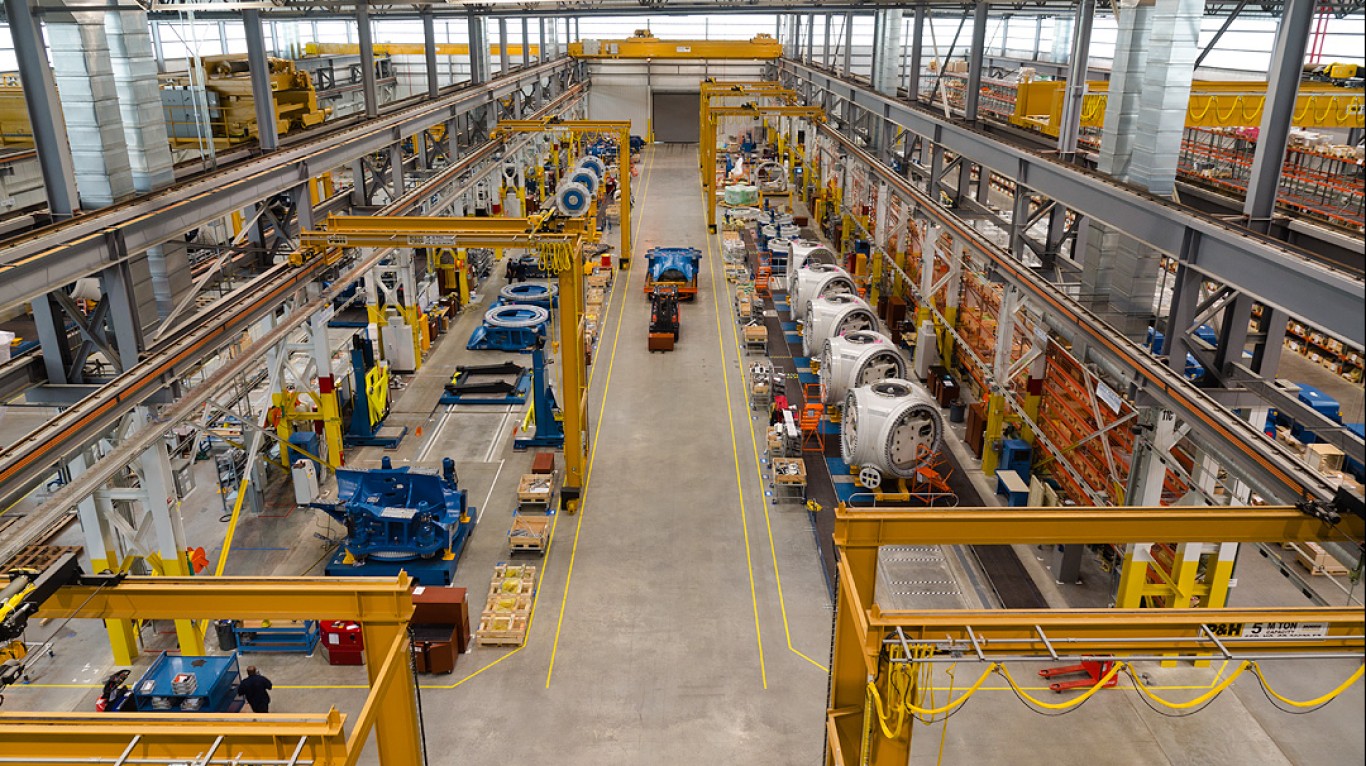
GE Vernova (NYSE:GEV) makes the heavy equipment that generates electricity and moves it around. Its gas turbines spin generators. Its transformers step voltage up for long-distance lines and back down for local use. Its switchgear works like a giant breaker panel that routes power and isolates faults. That matters because, according to a 2024 Lawrence Berkeley National Laboratory report, data centers could use between 6.7% and 12% of total U.S. electricity by 2028.
Second-quarter revenue rose 21.8% to $11.10B, beating the $10.77B estimate. Orders hit $24.20B (+88% organic), and total backlog reached $176B. Electrification, the grid-gear segment, grew revenue 68% to $3.6B. Chief Executive Scott Strazik spelled out how much data centers now matter: “About $5 billion of our orders the first half of the year with data centers on the about $14 billion of orders in total in the first half.”
Bull case: GE Vernova sells at both ends of the bottleneck. Gas gigawatts under contract rose from 100 to 116 gigawatts sequentially, and the Electrification equipment backlog grew 69% to $40.6 billion. Risk: Wind revenue fell 10% in the quarter, and offshore projects face cost pressure. The stock also swings with sentiment around AI spending. It dropped 11.53% over the past week, a decline Barron’s linked to AI financing fears.
Eaton Wires the Data Hall From Utility Feed to Server Rack
Eaton (NYSE:ETN) supplies the equipment between the utility’s connection and the servers. That includes switchgear, backup power systems and busways, which are enclosed metal bars that carry power across a building in place of bundles of cable. Its $9.55B purchase of Boyd Thermal, closed in March 2026, added liquid cooling, the plates and pumps that draw heat off AI chips.
Second-quarter adjusted EPS of $3.15 beat the $3.08 estimate, and revenue rose 21.4% to $8.53B. Organic growth of 14% came in above the high end of guidance. Rolling 12-month orders in Electrical Americas rose 41%. Eaton’s chief executive described the demand runway this way: “Total U.S. data center backlog has grown to 307 gigawatts or 15 years of backlog at 2025 build rates, up from 12 years in our last update.”
Bull case: Eaton raised its full-year adjusted EPS guidance to $13.40-$13.60. It now sells both the power gear and the cooling inside a hyperscale facility. Risk: Long-term debt rose to $18.5B (from $8.8B YE2025), interest expense climbed to $201M, and the company still has to integrate Boyd and spin off its Mobility business. The stock fell 16.56% over the past month and is down 0.6% over one year.
Hubbell Supplies the Grid’s Nuts, Bolts and Connectors
Hubbell makes the hardware that holds transmission lines, substations and distribution poles together. It also makes the connectors, fittings and wire management products that join cables inside buildings. One example is its DMC connector, which management said replaces a field weld by crimping onto a bus bar. That saves limited skilled labor on site.
Second-quarter adjusted EPS of $5.52 beat the $5.38 estimate. Revenue rose 15.3% to $1.71B, with 10% of that growth organic. Electrical Solutions data center sales jumped approximately 65%. Chief Executive Gerben Bakker said, “We continue to believe utility T&D markets are in the early stages of a multiyear investment cycle and we are investing proactively in additional capacity to serve the long-term needs of our customers.”
Bull case: Hubbell raised 2026 adjusted EPS guidance to $20.25-$20.55. It also referenced a $1.5 billion high-voltage transmission opportunity over 10 years, with its first 765 kV win due to start shipping in 2027. Risk: The roughly $3.0 billion NSI Industries deal drove total debt to $5.37B and net debt-to-capital to 52%. GAAP net income was delayed 1.6%. The market has also priced the story cautiously, with the stock up just 1.8% year to date.
Where This Layer Goes From Here
Grid gear and data center orders are piling up faster than the copper supply chain behind them can grow, and Grupo México’s Arizona plan is the latest response to the U.S. refining gap. Freeport and Southern Copper are making more as copper remains tight. GE Vernova, Eaton and Hubbell are turning record backlogs into revenue. In the coming months, keep an eye on Hayden’s feasibility milestones, Freeport’s Grasberg ramp, and the next round of backlog figures from the equipment makers to see whether this bottleneck is starting to ease.
The power, cooling, and connector suppliers behind this expansion are exactly the kind of picks-and-shovels names we profiled in a free guide to non-chipmaker stocks, which you can download here: 7 Stocks Powering the AI Boom (That Aren’t Chipmakers).
Contact [email protected] for any questions or corrections.
After two decades of patrolling the dark corners of suburbia as a police officer, Rich Duprey hung up his badge and gun to begin writing full time about stocks and investing. For the past 20 years, he’s been cruising the markets looking for companies to lock up as long-term holdings in a portfolio while writing extensively on the broad sectors of consumer goods, technology, and industrials. Because his experience isn’t from the typical financial analyst track, Rich is able to break down complex topics into understandable and useful action points for the average investor. His writings have appeared on The Motley Fool, InvestorPlace, Yahoo! Finance, Money Morning, and, of course, 24/7 Wall St. He has been featured in both U.S. and international publications, including MarketWatch, Financial Times, Forbes, Fast Company, and USA Today.