Forget the Short-Term Noise: Where Could Tesla Be in 2030?
Tesla is down big this year, burning through billions in R&D, and facing a Wall Street consensus that barely sees any upside. Yet one bold target suggests the stock could nearly double by 2030, and the case for it rests…

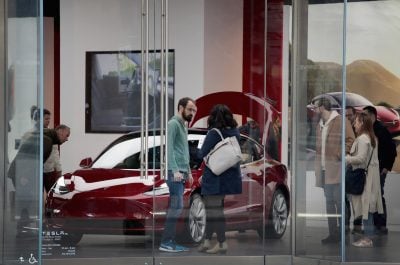
Tesla (NASDAQ:TSLA | TSLA Price Prediction | TSLA Price Prediction) delivered 486,532 vehicles last quarter. It also reached 1.74M active FSD subscriptions and started unsupervised Cybercab rides in Austin. Still, the stock is down 16.71% this year and closed at $374.58.
On the Q3 call, Elon Musk said, “I think we’re now headed for a lot of fun and significant growth.” My question is whether Tesla can reach $700 by 2030.
What’s Holding Tesla Back Right Now
Spending is the problem. Q3 operating income dropped 55.79% year over year to $718 million, while R&D rose to $2.76B from $1.63B. Revenue was flat, with a change of -0.17%.
The WSJ summed up the quarter as profit falling because batteries are limiting growth (WSJ). Management also raised its capex guidance for the year to roughly $20 billion.
The stock lost 3.08% on October 22 and is down 1.14% over the past month, even after a 3.35% gain over the past week. With a beta of 1.916, these moves are normal for Tesla.
Wall Street Sees 6.2% Upside. I Think That Is Too Timid
The consensus target of $397.83 points to only 6.2% upside. Of analyst ratings, 4 are Strong Buys, 15 are Buys, 21 are Holds, 2 are Sells and 2 are Strong Sells.
Our model projects $404.84, offering 8.1% upside. Its one-year range runs from $363.68 to $466.97, and the model has high confidence in it.

Only 43% of analysts are bullish, and the earnings growth factor subtracts 0.003. That undercounts Tesla. Earnings are lower because management chose to spend on R&D. Car demand did not fall off.
Here’s What It Takes for Tesla to Reach $700
Moving from $374.58 to $700 means a jump of 86.9%. With forward EPS of $2.0882, a $700 share price works out to a forward P/E of 335x. The base case already implies 225x, so the target needs about 111x more multiple expansion.
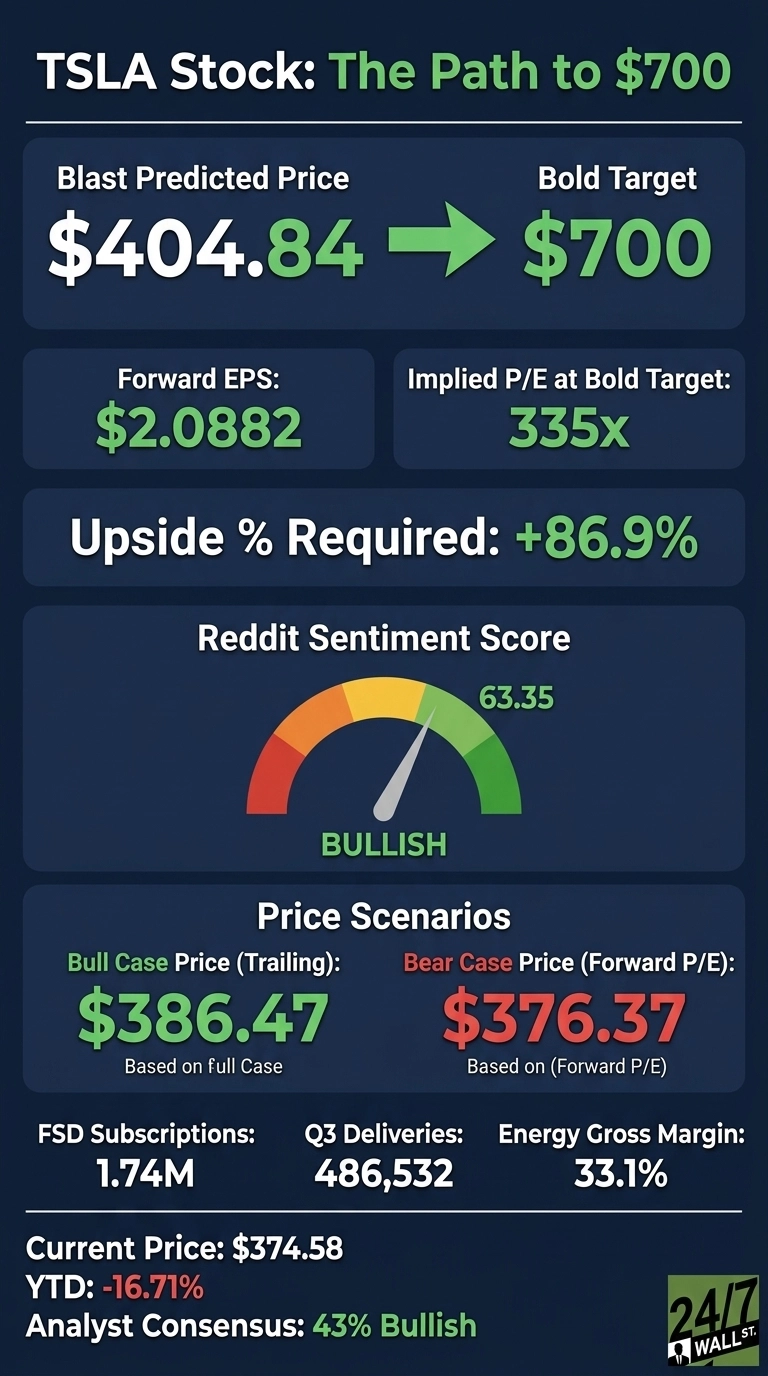
Earnings growth would do most of that work. Consensus growth is 18.23%. At that rate, EPS would reach about $4.08 in four years. That would put $700 at roughly 172x, which is below today’s multiple. An adjustment factor of 1.052 is also already positive in the model.
Here are the catalysts I see:
- Megapacks are “almost sold out” for 2027, and energy gross margin rose to 33.1%.
- More than 75% of North American Q3 deliveries included a paid FSD sign-up. Vaibhav Taneja said FSD “probably at least doubles the profit per car” over its lifetime.
- Tesla and SpaceX are in merger talks, and Morningstar highlighted valuation as a key issue (Morningstar).
The main risk is cost: Musk said TeraFab alone could need capital “north of 100 billion”.

Where Tesla Trades Today vs Its Earnings Power
At 179x forward earnings, Tesla is expensive. The stock trades in a 52-week range from a high of $498.83 to a low of $297.38.
Over 10 years, the stock has returned 2,671.11%. That record helps explain why investors pay a premium for Tesla’s future earnings.
$700 Is a Stretch, But Here’s Why It’s Possible
Reaching $700 means a 86.9% gain. The model’s highest 2030 bull case is $584.92, so I see $700 as a stretch.
Three things would have to go right. Robotaxi would need to become significantly profitable in 2027, energy margins would have to keep rising, and Optimus would need to start customer deliveries on schedule.
If battery shortages and spending keep pressuring profits, the target falls apart. Returns at this level shouldn’t be expected every year, but we’ve outlined the plan for how Tesla could reach $700 in 2030.
Contact [email protected] for any questions or corrections.
Vandita Jadeja is a financial publisher with over a decade of experience writing about financial topics, including investment, savings, retirement, insurance and banking. Vandita is a Chartered Accountant who loves to debunk financial concepts for readers.
Her work has appeared on sites that include The Motley Fool, InvestorPlace, and Benzinga. She covers investing and focuses on stock picks and price prediction for 24/7 Wall St.
When not looking for the next stock investment opportunity, she can be found traveling, reading, chasing sunsets and enjoying her iced latte.