Microsoft Vs. Oracle: Massive Backlog Fortunes With Vastly Different Risk Profiles
Both Microsoft and Oracle ended their latest quarter with a record backlog within striking distance of each other, but the financial machinery behind those matching numbers points to two very different bets on the future of AI infrastructure.

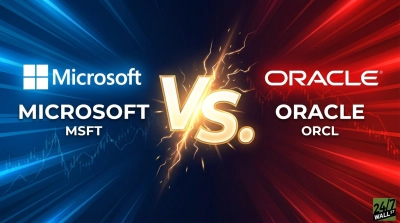
Microsoft (NASDAQ:MSFT | MSFT Price Prediction) and Oracle (NYSE:ORCL) each ended their latest quarter with a record backlog. Microsoft reported $678B in commercial RPO, and Oracle reported $664B. The two figures are close, but the money behind them is very different. Microsoft pays for AI capacity out of a highly profitable software business. Oracle is turning itself into an AI infrastructure landlord and relies in part on raised capital to do it.
Azure Throws Off Cash While Oracle’s Cloud Burns It
Microsoft’s fiscal Q4 revenue reached $90.01B, up 17.8%, and Azure grew 43%. Even after heavy spending, the quarter produced $19.64B in free cash flow, so the AI expansion is paying for itself. Copilot passed 30 million paid seats, which shows AI is earning money in Office as well as in data centers. CFO Amy Hood said “customer demand continues to exceed available capacity.”
Oracle’s cloud infrastructure revenue grew 121% in fiscal Q1, and GPU usage was 97.9%. Demand is clearly there. However, $28.50B of capex turned free cash flow negative at $5.40B. License revenue fell 15% as the older software base moves to the cloud.
| Business Driver | Microsoft | Oracle |
|---|---|---|
| Main Growth Engine | Azure and Copilot | AI training and inference capacity |
| Backlog Growth | Up 84% YoY | Up $209B YoY |
| Quarterly Free Cash Flow | $19.64B | -$5.40B |
| Legacy Drag | More Personal Computing -4% | Software -3% |
Microsoft Spreads Its Risk While Oracle Leans on a Few Giants
Excluding OpenAI, Microsoft’s RPO rose 25%. Nearly 90% of Microsoft Cloud revenue came from customers outside the frontier model companies, which limits concentration risk. Hood also pointed to how flexible the spending is: “If the demand environment changes, you just slow down what is, in fact, the largest component.”
Oracle relies on a small number of very large AI contracts. Interest expense rose 55% to $1.4B, and the company finished a $20 billion at-the-market stock sale. Management says prepay and bring-your-own-hardware deals cover most of the more than $30 billion in new contracts. CFO Hilary Maxson would not say when free cash flow will turn positive: “We haven’t given a particular timeframe on that yet.” That lack of a timeline concerns me.
Cash Flow Timing Will Decide Who Pulls Ahead
My focus will be on whether Microsoft’s Azure growth hits the about 45% in constant currency it guided for fiscal Q1. I also want to see whether “seat plus usage” pricing speeds up Microsoft 365. For Oracle, watch whether net cash capex remains at not more than $70 billion and whether revenue hits at least $90B this fiscal year.
Why I Lean Toward Microsoft for Steadier AI Exposure
Investors have already priced in the gap. Oracle shares fell 54.35% over the past year as part of an AI debt selloff. Microsoft gained 1.59% over the same period. Oracle now trades at about 18x forward earnings, compared with 25x for Microsoft. Oracle’s lower multiple likely reflects balance sheet risk.
For my own research, I prefer Microsoft. It has many sources of revenue, positive cash flow, and a customer base that does not depend on one AI lab. Oracle carries more uncertainty, though a single quarter of positive free cash flow would change its story quickly. If that happens, I would take a closer look. All of that AI capex also has to be powered, cooled, and networked by someone, and we included seven of those suppliers into a free report on the AI boom beyond the chipmakers.
Contact [email protected] for any questions or corrections.
Alex Sirois is a financial writer with experience spanning both retail and institutional investing. He has written for InvestorPlace and held roles at BNY Mellon and Bernstein, giving him a perspective that bridges Main Street portfolios and Wall Street analysis.
Alex holds an MBA from George Washington University and has built his career across multiple industries, including e-commerce, education, and translation — a breadth of experience that informs how he breaks down complex financial topics for everyday investors. His writing is conversational, actionable, and grounded in long-term, buy-and-hold investing principles.
At 247 Wall St., Alex focuses on delivering analysis that is both accessible and useful, with a clear emphasis on helping readers make more informed decisions with their money.