America’s Emergency Oil Reserve Is at a 1982 Low, and Gas Is Costlier Than Under Biden

This post may contain links from our sponsors and affiliates, and Flywheel Publishing may receive compensation for actions taken through them.

America’s emergency oil stockpile and its gasoline bill each crossed a political line on October 26, 2026. The Energy Department reported that Strategic Petroleum Reserve crude stocks fell to 282.6 million barrels, the lowest since October 1982. AAA data showed regular gasoline has averaged $3.472 a gallon during Trump’s current term, compared with $3.471 under Biden.
Crude moved little, as Brent settled down 91 cents, or 0.8%, at $115.81 a barrel, and WTI fell $1.51, or 1.46%, to $101.76.
United States Oil Fund (NYSEARCA:USO) slid 1.97% to $166.19. State Street Energy Select Sector SPDR ETF (NYSEARCA:XLE) rose 0.43% to $69.63.
The Finland-based Center for Research on Energy and Clean Air, an advocacy nonprofit that wants countries to move off fossil fuels, estimates US consumers have paid an extra $471 each for fuel since the Iran war began February 28. The worldwide figure is about $60 per person. Americans account for $160 billion of the $468 billion in extra spending across the 169 countries studied.
How Fast the Emergency Cushion Is Draining
The reserve is there to cover supply shocks, so its size tells traders how much buffer Washington has left. The drop comes from a committed withdrawal of 172 million barrels. On top of that, the department approved an emergency exchange of up to 400,000 barrels to cover a disruption at Phillips 66 (NYSE:PSX | PSX Price Prediction) in Lake Charles, Louisiana.
The reserve held 415.442 million barrels in the week ending March 6 and 282.683 million barrels in the week ending October 16. That is a drop of about 133 million barrels, or roughly 32%, in about seven months. The last time the level was lower was the week ending October 15, 1982, at 280.802 million barrels.
The reserve actually grew under Trump at first, from 394.566 million barrels in January 2025, until the war release began. Because less oil is left to soften the next shock, traders are likely to keep paying extra for crude.
Diesel Carries the Real Gap at the Pump
The gap in gasoline averages between the two terms is small, while diesel’s is wider: it has averaged $4.343 under Trump against $4.078 under Biden, and it set a record of $6.5276 on September 22.
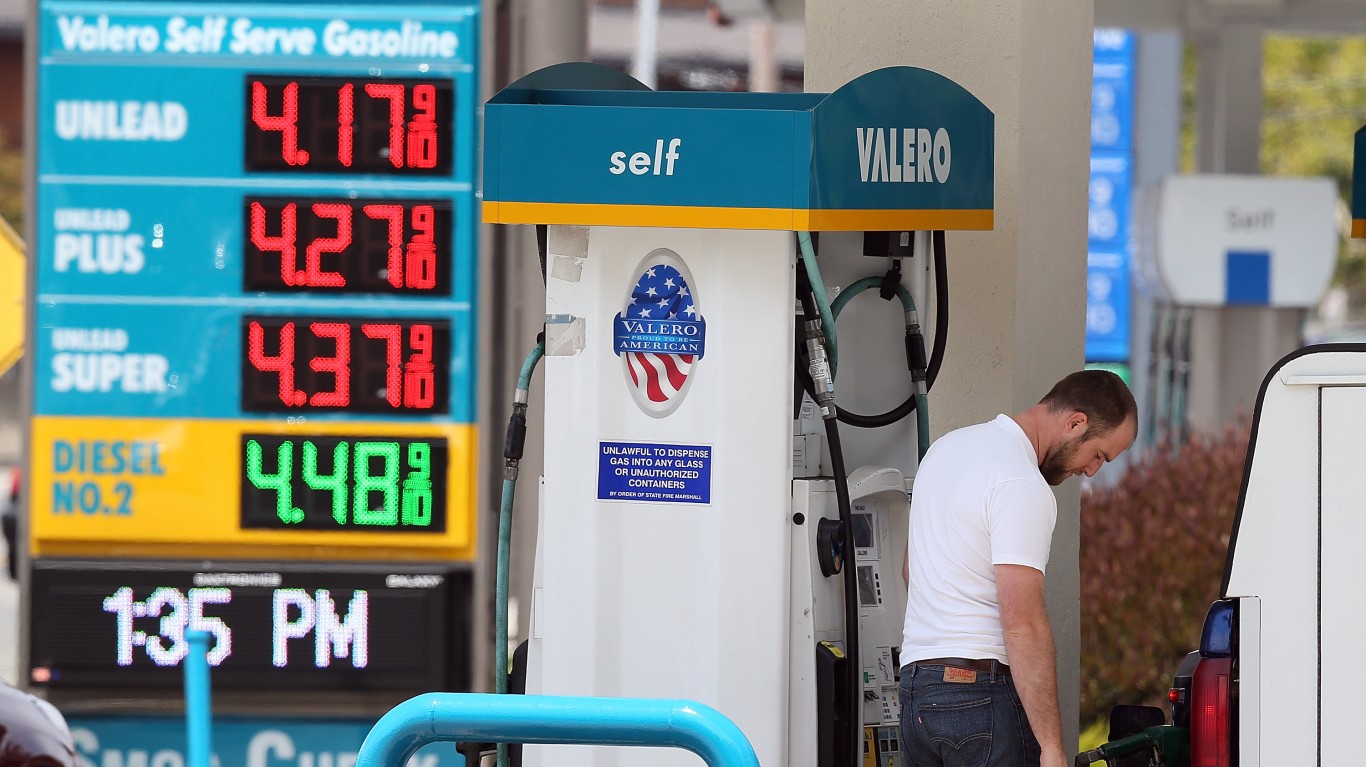
Regular averaged $4.2858 on October 26. That is up about 40% from $3.0532 a year earlier. It is also down from $4.4874 a month earlier and well below the $5.0165 record set June 14, 2022.
White House spokeswoman Taylor Rogers said, “Once this conflict comes to an end, gas prices will drop drastically.” Voters have shown less patience, and Trump’s approval hit 31% in a Reuters/Ipsos poll published October 19, with 23% approving of his handling of the country. Year-ahead inflation expectations rose to 4.7% from 3.4% in February.
At an October 24 rally in Perry, Georgia, Trump said the U.S. profits from the war even though drivers struggle at the pump: “I don’t give a damn, I’m gonna say it: We’re making a frickin fortune.”
Reality Check on the Two Funds
USO holds near-month WTI futures contracts. That means it takes on roll risk each time it replaces expiring contracts, and it would drop fastest on a ceasefire or a policy-driven fall in crude. It trades near the top of its $65.99 to $169.96 yearly range after a 127.15% one-year return.
XLE sits just under its $69.86 high. Its biggest holdings as of June 30 were Exxon Mobil (NYSE:XOM) at 22.67% and Chevron (NYSE:CVX) at 16.09%. Those companies produce cash flow and shareholder returns regardless of what the futures curve does, although they still fall when oil does.
What Could Pull USO Lower Before the Midterms
Brent is roughly double its late-2025 spot range of $61 to $63, so USO already reflects the war. The White House is promising lower prices ahead of the November 3 midterms, and the Fed announces its rate decision on October 28.
Diesel near $6.3492 is likely weighing on demand. A ceasefire would take the war premium out of the front-month contracts USO holds faster than anything else could.
XLE carries less of that risk. Producers can likely handle lower crude prices, so a peace deal would cut their earnings without hitting the fund the way it would hit a futures fund.
If USO closes above its $169.96 high before November 3, the market would be pricing in a longer war than this analysis assumes.
Contact [email protected] for any questions or corrections.
Omor Ibne Ehsan is a writer at 24/7 Wall St. He is a self-taught investor with a focus on growth, cyclical, and dividend equities that have strong fundamentals, value, and long-term potential. He also has an interest in high-risk, high-reward investments such as penny stocks.