CoreWeave’s Debt Service is The True Neocloud Litmus Test
CoreWeave reached $5 billion in annual revenue faster than any cloud company before it, but its interest expense is growing faster than its operating income. What happens in the next two quarters will determine whether the neocloud model survives its…


CoreWeave (NASDAQ:CRWV) trades at $59.57. Whether it can keep up with payments on a fast-growing debt load has become the key question for the whole neocloud model.
CoreWeave rents GPU capacity to AI labs and enterprises. It became the fastest cloud to reach $5B in annual revenue, and it paid for that growth mostly with borrowed money. Total debt reached $51.6 billion last quarter, and capital lease obligations added another $16.54 billion. The stock fell 31.99% over the past month. During that decline, traders known from The Big Short explained their short position, Bloomberg described the rout as a warning for the broader market, and Elon Musk said more than 200 neoclouds face “guppy-level death” (per Business Insider, Bloomberg and CNBC).
A $104 Billion Backlog Backs Every Loan
Revenue backlog stood at $104.2 billion, up 246% year over year. That figure leaves out more than $25 billion in commitments added early in Q3. Operating cash flow came in at $679M, a swing from -$251M a year earlier, and adjusted EBITDA reached $1.5 billion at a 59% margin.
Pricing power is growing too. In July CoreWeave raised prices by roughly 25% across SKUs. Its weighted average cost of debt fell almost 300 basis points over the past year, which management values at about $1.1 billion of annualized interest savings. The company says each cluster ends up “fully repaying asset-level debt used to fund the CapEx while generating significant additional free cash flow.”
Interest Expense Is Outrunning Operating Income
Quarterly interest expense rose from $267M to $536M and then to $640M. Q3 guidance calls for $860 million to $940 million. Against that, Q2 operating income was -$49M, which leaves an interest coverage ratio of -0.037.
Free cash flow was -$5.74B, so the company leaned on $10.07B of financing to cover the gap. Debt-to-equity is 8.94 and net debt to EBITDA is 10.75. Full-year capex guidance of $35 billion to $39 billion means CoreWeave needs credit markets to stay open.
Q3 Results Will Show Whether Margins Can Keep Pace
Management guides Q3 adjusted operating income to $200 million to $260 million and expects adjusted operating margins to reach the low teens in Q4. More than 50% of the backlog is already tied to contracts where delivery has started. Management expects that share to pass two-thirds by year end. If both happen, operating profit could start catching up with interest costs. The two lines still sit far apart today.
Analysts See 126% Upside as the Stock Trails the S&P 500
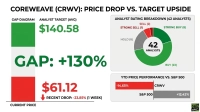
The $134.50 consensus target means about 125.8% upside from the current price. Price targets are one input, and they carry no guarantee. Among 42 analysts:
- Strong Buy: 8
- Buy: 23
- Hold: 8
- Sell: 2
- Strong Sell: 1
CoreWeave is down 16.81% year to date, while the S&P 500 is up 12.87%. Over one year the stock has fallen 56.22% as the index gained 12.33%. Shares trade at about 19x EV/EBITDA, and the price sits well below the $91.89 200-day average.
Operating Profit Must Catch Up With Interest Before the Outlook Clears
At $59.57, CoreWeave’s outlook depends on operating income and interest expense.
The outlook would strengthen if CoreWeave hits its Q3 revenue guidance of $3.45 billion to $3.6 billion, keeps interest expense inside its range, and keeps raising debt at falling rates. The outlook would weaken if interest exceeds guidance, financing costs rise, or margins remain stuck below the low teens.
A clean quarter could narrow the gap between operating income and interest expense, while a credit scare would weigh more heavily with operating income still negative. Each quarter, compare adjusted operating income with interest expense.
The backlog shows the demand is real, and the next two earnings reports should reveal if CoreWeave can afford to serve it. The same AI expansion funding this debt load is lifting a different set of suppliers in power, cooling, and networking, which we profiled in a free report on seven AI infrastructure names that aren’t chipmakers.
Contact [email protected] for any questions or corrections.
Alex Sirois is a financial writer with experience spanning both retail and institutional investing. He has written for InvestorPlace and held roles at BNY Mellon and Bernstein, giving him a perspective that bridges Main Street portfolios and Wall Street analysis.
Alex holds an MBA from George Washington University and has built his career across multiple industries, including e-commerce, education, and translation — a breadth of experience that informs how he breaks down complex financial topics for everyday investors. His writing is conversational, actionable, and grounded in long-term, buy-and-hold investing principles.
At 247 Wall St., Alex focuses on delivering analysis that is both accessible and useful, with a clear emphasis on helping readers make more informed decisions with their money.