CoreWeave More Than Halved Over the Past 6 Months: This Pro Analyst Expects 360% Returns to Come
CoreWeave's $104 billion revenue backlog and a Street-high price target pointing to 365% upside tell one story, but its bond market tells a very different one, and right now the bond market is winning.

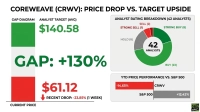
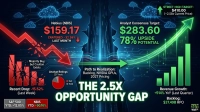
CoreWeave (NASDAQ:CRWV) currently trades at $53.74. Wall Street’s average price target is $134.58, which implies 150.4% upside.
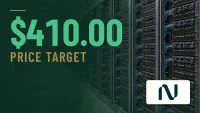
CoreWeave leases NVIDIA (NASDAQ:NVDA | NVDA Price Prediction) GPU capacity to AI labs, hyperscalers and enterprises for model training and inference. Its revenue backlog reached $104.2 billion last quarter, and the stock was added to the Nasdaq-100. Rosenblatt Securities’ John McPeake holds the Street-high target of $250.00, which implies about 365% upside.
The backlog is large. The open question is whether CoreWeave can finance the expansion long enough to deliver it.
Debt Fears Turned a Growth Story Into a Credit Story
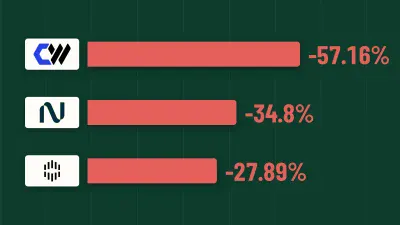
CoreWeave has more than halved because of its debt. Shares fell 57.16% over six months. Reuters reported the company carries about $50 billion in debt. It also reported that CoreWeave’s April-issued bonds yielded around 15% and that default-insurance pricing implied a nearly 63% chance of default in five years.
Second-quarter revenue rose 112.3% to $2.58B and beat estimates. Over the same stretch, interest expense climbed to $640 million from $267 million, and free cash flow came in at -$5.74B. Guidance calls for third-quarter interest expense of $860 million to $940 million and full-year capex of $35 billion to $39 billion.
Sector stress made it worse. Debt-heavy AI compute providers have come under pressure, and CNBC reported that confidence in CoreWeave is eroding among both its stock and bond investors. A securities class action saying concealed data center construction delays adds another burden.
Analysts Are Anchored to $104 Billion in Signed Demand
The bull case starts with contracts. Early in Q3, CoreWeave added over $25 billion in net new commitments that are not yet counted in the backlog, and secured power reached 4.2 gigawatts. Management expects a year-end annualized revenue run rate of $18.5 billion to $19.5 billion.
Margins are the second pillar. In July the company raised prices approximately 25% across SKUs, and it expects Q4 adjusted operating margins in the low teens, up from 5% in Q2. Chief executive Michael Intrator said on the earnings call, “Our near-term capacity remains effectively sold out.”
NVIDIA adds a guarantee. It has agreed to buy any unsold CoreWeave capacity through April 13, 2032, and NVIDIA CEO Jensen Huang told reporters, “Their cost of capital is actually decreasing.” McPeake’s $250 thesis rests on pure-play neocloud scale, a multi-year backlog and speed in deploying liquid-cooled NVIDIA clusters.
Most of the Street still rates the stock positively. Among 42 covering analysts, the breakdown is:
- Strong Buy: 8
- Buy: 23
- Hold: 8
- Sell: 2
- Strong Sell: 1
Investors are watching the third-quarter earnings report to see if it lands within guidance of $3.45 billion to $3.6 billion in revenue.
Neocloud Peers Fell Together, and CoreWeave Took the Deepest Cut
The whole neocloud group sold off together. CoreWeave’s one-month drop of 40.04% is the largest of the three.
Nebius Group (NASDAQ:NBIS) fell 34.8% over the past month to $151.64, but it is still up 81.16% year to date. Its $281 average target implies 85.3% upside. Analysts have it at two Strong Buy, 12 Buy, five Hold, one Sell and one Strong Sell. That is less upside than Wall Street sees in CoreWeave.
Applied Digital (NASDAQ:APLD) dropped 27.89% over the past month to $17.81. Its $60.94 target implies 242.2% upside, and analysts rate it two Strong Buy, 11 Buy and two Hold. CoreWeave is one of its main tenants, so the two stocks share risk.
Applied Digital has the largest consensus-implied upside, CoreWeave is second and Nebius is third. Only Rosenblatt’s call on CoreWeave goes higher. Analysts treat the whole group as mispriced, and CoreWeave’s heavy debt makes it the most controversial of the three. The power, cooling, and networking suppliers feeding this same AI expansion are the subject of a free report we put together on seven infrastructure names behind the boom, here.
A 40% Monthly Slide While the S&P 500 Barely Moved
CoreWeave currently trades at $53.74, against an average target of $134.58 from 42 analysts. That works out to 150.4% implied upside. Analyst targets are estimates, and some of these were set before credit markets turned.
The stock is down 24.95% year to date and 57.46% over the past year. It sits near the bottom of its 52-week range of $49.46 to $138.25. The S&P 500 is up 10.63% year to date and down 1.97% over the past month.
Cheap on Backlog, Risky on Credit: Where I Land
The argument for buying improves if the Q3 report shows margins moving toward the low-teens target and borrowing costs keep falling. That combination would turn the backlog into cash and give the stock a path back toward $134.58. The downside scenario gains weight if bond yields hold near distressed levels. In that case, every capex dollar costs more, and dilution or refinancing stress could absorb the equity upside.
I lean carefully constructive. The signed demand supports a higher price than $53.74, but credit markets are setting the stock’s price for now. One quarter of steadying interest costs would help show whether the 150.4% gap reflects durable value.
Contact [email protected] for any questions or corrections.
Alex Sirois is a financial writer with experience spanning both retail and institutional investing. He has written for InvestorPlace and held roles at BNY Mellon and Bernstein, giving him a perspective that bridges Main Street portfolios and Wall Street analysis.
Alex holds an MBA from George Washington University and has built his career across multiple industries, including e-commerce, education, and translation — a breadth of experience that informs how he breaks down complex financial topics for everyday investors. His writing is conversational, actionable, and grounded in long-term, buy-and-hold investing principles.
At 247 Wall St., Alex focuses on delivering analysis that is both accessible and useful, with a clear emphasis on helping readers make more informed decisions with their money.