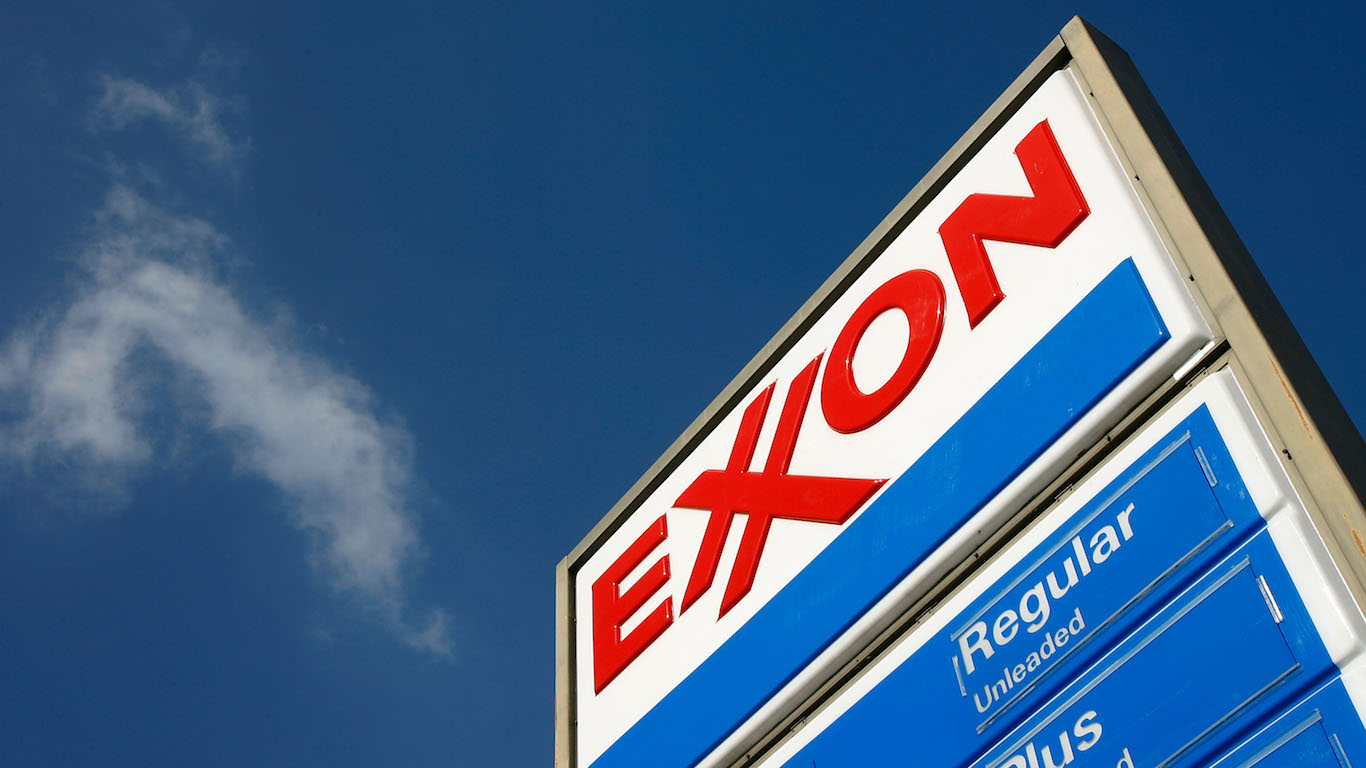
Exxon Mobil Stock Is Up 55% in 2026. Is Its Dividend Still Safe?
After a 55% surge in Exxon Mobil shares, income investors face a yield near historic lows and an oil market full of landmines. Here is what the cash flow numbers reveal about whether that $4.12 annual payout can survive the…

Exxon Mobil (NYSE:XOM | XOM Price Prediction) pays $4.12 per share per year, or $1.03 per quarter. A year ago, the quarterly payment was $0.99. The shares trade at $183.08 after a 55.16% year-to-date run, so the yield has dropped to 2.33%. Income investors buying after that rally need to know whether the payout still holds up once oil prices cool.
A Payout That Keeps Rising Through Every Cycle
The fourth-quarter 2025 raise of 4% extended Exxon’s run to 43 consecutive years of annual dividend growth. The quarterly figures show a steady climb: $0.87 in 2020, $0.91 in 2023, and $0.95 in 2024. Exxon kept paying in 2020, a year when operating cash flow of $14.668 billion came in below dividends of $14.865 billion.
Coverage Held Up Even at $60 Oil
The simplest test is 2025, when monthly WTI crude ran from $57.97 to $75.74 a barrel. Free cash flow is the cash left after capital spending, and it came to $26.13 billion. Dividends cost $17.231 billion, so free cash flow covered them about 1.5 times. That dividend bill was roughly 60% of net income.

Oil prices drive Exxon’s cash flow. When crude rises, Exxon’s revenue from each barrel it pumps rises too, while drilling budgets stay mostly fixed, and the extra money drops almost straight into cash flow. WTI rose from $60.04 in January to $97.31 in September. Second-quarter operating cash flow reached $23.555 billion, and free cash flow covered that quarter’s dividend nearly 4 times. On the July earnings call, Chief Executive Darren Woods described Exxon’s goal:
“We are building a company that can perform through disruption and delivers superior long-term shareholder value across cycles.”
Chief Financial Officer Neil Hansen pointed to Guyana as the next source of cash. He said Exxon expects “2x the level of free cash flow in 2030 than we saw in 2025.”
Buybacks Give Exxon Room to Adjust
In 2025, dividends and buybacks together totaled $37.5 billion, well above free cash flow. Most of that was the $20 billion repurchase program. Exxon plans to repeat it in 2026 “assuming reasonable market conditions.” Exxon can scale buybacks back up in a downturn, so they cushion the dividend. The balance sheet adds more protection: debt-to-equity of 0.168, net debt to EBITDA of 0.548, and interest coverage of 56.28x.
How Chevron and Shell Compare
Chevron (NYSE:CVX) raised its quarterly payout to $1.78, its 39th consecutive annual increase. Its interest coverage is a lower 13.7x, and its first-quarter free cash flow was negative at -$1.549 billion. Shell (NYSE:SHEL) pays $0.3906 per quarter. In the fourth quarter of 2025, its distributions topped free cash flow, and by the first quarter of 2026 net debt had risen to $52.6 billion.
Middle East Disruption Threatens Exxon’s Cash Cushion
The Middle East is the biggest threat. Exxon temporarily lost about 10% of its upstream production because of the conflict. First-quarter free cash flow fell to $2.70 billion, below that quarter’s dividend bill of $4.334 billion. Exxon reports third-quarter results soon. That report will show how much of the oil rally flowed through to free cash flow.
Verdict: The Payout Looks Built to Last
Exxon covered its dividend with $60 oil, kept paying through 2020, and carries the strongest balance sheet of the three companies here. The $20 billion buyback gives it room to cut back before the dividend is at risk, and at $4.12 a share, the payout looks durable, with further raises likely.
Contact [email protected] for any questions or corrections.
Chris Lange is a financial and geopolitical writer with more than a decade of experience covering a myriad of topics. He has published thousands of articles for 24/7 Wall St., with past coverage focused heavily on stocks, IPOs, healthcare, defense, global affairs, and technology.
His work has been quoted, or referenced by a number of outlets including Business Insider, USA Today, Yahoo Finance, MSN, The Motley Fool, and many other publications. A graduate of Southwestern University, he studied business with a focus on investments and has previous experience in banking and startups.
When not reading or writing the news, he is following his passion for Lacrosse, playing chess, or building solar projects with his dad.