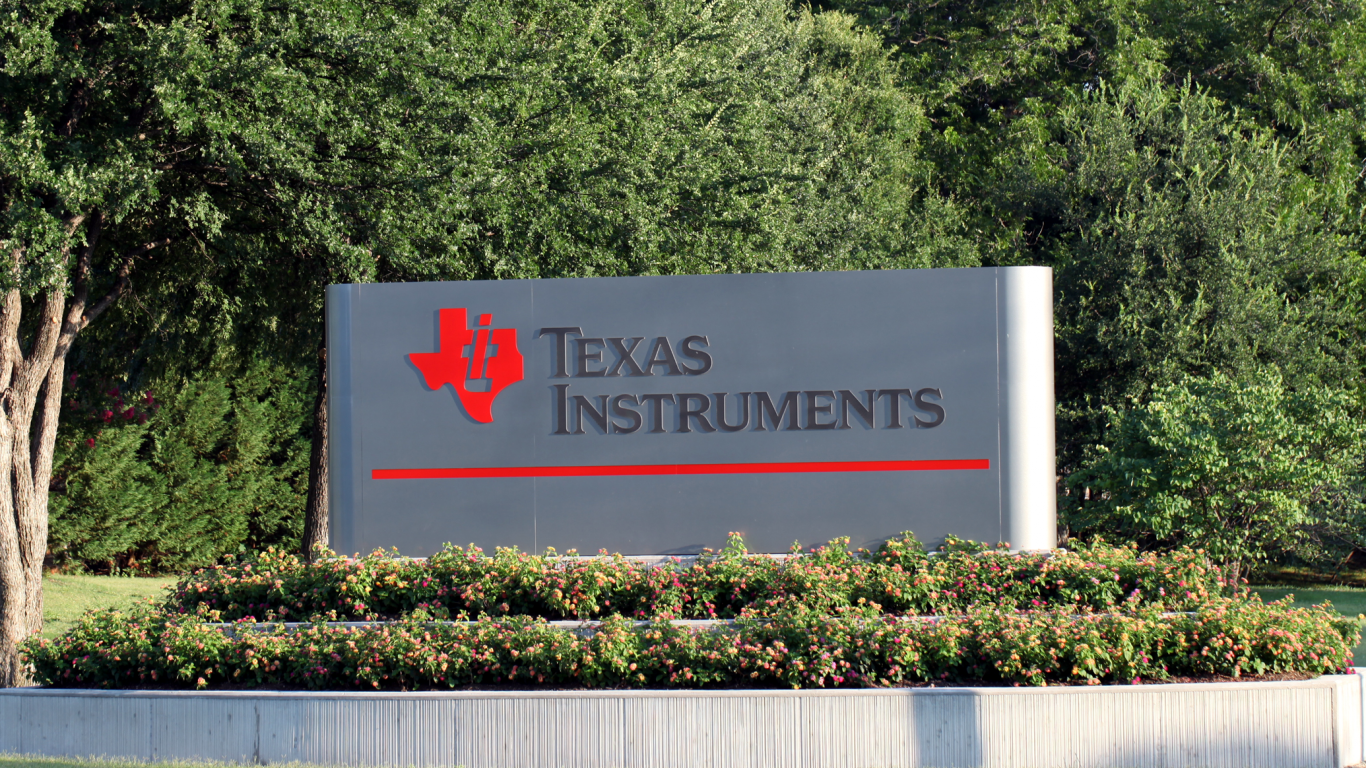
Texas Instruments Pays $1.52 a Quarter, Analog Devices $1.10. Which Dividend Is Stronger?
Texas Instruments just raised its dividend again and throws off billions in free cash flow, yet one number buried in its payout math raises a real question about which analog chip giant actually has the safer income stream.

Texas Instruments (NASDAQ:TXN | TXN Price Prediction) just raised its quarterly dividend to $1.52 from $1.42. Analog Devices (NASDAQ:ADI) pays $1.10. Both make analog chips, which turn real-world signals like heat, sound, and voltage into usable data. Those parts stay in factory equipment and cars for years, so the cash they produce tends to be steady, and steady cash is what pays dividends.
Factories and Data Centers Are Paying for Both Dividends
At Texas Instruments, industrial revenue climbed more than 40%, and data center revenue rose about 95%. The recovery was broad, and it showed up in cash. Trailing free cash flow reached $8.4 billion, up from $2.4 billion a year earlier as spending on its 300mm wafer factories slowed. CEO Haviv Ilan credited “the benefit of 300mm production.”
Analog Devices grew faster. Industrial sales rose 53% to $1.972B, and communications jumped 84% on AI data center demand. The adjusted operating margin hit 50.0%, which points to real pricing power. CEO Vincent Roche put it: “The origin of the high gross margin structures is the innovation premium that we attract.”


| Dividend Lens | Texas Instruments | Analog Devices |
|---|---|---|
| Forward yield | 1.98% | 1.03% |
| Straight annual increases | 23 | 22 |
| Latest raise | 7% | 11% |
| Dividends as share of TTM free cash flow | 62% | 42% |
| Cash and short-term investments | $8.1 billion | $2.3 billion |
Texas Instruments Pays More While Analog Devices Keeps a Wider Cushion
Texas Instruments sends almost all of its returned cash out as dividends. Buybacks came to only $48M last quarter. Trailing free cash flow also includes $1.6 billion of CHIPS Act incentives. Strip those out, and dividends use about 76% of free cash flow. That leaves a much thinner margin of safety.
Analog Devices plans to put 40% to 60% of free cash flow toward the dividend and use the rest to buy back stock. It repurchased $1.157B in the quarter, so it has a large pool of cash it could redirect before ever cutting the dividend. The catch is the balance sheet. Total debt rose to $9.12 billion after the all-cash $1.5 billion purchase of Empower Semiconductor.


One Risk Hangs Over Each Payout
For Texas Instruments, the risk is capital spending in 2027. Ilan said that budget depends on “demand and our aspiration for growth,” and he admitted the company is “investing ahead of demand.” If capex climbs again just as CHIPS incentives wind down, free cash flow could shrink while the dividend continues rising.
Analog Devices faces a different exposure. Roche noted that “AI capex could slow or decrease,” and data center sales now make up 80% of its communications segment.
Why I Give Analog Devices the Durability Edge
If you want the most income today, Texas Instruments pays nearly double the yield, and its 23-year record of increases speaks for itself. When I ask which dividend will last, though, I pick Analog Devices. It spends less on factories, earns higher margins, and pays its dividend with less than half of its free cash flow. I would rethink that if Texas Instruments keeps 2027 capex in the $2 billion to $3 billion range, similar to this year.
Contact [email protected] for any questions or corrections.
Chris Lange is a financial and geopolitical writer with more than a decade of experience covering a myriad of topics. He has published thousands of articles for 24/7 Wall St., with past coverage focused heavily on stocks, IPOs, healthcare, defense, global affairs, and technology.
His work has been quoted, or referenced by a number of outlets including Business Insider, USA Today, Yahoo Finance, MSN, The Motley Fool, and many other publications. A graduate of Southwestern University, he studied business with a focus on investments and has previous experience in banking and startups.
When not reading or writing the news, he is following his passion for Lacrosse, playing chess, or building solar projects with his dad.