If AI Spending Slows in 2027, These Semiconductor Stocks Could Hold Up Best
AI budgets face real pressure heading into 2027, but three chipmakers controlling very different choke points in the supply chain may not feel the pain equally. Here is what separates the most resilient semiconductor plays from the one with the…


Each of these three chipmakers controls a different constraint in the AI expansion. NVIDIA (NASDAQ:NVDA | NVDA Price Prediction) designs the accelerators. Micron Technology (NASDAQ:MU) supplies the high-bandwidth memory that feeds them. Taiwan Semiconductor Manufacturing (NYSE:TSM) makes the leading-edge silicon.
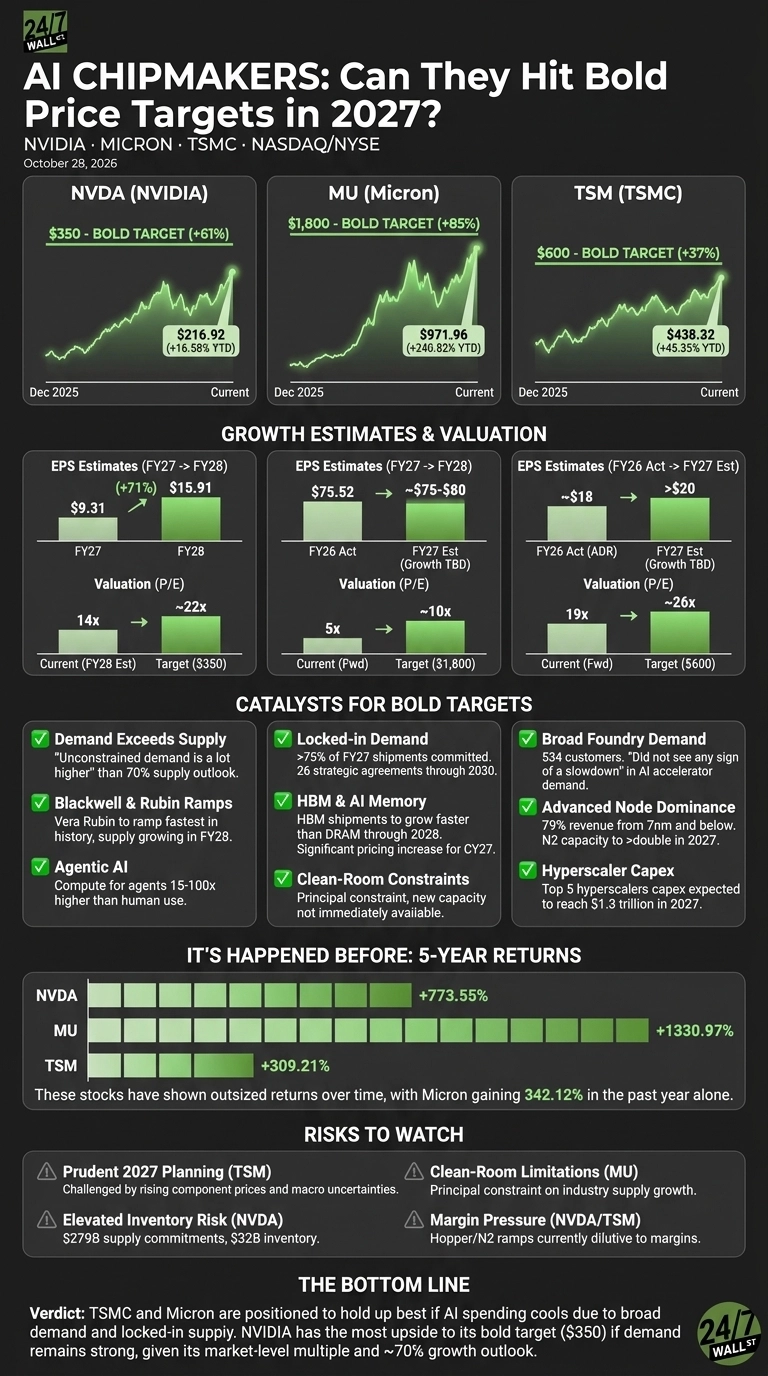
Year to date, NVIDIA shares are up 16.58%, Micron is up 240.82% and TSMC is up 45.35%.
Investors are now asking whether AI budgets can keep growing in 2027. Below, I lay out how each stock could still reach a bold target: $350 for NVIDIA, $1,800 for Micron and $600 for TSMC.
Wall Street Already Sees Big Upside in All Three
The consensus price targets are $328.95 for NVIDIA, $1,561.91 for Micron and $584.39 for TSMC. From current prices, that works out to upside of about 52%, 61% and 33%. Estimates are still going up. Analysts now expect NVIDIA to earn $15.9146 per share in fiscal 2028, up from $12.8148 90 days ago.

All three exceeded their most recent EPS estimates. NVIDIA’s $2.22 was its fifth consecutive beat, and Micron’s $33.42 was its eighth. TSMC earned $4.60 per ADR versus $4.46 expected. Beat streaks like these suggest actual results could again come in above forecasts.

Here’s What It Takes to Reach Each Target
NVIDIA, at $216.92, trades at about 14x fiscal 2028 estimates. At $350, the multiple would be roughly 22x, in line with the S&P 500’s 21x to 23x. That’s modest for a company expecting revenue growth of approximately 70% next year.
At 5x forward earnings, a $1,800 price would put Micron near 10x. TSMC’s 19x forward P/E would rise to about 26x at $600.
How could these stocks reach their targets?
- Demand exceeds supply. NVIDIA’s chief executive said, “Even though our demand is much greater than 70%, our supply allows us to confidently deliver 70%.”
- Memory demand is locked in. Micron has more than 75% of fiscal 2027 shipments committed. It also has 26 strategic customer agreements covering supply through 2030, which gives it the strongest protection against a slowdown.
- Foundry demand is broad. TSMC served 534 customers in 2025. CEO C.C. Wei said of AI accelerators, “We did not see any sign of a slowdown.” TSMC also expects N2 capacity to more than double in 2027.
- Hyperscaler budgets keep growing. Capex from the top five hyperscalers is expected to reach $1.3 trillion in 2027.
There are hurdles. TSMC says it is “being prudent in our business planning going into 2027,” and NVIDIA carries $279B in supply commitments.

Past Returns Show These Gains Are Within Reach
To hit these targets, NVIDIA would need to gain 61%, Micron 85% and TSMC 37%. All three have done far more over five years: NVIDIA returned 773.55%, Micron 1330.97% and TSMC 309.21%. Micron gained 342.12% in the past 12 months alone.
At market caps of $5.23 trillion, $1.10 trillion and $2.27 trillion, matching that pace gets harder. Still, these stocks have shown how quickly they get re-rated when earnings beat expectations.

Which Chip Stock Holds Up Best? Here’s My Take
If AI spending cools in 2027, I expect TSMC and Micron to hold up best. TSMC has the broadest customer base, and Micron has committed shipments plus tight clean-room supply. NVIDIA has the most upside if demand stays strong, since it trades at a market-level multiple while guiding to approximately 70% growth.
All three targets would be harder to reach if the market weakens or hyperscaler spending pauses. While such gains shouldn’t be expected every year, this is how NVIDIA, Micron and TSMC could see outsized returns in 2027.
Contact [email protected] for any questions or corrections.
Vandita Jadeja is a financial publisher with over a decade of experience writing about financial topics, including investment, savings, retirement, insurance and banking. Vandita is a Chartered Accountant who loves to debunk financial concepts for readers.
Her work has appeared on sites that include The Motley Fool, InvestorPlace, and Benzinga. She covers investing and focuses on stock picks and price prediction for 24/7 Wall St.
When not looking for the next stock investment opportunity, she can be found traveling, reading, chasing sunsets and enjoying her iced latte.