After Massive 2026 Gains, Can NVIDIA, Micron, and SanDisk Keep Climbing in 2027?
NVIDIA is up 23% this year, but Micron and SanDisk have left it in the dust with gains that few analysts thought possible. Now Wall Street is drawing a roadmap to prices that would require the whole cycle to repeat…


NVIDIA (NASDAQ:NVDA | NVDA Price Prediction) CEO Jensen Huang summed up this cycle in six words: “Now, compute is revenue.” That compute runs on memory, which explains why Micron (NASDAQ:MU) and SanDisk (NASDAQ:SNDK) have outrun even NVIDIA.
So far this year, NVIDIA is up 23.54%, Micron has gained 264.75%, and SanDisk has risen 608.7%. All three now have multi-year customer commitments behind them.
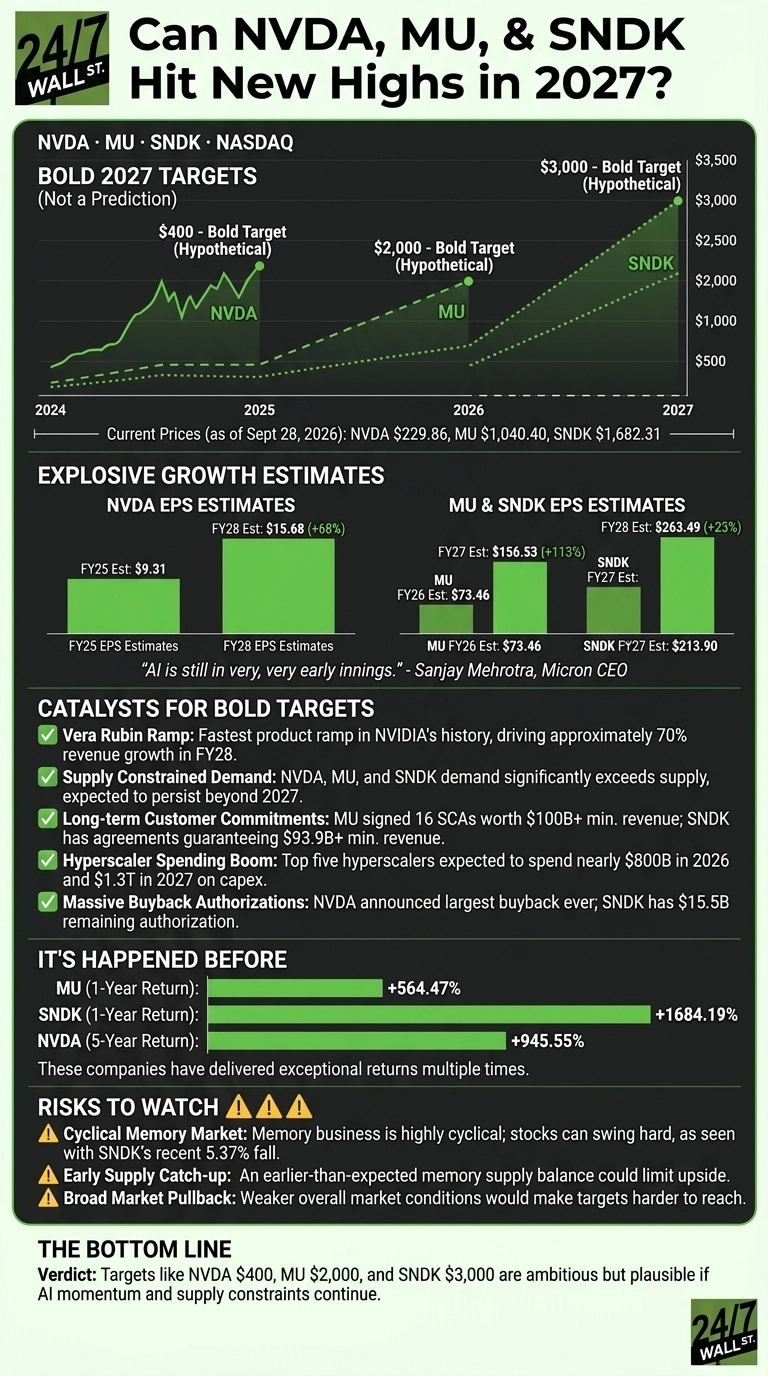
Here’s how NVIDIA could reach $400, Micron $2,000, and SanDisk $3,000 in 2027.
Wall Street Already Sees Up to 46% Upside, and Estimates Keep Climbing
The consensus targets are $327.70 for NVIDIA (42.6% upside), $1,515.54 for Micron (45.7%), and $2,136.54 for SanDisk (27%).

Estimates keep moving higher. NVIDIA’s fiscal 2028 EPS estimate is $15.6826, up from $12.6737 90 days ago. Micron’s fiscal 2027 estimate went from $117.8618 to $156.5298. SanDisk’s went from $188.8767 to $213.903.

The three have also exceeded expectations for several quarters running: five in a row for NVIDIA, seven for Micron and five for SanDisk. That record suggests the forecasts are still too low.
Here’s the Valuation Math Behind $400, $2,000, and $3,000
| Stock | Price | Next-Year EPS Est. | Forward P/E Now | P/E at Target |
|---|---|---|---|---|
| NVIDIA | $229.86 | $15.6826 | 15x | 26x |
| Micron | $1,040.40 | $156.5298 | 7x | 13x |
| SanDisk | $1,682.31 | $213.903 | 8x | 14x |

The S&P 500 trades at about 21x to 23x forward earnings. Even at these bull-case prices, Micron and SanDisk would still trade well below the market multiple, and NVIDIA would sit only slightly above it.
What Could Push All Three to Their Targets?
- Demand that outruns supply: NVIDIA expects “to grow revenue by approximately 70% in fiscal 2028,” and it calls that a supply-constrained outlook. Management expects Vera Rubin to be “the fastest product ramp in NVIDIA’s history.”
- Rising memory prices: NVIDIA said memory price increases “are headed even higher into next year.” Micron expects tight conditions “to persist beyond calendar 2027.”
- Contracted revenue floors: Micron has signed 16 Strategic Customer Agreements, and 14 of them carry about $100 billion in minimum-price revenue. SanDisk’s agreements guarantee at least $93.9 billion.
- Hyperscaler spending: The top five hyperscalers are expected to spend nearly $800 billion in 2026 and $1.3 trillion in 2027 on capital projects.
- Buybacks: NVIDIA just announced its largest buyback expansion ever, according to the New York Times. SanDisk has $15.5 billion left under its repurchase authorization.
All that hyperscaler capex has to be powered, cooled, and networked by someone other than the chipmakers, and we rounded up seven of those infrastructure suppliers in a free report you can grab here.
Past Returns Show These Gains Aren’t Out of Reach
The targets require increases of 74% for NVIDIA, 92% for Micron and 78% for SanDisk. In the past year alone, Micron returned 564.47% and SanDisk returned 1,684.19%. NVIDIA is up 945.55% over five years.
Memory is still a cyclical business, and the stocks swing hard. Today alone, SanDisk fell 5.37% as AI stocks slipped.
Bottom Line: Three Stretch Targets With a Clear Blueprint
To get there, all three need Wall Street’s upside plus more. They are growing into that. Estimates are rising, the beat runs are intact, and signed contracts put a floor under revenue.
A weaker market or an earlier-than-expected memory supply catch-up would make the targets harder to reach. Micron’s CEO put the long-term view simply: “AI is still in very, very early innings.” Such returns won’t happen every year, but we’ve laid out how NVIDIA, Micron, and SanDisk could deliver outsized returns in 2027.
Contact [email protected] for any questions or corrections.
Vandita Jadeja is a financial publisher with over a decade of experience writing about financial topics, including investment, savings, retirement, insurance and banking. Vandita is a Chartered Accountant who loves to debunk financial concepts for readers.
Her work has appeared on sites that include The Motley Fool, InvestorPlace, and Benzinga. She covers investing and focuses on stock picks and price prediction for 24/7 Wall St.
When not looking for the next stock investment opportunity, she can be found traveling, reading, chasing sunsets and enjoying her iced latte.