Microsoft and Amazon ‘Won’ With Cloud But Other Hyperscalers Should Celebrate
Azure and AWS just posted their strongest cloud numbers in years, yet the companies that stand to benefit most from this surge are neither Microsoft nor Amazon.

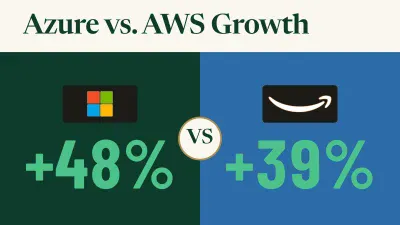
Microsoft (NASDAQ:MSFT | MSFT Price Prediction) and Amazon (NASDAQ:AMZN) reported earnings back to back, and cloud was the biggest story for both. Azure grew 48%. AWS grew 39%, its fastest pace in nearly five years. Both companies say demand still exceeds supply. That is good news for every rival that rents out computing power.
Azure Speeds Up While AWS Props Up a Soft Retail Quarter
Microsoft beat on both earnings and revenue. Non-GAAP EPS came in at $4.89 against $4.72 expected, its sixth beat in a row. Azure revenue reached $33.17 billion, and growth accelerated from 43% last quarter. Amy Hood, the CFO, credited the engineering teams: “Those efficiencies… they’re sort of ground out every week.” PCs are the weak spot. Windows OEM and Devices revenue fell 22%, and management expects a mid-30s decline next quarter.
Amazon missed estimates, with EPS of $1.89 against $1.96 expected. Prime Day moved into the second quarter and cut about 400 bps from retail growth, so the timing explains much of the miss. AWS operating income rose to $17.77 billion from $11.43 billion. CEO Andy Jassy was direct: “In AWS, our plan is working.”
| Business Driver | Microsoft | Amazon |
|---|---|---|
| Cloud Growth | Azure +48% | AWS +39% |
| Contracted Backlog | $677B RPO, +73% | $578B AWS backlog |
| Weak Spot | Windows OEM -22% | Online Stores +2% |
| AI Hook | Copilot, Foundry | Bedrock, Trainium |
Software Layers Versus Custom Silicon
Microsoft wants to earn money from every layer of a workload. Foundry revenue grew more than 3x, and agents now open more than one-third of GitHub pull requests. Software that writes software extends Microsoft’s revenue opportunity beyond raw compute. Satya Nadella describes customers switching between models freely: “I may start at the frontier. I may go to an open weight. I may go to an MAI model.”
Amazon is leaning on its own chips. Customers using its custom silicon saved more than $2 billion in the third quarter, and that cost advantage supports a 38.7% AWS margin. The expansion is expensive, though. Quarterly capex reached $77.26 billion, which caused a trailing free cash outflow of $42.4 billion.
Capacity Shortages Give Rivals a Reason to Cheer
Microsoft said some third-party GPU capacity deliveries slipped to the second half of the fiscal year. Amazon puts in an AI accelerator about every 14 seconds, and customers use that capacity almost as fast as it goes in. When the two biggest clouds cannot build fast enough, extra demand flows to Alphabet (NASDAQ:GOOGL), Oracle (NYSE:ORCL) and smaller AI-focused clouds. One thing to watch is whether Azure hits its 49% to 50% constant-currency growth guidance. I also want to see whether spending in 2027 that runs significantly above $220 billion starts to squeeze AWS margins.
Free Cash Flow Separates Microsoft From Amazon
Microsoft’s cash generation stands out. It generated $18.6 billion of free cash flow while still spending heavily, and Copilot gives it a second growth engine on top of raw computing power. Amazon has the bigger long-range story, and Jassy’s call for AWS growth above 40% in both 2027 and 2028 sets a high bar. I want to see free cash flow turn positive before I trust that spending curve. Another thing to track is whether AWS margins hold up while capex keeps climbing.
Contact [email protected] for any questions or corrections.
Alex Sirois is a financial writer with experience spanning both retail and institutional investing. He has written for InvestorPlace and held roles at BNY Mellon and Bernstein, giving him a perspective that bridges Main Street portfolios and Wall Street analysis.
Alex holds an MBA from George Washington University and has built his career across multiple industries, including e-commerce, education, and translation — a breadth of experience that informs how he breaks down complex financial topics for everyday investors. His writing is conversational, actionable, and grounded in long-term, buy-and-hold investing principles.
At 247 Wall St., Alex focuses on delivering analysis that is both accessible and useful, with a clear emphasis on helping readers make more informed decisions with their money.