The Nasdaq 100 Is Now Officially in a Correction
A late-session reversal wiped out early gains and pushed the Nasdaq 100 past a threshold it had nearly touched days earlier, while chips cratered and most of the market quietly moved higher. What that split tells long-term QQQ holders about…

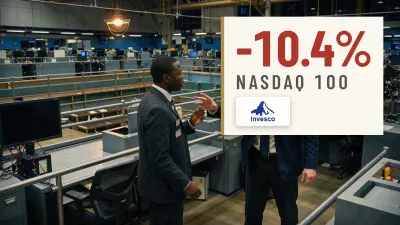
The Nasdaq 100 opened Monday, November 2, 2026, with a rally, with the major indexes up more than 1.1% at their highs. By the close, it had fallen more than 750 points from its intraday peak and finished down 1.39% at 27,989.82.
That close is 10.4% below the record close of 31,224.47 set on October 6. By convention, a correction means a close at least 10% below a record close. That line was 28,102.02, and the index closed 112 points below it, its lowest close since July 29.
The index reached that line only during the session on October 30, at 28,093.24, then closed at 28,384.85. That makes November 2 its first close in correction.
QQQ Sits Just Above Its 200-Day Average
Invesco QQQ Trust (NASDAQ:QQQ) closed at $681.09, down 1.36%, and was trading at $682.58 after hours. It has lost 6.14% since its $725.61 close on October 28 and stands 10.34% below its October 6 close of $759.66.
Its 200-day average is $679.82. That figure is the average close over the last 200 trading sessions, and it stands just under the fund’s November 2 low of $680.33. QQQ last traded at or below that average on April 7. It remains up roughly 10.9% from its $614.31 close at the end of 2025.
Chips and AI Spenders Led the Decline
Marvell Technology (NASDAQ:MRVL | MRVL Price Prediction) fell 13% after it announced an all-stock deal for an optical-component maker. The deal is valued at $115 billion including debt, and the target’s shares dropped 18.6%.
Oracle (NYSE:ORCL) fell almost 9% after it announced plans to sell $20 billion of debt and stock. Intel (NASDAQ:INTC) lost 8.8% after a 29% drop on October 30, and AMD (NASDAQ:AMD) fell 7.5%.
The Philadelphia Semiconductor Index fell 3.4% to its lowest close since April 29, which leaves it 29.4% below its June 22 record. The S&P 500 tech sector lost 2.66% after a 4.2% drop on October 30. Selling came amid doubt about whether AI spending will pay off.
Most of the Market Rose While Chips Fell
The Dow gained 0.41% to 51,983.98. The S&P 500 slid 0.51% to 7,541.40, its third straight drop and its lowest close since July 31.
Seven of eleven S&P 500 sectors rose. Consumer discretionary, materials, financials and consumer staples led, and the equal-weight S&P 500 gained 0.73%. Energy fell 3.97% as WTI crude dropped 7.3% to $96.51 on hopes for US-Iran peace talks.
Money left chips and went into cyclical stocks and banks, which points to rotation between sectors within the stock market. Investors who want out of stocks entirely usually sell nearly everything. Lower oil could also ease inflation.
Earlier 2026 Corrections Ended in Records
The index also closed in correction on March 27, at 23,132.77, and on July 29, at 27,192.31. New records followed both times, and the index is still up about 11% for 2026.
Past rebounds offer limited guidance on what comes next. AMD reports after the close on November 3, the day of the midterm elections. Treasury’s quarterly refunding announcement follows on November 4, the October jobs report comes out on November 6, and QQQ’s largest holding reports on November 17.
What the Correction Means for QQQ Investors
QQQ’s recent history offers some context for long-horizon investors. The selling has been concentrated in chips and AI names while most of the market rose, and both earlier 2026 corrections ended in new records. Riding out a mania without giving back the gains is its own skill, and we laid out both sides, staying in and knowing when to step aside, in a free bubble survivor’s handbook.
Concentration is the main risk. QQQ weights its holdings by market value, so it falls hard when its biggest holdings drop together, and the November calendar could extend the decline.
Investors concerned about tech concentration can research equal-weight S&P 500 funds as a point of comparison. That index gives every company the same weight, and it gained 0.73% on a day QQQ fell.
After the November 6 jobs report, check QQQ against its 200-day average of $679.82. A close below that level would suggest the selling has spread beyond chip stocks, and it would hurt the case for a quick recovery.
Contact [email protected] for any questions or corrections.
Omor Ibne Ehsan is a writer at 24/7 Wall St. He is a self-taught investor with a focus on growth, cyclical, and dividend equities that have strong fundamentals, value, and long-term potential. He also has an interest in high-risk, high-reward investments such as penny stocks.