3 Dividend Aristocrats With the Most Room to Keep Raising Their Dividends
Some S&P 500 Dividend Aristocrats raise their payouts every year mostly out of habit, but a few have payout ratios so low that a rough recession barely threatens the next increase. Three names on the roster stand out for the…

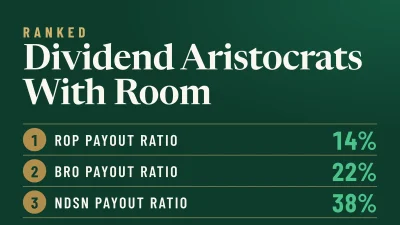
A payout ratio is the share of a company’s profit, or its free cash flow, that goes out as dividends. A low ratio works as a cushion. Earnings can fall hard in a recession and the dividend still gets paid out of what is left, and in good years the board can raise the check without stressing the business. Three S&P 500 Dividend Aristocrats have long records of annual increases and payout ratios low enough to fund plenty more: Roper Technologies (NASDAQ:ROP | ROP Price Prediction), Brown & Brown (NYSE:BRO) and Nordson (NASDAQ:NDSN). Roper’s forward dividend takes only about 14% of trailing earnings per share. All three start with modest yields. What income investors get is a dividend with a lot of room to keep growing.
Roper Technologies: A Software Cash Machine Paying Out a Sliver of Earnings
Roper pays $0.91 per share each quarter, or $3.64 a year. With shares at $484.02, that works out to a yield of about 0.75%. The yield is small. The buffer behind it is very large.
Dividend safety. The annual dividend uses roughly 14% of trailing diluted EPS of $25.27. Against management’s raised adjusted EPS guidance floor of $22.35 to $22.40, the ratio is about 16%. Cash coverage is even higher. Third-quarter free cash flow came to $805 million, or 37% of revenue, and that quarter’s dividend used only about 11% of it. Management expects full-year free cash flow of 30% or more of revenue. Net debt to EBITDA fell to 2.9x. Roper had $1.3 billion drawn on a $3.5 billion revolver and expects about $600 million of pretax proceeds from selling Indicor’s remaining flow-controls businesses.
Track record. Roper is a current holding in an ETF that tracks the S&P 500 Dividend Aristocrats. Its dividend history shows a higher payout every year back to 1999, when the quarterly rate was $0.065. The latest increase took the payout from $0.825 to $0.91, a raise of about 10%.
Bull case. Most of Roper’s revenue repeats every year. Organic recurring revenue grew 8% across its two software segments, and enterprise software gross retention held in the mid-90s. Third-quarter adjusted EPS of $5.89 beat the $5.79 estimate. Its chief executive, Neil Hunn, said capital will go where it compounds best: "We will pursue the opportunities that offer the most attractive, durable, long-term cash-flow-per-share compounding, whether through acquisitions or opportunistic share repurchases." The shares trade at about 19 times forward earnings.
Risk. Borrowing costs are rising. Buybacks totaled $2.7267B over the first nine months, partly funded with debt, and quarterly interest expense rose to $111M from $79M.
Brown & Brown: 33 Straight Years of Raises on a Fee-Based Model
Brown & Brown just raised its quarterly dividend to $0.18 from $0.165. The annual rate is now $0.72, a forward yield of about 1.02% at a share price of $70.92.
Dividend safety. The new annual rate equals about 22% of trailing diluted EPS of $3.26. Cash flow tells the same story. The broker generated $1.1 billion of cash flow from operations over the first nine months, up 13%. Three quarters of dividends at the old rate used roughly 15% of that. Long-term debt rose to $7.3B after the Accession deal, set against $1.099B of cash and $12.6B of equity. Management said it "has not seriously considered the idea of a leveraged stock buyback" and is balancing repurchases with paying down debt.
Track record. The chief executive, Powell Brown, put the run on the record: "Our board of directors raised our dividend by 9%, which represents an increase for the 33rd year in a row." The dividend history backs this up, with the quarterly rate climbing from $0.0925 in 2021 to $0.18 now. Brown & Brown is also among the current members of the S&P 500 Dividend Aristocrats.
Bull case. Accession is starting to pay off. Expected 2026 EBITDAC synergies went up to about $50 million, and run-rate synergies by the end of 2028 rose to $175 million. Early 2027 guidance calls for Retail organic growth of 2%-4% and Specialty Distribution growth of 1%-3%. The stock is down 10.34% year to date and trades at about 14 times forward earnings, compared with 22 times trailing.
Risk. Organic growth has stalled. It was just 1.2% last quarter, and management guided Specialty Distribution to a decline of 2%-4% in the fourth quarter as catastrophe property rates fall.
Nordson: A Double-Digit Raise Backed by Cash Conversion Above 100%
Nordson lifted its quarterly dividend to $0.94 from $0.82, an increase of about 14.6%. The annual rate is $3.76, a forward yield of about 1.13% at $331.73. It gives the highest starting yield of the three.
Dividend safety. The new annual rate is about 38% of trailing diluted EPS of $9.88, a figure pulled down by a noncash loss on a minority investment. Against adjusted EPS guidance at its floor of $11.80–$12.00, it is about 32%. Free cash flow was $237 million in the fiscal third quarter, or 144% of net income, excluding the noncash loss. That made it the fifth consecutive quarter above 100% conversion. The quarterly dividend used roughly 19% of that cash. Leverage dropped to 1.7x on net debt of about $1.6 billion, and total liabilities fell 11.53% year over year.
Track record. Nordson is among the current members of the S&P 500 Dividend Aristocrats. Its dividend history shows a higher quarterly rate every year since 2012, when it was at $0.125. So far this fiscal year, Nordson has paid $137 million in dividends and bought back $159 million of stock.
Bull case. Demand is strong. Third-quarter revenue of $817.67M beat estimates, organic sales grew 12% and backlog rose 35% year over year. About 60% of the portfolio earns recurring revenue from parts, consumables and services. Chief executive Sundaram Nagarajan called conversion "a strength, enabling a healthy mix of shareholder returns and reinvestment in growth."
Risk. Much of the recent growth comes from cyclical electronics demand. Advanced Technology Solutions grew 31% organically, and that kind of semiconductor-driven spending can reverse quickly when chip capex slows.
Low Payout Ratios Keep the Raises Coming
Roper pays out the smallest share of earnings, Brown & Brown has the longest verified run at 33 years, and Nordson pairs the biggest latest raise with the highest yield of the group. Each pays its dividend from a fraction of the cash it brings in. They can keep raising even if a downturn hits profits. For income investors focused on how fast the dividend can grow, these three have the most room on the Aristocrats roster.
Contact [email protected] for any questions or corrections.
Lee Jackson has covered Wall Street analysts' equity and debt research and equity strategy daily for 24/7 Wall St. since 2012. His broad, diverse career, including a stint as creative services director at an NBC affiliate in Austin, Texas, gives him unique insight into the financial industry.
Lee Jackson's journey in the financial industry spans more than 30 years, including nearly two decades as an institutional equity salesperson at Bear Stearns, Lehman Brothers, and Morgan Stanley. His career spanned pivotal sell-side Wall Street events, from the dot-com rise and bubble to the Long-Term Capital Management debacle, 9/11, and the Great Recession of 2008. This reflects his resilience and adaptability amid market volatility.
Lee Jackson’s practical financial industry experience, gained through a career at some of the biggest banks and brokerage firms, is complemented by a lifetime of writing across various platforms. This unique combination allows him to shed light on the intricacies of Wall Street in a way only someone with deep insider experience and knowledge can. Moreover, his extensive network across Wall Street continues to provide direct access for him and 24/7 Wall St., a privilege few firms enjoy.
Since 2012, Jackson’s work for 24/7 Wall St. has been featured in Barron’s, Yahoo Finance, MarketWatch, Business Insider, TradingView, Real Money, The Street, Seeking Alpha, Benzinga, and other media outlets. He attended the prestigious Cranbrook Schools in Bloomfield Hills, Michigan, and has a degree in broadcasting from the Specs Howard School of Media Arts.