Rate Hikes Could Be Coming: History Likes These 4 Dividend Stocks
Traders now price an 80% chance the Fed hikes again in December, and Treasuries yield more than every dividend stock on this list. Four income names have a record of thriving through tightening cycles, but each carries a risk worth…

This post may contain links from our sponsors and affiliates, and Flywheel Publishing may receive compensation for actions taken through them.
Although markets have enjoyed a strong run, with the benchmark S&P 500 up 12.45% year to date, the rate background has turned against income investors. Rate-setters raised rates at its September meeting, leaving the upper bound of the federal funds target at 4.00%. On Kalshi, a quarter-point hike at the December 9, 2026 meeting is priced at 80%, against 22% for a hold. But rising rates tend to rattle dividend stocks, because Treasuries and savings accounts start competing for the same income dollars. The 10-year Treasury yield is now at 4.95%, above the yield on every stock below.
History Rewards Dividend Growers When the Fed Tightens
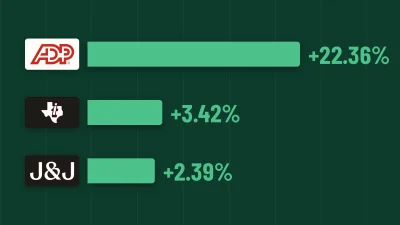
The stocks that hold up typically share three traits: rising payouts, earnings that cover those payouts, and cash flow that funds buybacks too. During the last hiking cycle, from March 16, 2022, to July 26, 2023, all four names here finished higher. Automatic Data Processing (NASDAQ:ADP | ADP Price Prediction) jumped 22.36%, Texas Instruments (NASDAQ:TXN) gained 3.42%, Johnson & Johnson (NYSE:JNJ) rose 2.39%, and Cisco Systems (NASDAQ:CSCO) held flat at 0.04%. Each also raised its dividend during that span and during the 2015 to 2018 cycle. We highlighted income plays ahead of September’s Fed meeting, and the case for dividend growth has only strengthened since.
ADP: Higher Rates Pad the Float
ADP pays $6.80 annually, a 2.24% yield at $304.02. Its $1.70 quarterly payout takes about 60% of fiscal Q1 2027 adjusted EPS of $2.82. Higher rates directly help: interest on client funds jumped 15% to $329.3 million as average balances grew to $36.9 billion. Management lifted fiscal 2027 adjusted EPS growth guidance to 10% to 12%. The quarterly dividend climbed from $1.04 to $1.25 across 2022, and from $0.63 to $0.79 during 2018. Risk: that float boost reverses once the Fed cuts, and payroll volumes track hiring.
Cisco Systems: AI Orders Fund the Payout
Cisco yields 1.63%, and its $1.66 trailing dividend equals about 50% of trailing EPS of $3.33. Against the low end of fiscal 2027 guidance of $5.05, coverage tightens to 33%. Fiscal 2026 net income rose 30.3% to $13.27 billion while AI orders reached $9.3 billion. The quarterly dividend stepped from $0.19 in 2015 to $0.33 by 2018, then from $0.37 to $0.39 through 2022 and 2023. Shares trade at 19 times forward earnings versus 31 trailing. Risk: the stock has slid from $112.82 on October 5 to $100.98 as AI expectations reset.
Texas Instruments: A Raise Delivered Into Higher Rates
Texas Instruments lifted its quarterly dividend to $1.52 from $1.42, a 7.04% increase, and yields 1.88%. Its trailing dividend takes up about 74% of EPS, but trailing free cash flow of $8.4 billion funded $5.8 billion in shareholder returns. The payout climbed from $0.02125 in early 2004 to $0.04 by late 2006, from $0.34 to $0.62 across 2015 to 2018, and to $1.24 in October 2022. Shares fetch 27 times forward earnings versus 41 trailing. Risk: a beta of 1.388 and an 81.06% year-to-date gain leave little room for a cyclical stumble.
Johnson & Johnson: 64 Years of Raises
Johnson & Johnson has raised its dividend for 64 consecutive years, most recently by 3.1% to $1.34 quarterly, putting it in rare company (we ranked ten of these 50-plus-year growers by valuation in a free Dividend Kings report). It yields 1.95%, and the $5.36 forward payout equals about 46% of the low end of 2026 adjusted EPS guidance of $11.60. A beta of 0.2 and oncology growth of 17.3% anchor the defense. The dividend rose from $0.75 in 2015 to $0.90 in 2018, and from $1.06 in 2022 to $1.19 in 2023. Shares trade at 23 times forward earnings. Risk: STELARA sales sank 55.2% on biosimilar competition, and GAAP payout coverage runs near 80%.
What to Watch Before the December 9 Meeting
First, keep an eye on the Kalshi hike probabilities; a sharp move from 80% would reprice every income stock. Second, the 10-year yield has swung between 4.63% and 5.31% since August, and a push back toward the high end would strengthened competition from bonds. Third, Texas Instruments guided fourth-quarter revenue to $5.80 billion to $6.30 billion, an early read on industrial demand under tighter money. The question is whether these four keep lifting payouts if borrowing costs climb.
Dividend growers with well-covered payouts have historically compounded through tightening cycles. Over the past decade, Texas Instruments returned 496.05% and Cisco 348.02%, spanning two hiking cycles. If rates climb again, the record favors companies that keep raising dividends over high yields with thin coverage.
Contact [email protected] for any questions or corrections.
Lee Jackson has covered Wall Street analysts' equity and debt research and equity strategy daily for 24/7 Wall St. since 2012. His broad, diverse career, including a stint as creative services director at an NBC affiliate in Austin, Texas, gives him unique insight into the financial industry.
Lee Jackson's journey in the financial industry spans more than 30 years, including nearly two decades as an institutional equity salesperson at Bear Stearns, Lehman Brothers, and Morgan Stanley. His career spanned pivotal sell-side Wall Street events, from the dot-com rise and bubble to the Long-Term Capital Management debacle, 9/11, and the Great Recession of 2008. This reflects his resilience and adaptability amid market volatility.
Lee Jackson’s practical financial industry experience, gained through a career at some of the biggest banks and brokerage firms, is complemented by a lifetime of writing across various platforms. This unique combination allows him to shed light on the intricacies of Wall Street in a way only someone with deep insider experience and knowledge can. Moreover, his extensive network across Wall Street continues to provide direct access for him and 24/7 Wall St., a privilege few firms enjoy.
Since 2012, Jackson’s work for 24/7 Wall St. has been featured in Barron’s, Yahoo Finance, MarketWatch, Business Insider, TradingView, Real Money, The Street, Seeking Alpha, Benzinga, and other media outlets. He attended the prestigious Cranbrook Schools in Bloomfield Hills, Michigan, and has a degree in broadcasting from the Specs Howard School of Media Arts.