The Chip Shortage Is Back, and Microchip Says AI Customers Are Crowding Everyone Out
Microchip beat its own forecast, yet the stock still got hammered. The CEO says AI buyers swept through supplier factories and shoved everyone else aside, and one fix could take six months. Is this a lasting problem or a timing…

Microchip Technology (NASDAQ:MCHP | MCHP Price Prediction) shipped more in the September quarter than it had forecast. Then, on November 5, 2026, it told investors it could have shipped more if AI buyers had not filled its suppliers’ factories. CEO, Chair and President Steve Sanghi said shortages are back in parts of the chip supply chain and that AI companies “came in and took over the whole factory. They pushed everybody out.”
The stock fell 10.02% to $58.35 on Friday, November 6, 2026, which leaves a market value of about $31.68 billion. It had already dropped 13.92% on Thursday during a sector-wide chip selloff, before the report came out. From the $75.34 close on November 4, shares are down 22.55%. The 52-week range runs from $48.52 to $105.91.
One-Time Items Inflated the September Quarter
Net sales came in at $1.622 billion, above the top of guidance. That was up 9.2% from the prior quarter and 42.2% from a year earlier. Non-GAAP EPS was $0.97, but GAAP EPS, which follows standard accounting rules and keeps costs the adjusted figure leaves out, was only $0.68. That GAAP number also included a 13-cent-per-share tax benefit.
CFO Eric Bjornholt said about $53 million of sales came from items that will not repeat, and all of it carried a 100% gross margin. The pieces were about $21 million from a price change on distributor inventory, $22 million of extra patent licensing, and $10 million from a customer contract. Those items helped push non-GAAP gross margin to 66.5%, which explains the December guidance step-down.

Longer Lead Times Push Revenue Into Later Quarters
Lead time is how long a customer waits between placing an order and receiving the parts. Sanghi said standard products that used to ship in four to eight weeks now take six to 32 weeks.
Customers who order further ahead add to backlog. Orders placed inside the new lead times often go unfilled, though, so that revenue moves into a later quarter. The book-to-bill ratio (orders received divided by shipments) stayed well above one, and Microchip started the December quarter with more backlog than it had going into September.
AI Is Taking the Factory Capacity Microchip Needs
The shortage is in factory capacity. Data center buyers have taken packaging and test lines at outside assembly and test houses (OSATs). Some substrates are unavailable, and trailing-edge capacity is tight. Microchip’s own customers still want more parts than it can supply.
Moving that work in-house or to other suppliers takes about six months. That is why Sanghi said, “some deceleration of the AI demand actually would be quite positive early on.”
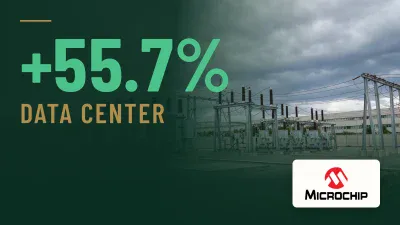
Microchip also makes money from AI. Its data center business topped $250 million in the quarter, rose 55.7% from a year earlier and is on track for $1 billion in calendar 2026.
December Guidance Comes Down While Supplier Costs Go Up
Guidance calls for December net sales of $1.573 billion to $1.638 billion, non-GAAP gross margin of 64% to 65% and non-GAAP EPS of $0.87 to $0.95. At the midpoint, sales would still be up 35.4% from a year earlier.
Sanghi said most major foundries and OSATs will raise prices again starting around January. Microchip plans to absorb those increases for now, but it could raise customer prices again if costs keep climbing.
Analysts Slash MCHP Price Targets but Stay Above Friday’s Close
Truist cut its price target to $62 from $90, and Raymond James cut to $80 from $125. Citi moved to $75 from $95, and JPMorgan to $100 from $120. Every one of the lowered targets is still above Friday’s price.


The pressure on Microchip looks temporary. Backlog keeps rising, and some high-margin orders that slipped are now scheduled for the March quarter. Sanghi also said March-quarter backlog is better than December’s was at the same point in the quarter. Meanwhile, the board declared a quarterly dividend of 45.5 cents per share, due December 8 to holders of record on November 23.
The key is the March-quarter guidance in Microchip’s next earnings report: if it shows the delayed backlog becoming revenue, the case for temporary pressure holds. If it does not, the margin damage is likely to last longer.
Contact [email protected] for any questions or corrections.
Omor Ibne Ehsan is a writer at 24/7 Wall St. He is a self-taught investor with a focus on growth, cyclical, and dividend equities that have strong fundamentals, value, and long-term potential. He also has an interest in high-risk, high-reward investments such as penny stocks.