ASML Says Its Customers Want More Machines Than It Can Build Through 2028
ASML is the only company on earth that builds the machines chipmakers need for advanced semiconductors, and it just told customers it cannot keep up with their orders. What that supply crunch means for chip prices, AI timelines, and the…

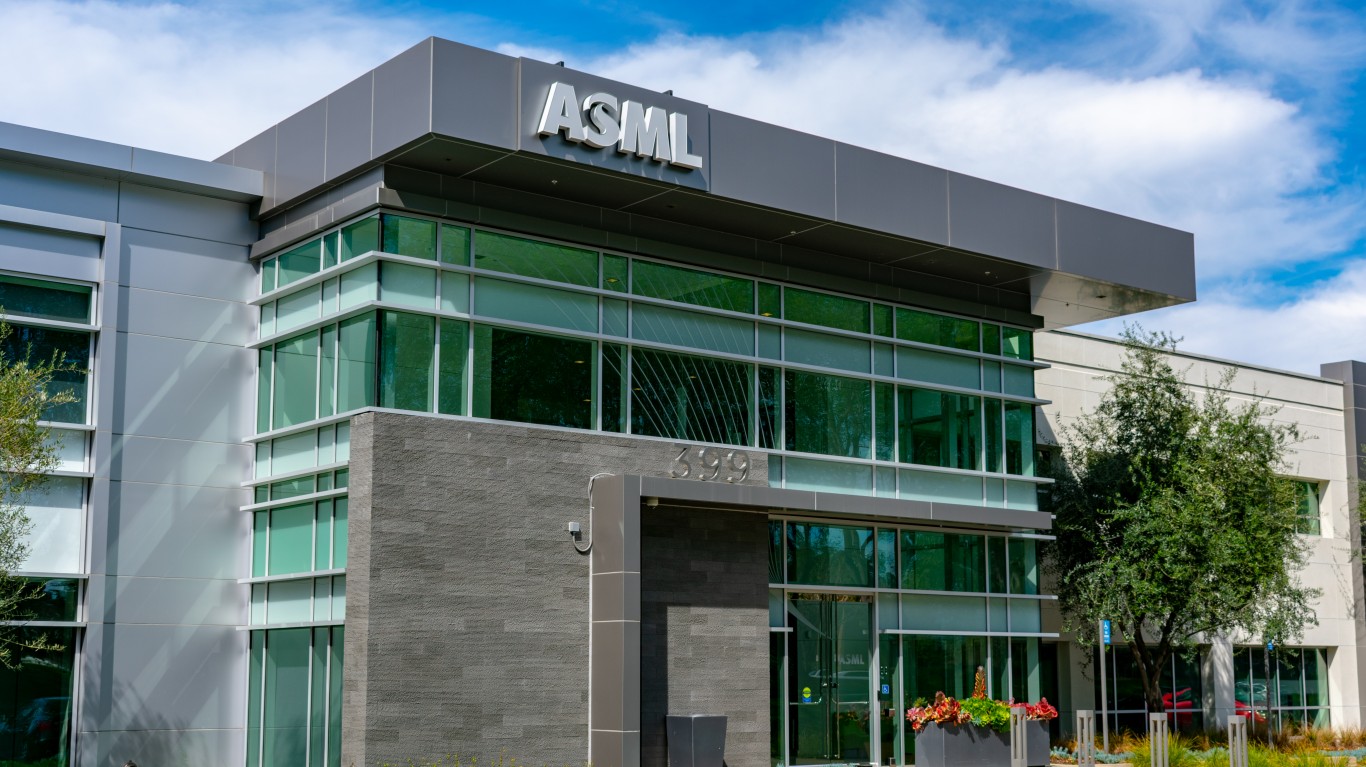
At 1:00 a.m. Eastern on October 14, 2026, ASML (NASDAQ:ASML | ASML Price Prediction) said it cannot build enough lithography machines for its customers in 2027 or 2028. ASML is the only supplier of EUV lithography machines. EUV stands for extreme ultraviolet, and these systems print the finest circuits on advanced chips.
Chief executive Christophe Fouquet wrote that “we now expect that our supply as currently planned for both 2027 and 2028 will not fully meet the demand of our customers.” He added that “some customers are expressing an interest in placing orders with us for 2029 and even 2030.”
No regular session had traded on the results when they came out. The US-listed shares closed at $1,717.76 on October 13, down 1.86%, and traded at $1,705.00 after hours. The stock is up 61.35% year to date but down 6.34% over the past week.

What ASML Committed To Versus What It Is Only Studying
The firm commitment is a 30% capacity increase for 2027 in low NA EUV and DUV immersion. DUV immersion machines are older deep ultraviolet tools used on less critical chip layers. A further 30% for 2028 is still only under investigation, and ASML is now studying ways to go past it.
Customer interest in 2029 and 2030 orders has not yet turned into firm orders. The release gives no bookings figure, so none of it should be counted as backlog.
Fouquet called the quarter “a record total net sales of €11.7 billion, towards the high end of our guidance.” Compared with the prior quarter, gross margin rose to 57.5% from 54.0%, earnings per share climbed to €12.95 from €7.59, and new systems sold rose to 113 from 86. Fourth-quarter guidance of €14.2 billion to €15.2 billion at around 57% gross margin indicates the demand is already reflected in the numbers.

Why a Shortage Gives ASML Pricing Power
A customer that cannot get an EUV machine has no second supplier to turn to. So a shortfall shows up as longer queues, firmer pricing, and a richer product mix. In July, management said the environment “gives us flexibility on pricing more so than what you would have seen in the past.”
On October 13, Applied Materials (NASDAQ:AMAT) fell 6.69%, Lam Research (NASDAQ:LRCX) dropped 2.73%, and KLA (NASDAQ:KLAC) slipped 3.22%. Applied’s drop was attributed to profit-taking after an 80% gain this year. All three sell deposition, etch, and inspection tools into the same factory expansion, so the selloff looks like position-trimming and says little about demand.

Risks Still Sitting Under the Demand Story
Export restrictions remain a risk in China, which ASML expected to make up around 20% of 2026 sales, and orders are concentrated among a handful of leading-edge chipmakers. Memory spending is cyclical, and memory system sales were expected to grow over 75% in 2026, so ASML could be adding capacity just as demand tops.
ASML bought back about €4.1 billion of stock in the quarter and declared a €1.88 interim dividend payable November 4. That is a sound use of cash, because management said the 2027 and 2028 increases come from existing clean-room space, with a new campus aimed at capacity beyond 2028. The whole shortage traces back to the AI data-center expansion, and the suppliers riding that wave go well beyond the chipmakers themselves (we covered seven of them, from power to cooling, in a free report you can grab here).
What Will Decide Whether ASML’s Shortage Becomes Lasting Growth
The shares trade at $1,717.76, below the $1,999.96 52-week high, and full-year guidance calls for €44 billion to €45 billion in sales at around 56% gross margin. The 9:00 a.m. Eastern call on October 14 comes next. It should show whether the 2028 increase beyond 30% approaches a firm commitment.
The bigger tests are fourth-quarter sales of at least €14.2 billion and a committed 2028 plan by the June 10, 2027 Capital Markets Day. If 2028 is still under investigation by then, the demand signals have weakened.
Contact [email protected] for any questions or corrections.
Omor Ibne Ehsan is a writer at 24/7 Wall St. He is a self-taught investor with a focus on growth, cyclical, and dividend equities that have strong fundamentals, value, and long-term potential. He also has an interest in high-risk, high-reward investments such as penny stocks.