His $1.4 Million Portfolio Is 70% Tech After a Decade of Gains, and at 66 He Won’t Let His Adviser Sell a Share. Waiting Until 70 Gives Him a $3,968 Monthly Social Security Benefit a Stock-Market Crash Cannot Cut

This post may contain links from our sponsors and affiliates, and Flywheel Publishing may receive compensation for actions taken through them.
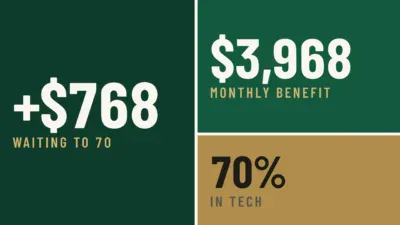
Picture a 66-year-old with $1.4 million invested, 70% of it in tech after a decade of gains. That works out to $980,000 in one sector. His adviser wants to cut back. He refuses, because those shares built his wealth and selling feels like benching the players who won the title.
Plenty of retirees feel the same loyalty to the stocks that made them money.
Social Security plays a central role here because nothing else in his plan is so completely cut off from the stock market.
Waiting Until 70 Adds $768 a Month for Life
Assume his benefit at a full retirement age (FRA) of 67 is $3,200 a month. Every year he waits past that point makes the check 8% larger.
If he claims at 70, he collects $3,968 a month, or $47,616 a year before any future inflation adjustments.
Compared with claiming at 67, that’s $768 more each month, or $9,216 a year, for as long as he lives. Inflation raises are applied to the bigger base, and the 2027 increase is 3.6%.
Now consider a crash. If his tech holdings alone fell 40%, he would lose $392,000. His monthly benefit from the government would stay exactly where it was. The program’s risk is political.
According to the trustees’ most recent report, the combined trust funds can pay 83%[1] of scheduled benefits after 2034 unless Congress acts. That decision is up to lawmakers. Stock prices have nothing to do with it.
Paying for the Four-Year Wait Without Forced Sales
Waiting has a cost: he has to live on the portfolio for four years. If he draws roughly what his benefit would pay at age 70, that adds up to about $190,464.
This is where all that tech becomes dangerous. Suppose the downturn comes in his first year without a paycheck and his living expenses have to come from tech shares. He would be selling near the bottom, and those shares would no longer be around for the recovery. Planners call this sequence risk. A bad first few years does more lasting damage than the same losses ten years later.
He already has the fix. About $420,000 of his money sits outside tech. If he sets aside roughly four years of spending in cash, Treasuries, or short-term bonds, the wait is paid for no matter what the sector does. He keeps most of his winners. They just stop being his grocery money.
Why Trimming Now Can Cost Less in Taxes
The years between retiring and claiming at 70 are often a retiree’s lowest-income years, and that helps if he does sell. For 2026, long-term capital gains are taxed at 0% for married couples with taxable income up to $98,900, or $49,450 for those filing alone. These shares are in a taxable account, and a few years of planned sales could fill that bracket cheaply.
Spreading the sales out also protects his Medicare costs. In 2027, the standard Part B premium is $209.40[2] a month. Joint income above $224,000[2] pushes it to $293.10, and the higher income levels cost more. One big sale can raise his premiums two years later. A steady trim usually keeps them at the standard rate.
Timing matters for another reason. Once his checks start at 70, extra income can make up to 85% of his benefit taxable. That makes the years before he claims the cheaper time to sell.
What Deserves His Attention Before Anything Else
- Fund the gap first. Waiting until 70 only works if those four years are already paid for. Once the bridge money is set aside, he can leave his tech shares alone through a downturn and treat them as long-term growth money instead of a paycheck.
- Forced selling is the hardest mistake to undo. He can recover from a missed rally. Shares sold at the bottom to pay the mortgage can’t be bought back at that price. Moving only enough to cover four years lets him keep his convictions and hold onto the larger government payout too.
A spouse’s survivor benefit, health, and cost basis could all change the best order of steps. It’s worth walking through his own numbers before he commits to a plan.
Contact [email protected] for any questions or corrections.
Gerelyn Terzo is the author of dividend investing handbook "Dividend Investing Strategies: How to Have Your Cake & Eat It Too." A veteran financial journalist, she covers agri-finance for outlets like Global AgInvesting and the broader stock market and personal finance for 24/7 Wall Street. She began at CNBC and later helped launch Fox Business in New York. Gerelyn currently resides in Woodland Park, Colorado and dabbles in nature photography as a hobby.