David Sacks Warns the AI Data Center Pipeline Could Dry Up. Here’s What’s at Stake
A permitting fight could stall the buildings that every AI chip, cable, and cooling system needs. While chip stocks sank in a single month, one corner of the market barely flinched. Which suppliers are exposed, and who collects rent either…

This post may contain links from our sponsors and affiliates, and Flywheel Publishing may receive compensation for actions taken through them.
David Sacks thinks the AI data center boom could run out of road within about two years. On the All-In podcast episode released November 7, which covered the midterm elections, the AI selloff, and what the hosts called a data center freeze, David Sacks said: “Nobody can make a $50 billion investment in conditions of uncertainty. I think by 2028 the pipeline will be closed or significantly reduced.”
His argument rests on permitting. Sacks said the biggest danger is breaking ground and then, halfway through, getting “enjoined” or stopped by a worker strike or a community group. According to Sacks, governors in the largest data center states are “basically indicating that they favor a moratorium” until certain conditions are met.
Why a Permitting Freeze Reaches Every Supplier
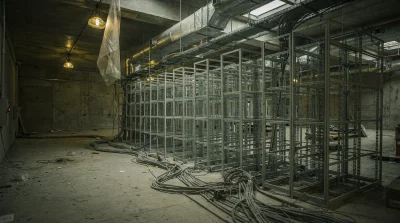
A data center needs land, power, and a finished building before a single chip goes in. Broadcom’s chief executive made the same point on the company’s September call: “Before you get the chips out there, you have to get the data center shell in place and ready for production.” If the buildings stall, chip, networking, and cooling orders slow down after them.
That dependency matters because each company in the chain is posting growth that assumes the expansion keeps going:
- The company, NVIDIA (NASDAQ:NVDA | NVDA Price Prediction), reported Data Center revenue of $89.02B, up 117%, guided next quarter to $108.0B +/- 2%, and disclosed supply obligations of $279.00B in its latest earnings release filed with the SEC.
- Broadcom (NASDAQ:AVGO) sees fiscal 2028 AI semiconductor revenue reaching $230 billion. That target falls inside Sacks’s 2028 window.
- Arista Networks (NYSE:ANET) grew revenue 58.5% and guided Q4 to $3.9B-$4.0B. It also disclosed that a limited number of large customers drive much of that revenue.
- Vertiv (NYSE:VRT) reported organic orders up over 100%, and customers typically order 12 to 18 months ahead.
The power, cooling, and networking names behind the data center buildings are a trade of their own, and we pulled together seven of them in a free report on the AI suppliers that aren’t chipmakers.
Landlords Held Up While Chip Stocks Fell
Over the month ending November 6, NVIDIA fell 21.4%, Broadcom 22%, Arista 20.86% and Vertiv 25.81%. Over the same month, Equinix (NASDAQ:EQIX) slipped only 1.85% and Digital Realty 3.47%.
One explanation is that a freeze could help companies that already own permitted, powered sites. Equinix’s chief executive said, “If there are a number of projects canceled, then it only makes what is already scarce capacity much more of a scarce resource.” She added that across its 3 gigawatts of planned capacity, “the land, power and permitting are largely secured.” Digital Realty has 1.5 gigawatts under construction, 63% pre-leased, and a record $2.5 billion backlog that gives it visibility through 2027 and into 2028.
Counterpoint: Permitting Outcomes Remain Unsettled
Sacks’s view is a forecast. Proposed moratoriums can be narrowed, delayed, or dropped, and nobody knows yet how state policy will land. Vertiv’s chief executive called power, permitting, and labor pacing items that “are not slowing down growth.” NVIDIA expects fiscal 2028 revenue growth of approximately 70% and describes that outlook as limited by supply, with customer demand running higher. NVIDIA also cited top-five hyperscaler capex of nearly $800 billion in 2026 and $1.3 trillion in 2027.
What Retirement Investors Should Watch Next
Many people own this trade without picking a single stock. A major Nasdaq-100 index fund’s prospectus notes significant exposure to the information technology sector, so a slowdown in AI spending would show up in many 401(k) and IRA balances. Four signals stand out:
- State action: whether moratorium talk in the big data center states turns into passed rules or remains at the proposal stage.
- Guidance checks: NVIDIA’s results against its $108.0B guide, and Broadcom’s against expected Q4 AI revenue of $21.7B.
- Vertiv orders: customers order 12 to 18 months ahead, so a slowdown in orders would be one of the first signs that 2028 projects are being pushed back.
- REIT pre-leasing and pricing: rising rents at Equinix and Digital Realty would suggest that scarcity is helping the landlords even as new construction slows down.
If permitting tightens, investors with heavy index exposure to AI hardware should know which parts of the chain depend on new construction and which ones collect rent on capacity that is already built.
Contact [email protected] for any questions or corrections.
Chris Lange is a financial and geopolitical writer with more than a decade of experience covering a myriad of topics. He has published thousands of articles for 24/7 Wall St., with past coverage focused heavily on stocks, IPOs, healthcare, defense, global affairs, and technology.
His work has been quoted, or referenced by a number of outlets including Business Insider, USA Today, Yahoo Finance, MSN, The Motley Fool, and many other publications. A graduate of Southwestern University, he studied business with a focus on investments and has previous experience in banking and startups.
When not reading or writing the news, he is following his passion for Lacrosse, playing chess, or building solar projects with his dad.