Sara Eisen Went on Bill Maher and Said What Wall Street Will Not About the AI Race
When a CNBC anchor made the case for American AI dominance on a comedy show, she got the national security argument exactly right and the investment argument exactly backwards. Here is what the hyperscalers spending nearly two trillion dollars over…

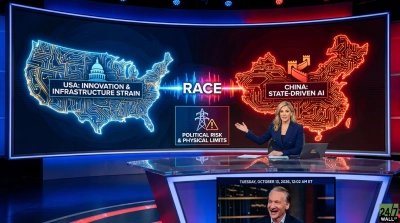
One of the clearest arguments for American AI this fall came on a late-night comedy show. CNBC anchor Sara Eisen made it while sitting beside Sen. Thom Tillis on HBO’s Real Time with Bill Maher. Where she said it matters, because the public fight over AI now plays out in front of voters, and investors mostly talk among themselves.
Her case was about competition with Beijing: “We do not want to not be on the side of progress. And we do not want to let China get ahead of us on this dangerous technology. We want to own it, and we want our best people doing it.”
The discussion passed over the money question underneath. The top five hyperscalers were expected to spend nearly $800 billion in 2026 and $1.3 trillion in 2027 on capital projects. That spending runs into local power grids, water systems and zoning boards. The political resistance is showing up faster than the revenue meant to pay for it.
Political Risk Now Sets the Timeline for AI Returns
Moratoriums and permitting fights decide where capacity gets built, how long it takes and what it costs, and when a project slips, its cash flows move further out, and discounting carries that delay straight into the share price. The timing gap already weighs on Amazon (NASDAQ:AMZN | AMZN Price Prediction). It said data center spending starts about two years before servers can earn money, and its trailing free cash flow is -$7.6 billion.
On a free cash flow basis, Alphabet (NASDAQ:GOOG, NASDAQ:GOOGL) posted -$5.86 billion after $44.92 billion of quarterly capex. It also paused buybacks.
Equinix (NASDAQ:EQIX) announces a project only after it has cleared internal checks on power, connection and permitting. Management credits that sequence for keeping builds on schedule.
Why the Backlash Crosses Party Lines
Residents object to power draw, water use and their electric bills far more than to the software. One north Denver campus was projected to use up to 805,000 gallons of water a day.
In the PJM region, the grid’s independent market monitor concluded that data center load growth is “the primary reason” for tight supply and high capacity prices. Because the complaint is about household costs, it shows up in red and blue states alike, and Maryland and California moved to set large-load rate rules, while Indiana and Idaho moved to speed up permitting.
Because a utility bill is concrete, this kind of complaint carries weight with voters.
A Race Justifies Spending Without Guaranteeing Returns
Eisen’s China argument holds up well on national security grounds. A rival that controlled frontier AI would carry military and economic costs that no government will accept. As an investment thesis it is weaker, because spending a country needs can still let down the companies doing it.
To back frontier labs that also buy its chips, NVIDIA (NASDAQ:NVDA) has invested nearly $50 billion. Management said “some will call this circular financing,” and its supply commitments rose to $279 billion.
Builders who call AI inevitable are probably right about deployment. Electricity was inevitable too, but much of its long-term value flowed to customers and later entrants rather than to the original builders.
Sentiment Starts to Bite When It Becomes Law
Institutional money sets prices, and it kept moving toward AI. Over the past year the S&P 500 rose 19.15%, and over six months software stocks gained 41.46%.
Investors paid most for physical infrastructure, expecting the expansion to keep requiring hardware, with Vertiv (NYSE:VRT) up 47.86% year to date, ahead of Equinix at 36.81% and NVIDIA at 21.64%. Public mood starts to move prices once it turns into statutes, permit denials or utility rate decisions. That shift also separates AI companies by their exposure to local politics.
Chip designers and model developers have little such exposure. Anything that requiring land, a grid connection and a permit carries a separate risk, and that includes Equinix’s 52 expansion projects. Most investors miss that part of the story. The power, cooling and networking suppliers behind those sites are why we pulled seven of them into a free report on the AI buildout beyond the chipmakers.
Which AI Stocks Carry the Least Permitting Risk
In the bull case, Microsoft (NASDAQ:MSFT) says demand still exceeds supply, and NVIDIA says it can fill only about 70% of orders.
The bear case rests on concentration, heavy spending with no visible return at Alphabet and Amazon, and growing permitting friction. NVIDIA also starts from a value of roughly $5.46 trillion.
All things considered, the AI stocks with the least permitting exposure sit in the layer that zoning boards can least affect. That layer includes NVIDIA, plus Microsoft, which expects to stay free cash flow positive even with FY27 capex near $175 billion.
Vertiv raised its revenue guidance to $13.8 to $14.2 billion. Its gains so far, though, assume permits keep coming through on time.
Contact [email protected] for any questions or corrections.
Omor Ibne Ehsan is a writer at 24/7 Wall St. He is a self-taught investor with a focus on growth, cyclical, and dividend equities that have strong fundamentals, value, and long-term potential. He also has an interest in high-risk, high-reward investments such as penny stocks.