In March 2000, Cisco Briefly Became The World’s Most Valuable Company As Its Stock Closed At $80.06. Buyers That Day Waited More Than 25 Years For It To Close Higher. Here’s What AI Investors Need To Know
Cisco was the best business in the world at its peak, and its company kept growing for decades. So why did some of its shareholders lose a generation? The answer could decide how today's AI leaders treat your portfolio.

This post may contain links from our sponsors and affiliates, and Flywheel Publishing may receive compensation for actions taken through them.
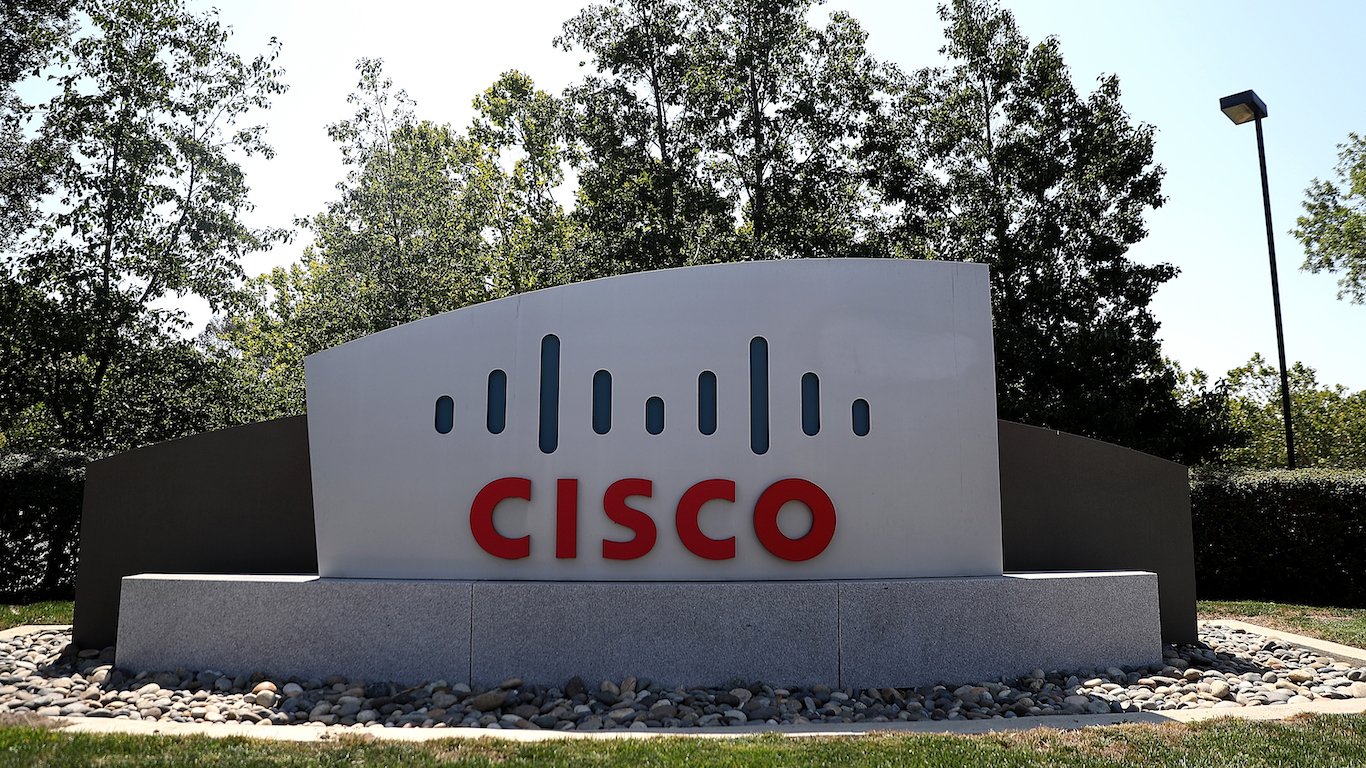
Although Cisco Systems (NASDAQ:CSCO | CSCO Price Prediction) has spent 2026 riding a fresh wave of AI networking orders, Wall Street still measures the company against one trading day from the dot-com era. At the close on Monday, March 27, 2000, the Associated Press reported, Cisco had a market value of $555.5 billion on basic shares. That inched past Microsoft (NASDAQ:MSFT) at $541.6 billion and made Cisco the world’s most valuable company. Sherwood News reporter Matt Phillips put Cisco’s dot-com closing high at $80.06. But buyers who paid that price waited more than 25 years for a higher close, Matt Phillips found. That history matters again now, because the biggest tech selloff in years has shaken the AI companies that hold Cisco’s old crown.
How Cisco Got Priced for Perfection
Cisco sold the picks and shovels of the internet boom. Its routers and switches carried the traffic of the dot-com expansion, and Matt Phillips reported that its stock vaulted roughly 4,000% from the end of 1994 to March 2000. By the peak, investors were paying in advance for decades of perfect growth. Per the Financial Times, as summed up by Slashdot, Cisco traded at a price-to-earnings ratio above 200 and an enterprise value-to-sales ratio of 31.
A Collapse That Took a Generation to Repair
When the technology-packed Nasdaq Composite came apart, Cisco went down with it. From the March 27, 2000 close to the Oct. 11, 2002 close, the shares fell 87.11%. MarketBeat puts the low at $10.32 on that October day, and a buyer at the bottom needed a 676.3% gain just to get back to the peak close. Bloomberg, as summed up by Insider Monkey, reported that Cisco lost approximately 90% of its market value and sank to around $60 billion in late 2002.
Getting back took a generation. Matt Phillips reported that Cisco finally set a new closing high on Dec. 10, 2025, and Bloomberg via Insider Monkey put the stock at $80.25 that day. The FT, via Slashdot, said the trip back lasted 25 years, eight months and 13 days.
What a Flat Share Price Hides
Cisco paid no dividend until 2011, when it paid its first quarterly dividend of $0.06 a share on April 20, 2011, per Cisco. Top buyers who held on have collected a growing stream of dividends since then. Buybacks also skew the picture. Because Cisco retired so many shares, Matt Phillips noted, its market value at the December 2025 high was still roughly $250 billion below its 2000 top. And per the FT via Slashdot, peak buyers still lost money to inflation for a generation.
A Business That Kept Compounding
The company kept growing the whole time. The FT, via Slashdot, wrote that “revenues have nearly quintupled since 1999, profits have quadrupled, earnings per share have grown eightfold, and margins have remained healthy throughout.” The price paid in March 2000 had already counted most of that success before it happened.
Cisco Is Riding an AI Supercycle Now
Today Cisco supplies AI infrastructure itself. Fiscal 2026 revenue reached $63.3 billion, and AI infrastructure orders from hyperscalers hit $9.3 billion, according to Cisco’s release. The company expects $7.5 billion of AI infrastructure revenue in fiscal 2027. Chair and CEO Chuck Robbins said Cisco is “well-positioned as the critical infrastructure for the AI era, building on our technology leadership and customer trust, while innovating at the speed and scale that our dynamic world demands.” We followed the early part of that order surge in our coverage of Cisco’s fiscal second quarter.
Per Fortune, the stock hit an intraday record of $119.36 on May 14, 2026. It traded at $94.89 on Friday morning, up 25.43% for the year but down 12.62% over the past week. Its market value of about $373.4 billion is still well below the AP’s March 2000 figure. Cisco is expected to report again on Nov. 12, a date the company has not confirmed.

Nvidia Inherits the Picks-and-Shovels Crown
The FT, via Slashdot, wrote that “Cisco’s trajectory draws obvious comparisons to Nvidia, today’s dominant ‘picks and shovels’ supplier for the AI boom.” NVIDIA (NASDAQ:NVDA) has a market value near $4.556 trillion. Its fiscal second-quarter revenue rose 105.85% year over year to $96.22 billion. Nvidia trades at roughly 37 times earnings, compared with the multiple above 200 that Cisco carried at its peak.
Even so, Nvidia shares have fallen 21.14% over the past month. The company has also taken on $279.0 billion in supply commitments, mostly for memory tied to its Vera Rubin ramp. Nvidia reports fiscal third-quarter results on November 17.

Lessons for Investors Holding Today’s AI Leaders
Matt Phillips wrote that the Cisco story “shows just how difficult it is” for a company at the center of a boom “to know precisely where one stands.” Shareholders face the same problem. Cisco shows that a great company bought at a peak multiple can deliver poor returns for decades. Every mania makes some people rich on the way up, and the question is who keeps it, which is exactly the ground our free bubble survivor’s handbook covers. Concentration adds to that risk, because a few of AI giants carry outsized weight in the benchmark S&P 500 and in the index funds and retirement accounts that track it. I’m watching the multiple investors pay for AI growth as closely as the growth itself.
Contact [email protected] for any questions or corrections.
AJ spent 10 years writing about financial markets at The Motley Fool. His coverage centers on technology stocks and the broader macroeconomic trends, from interest rates to geopolitics, that shape where markets are headed next. AJ is drawn to the stories where big-picture economics and individual companies collide.