3 Boring Businesses That Keep Customers Coming Back and Profits Growing

This post may contain links from our sponsors and affiliates, and Flywheel Publishing may receive compensation for actions taken through them.
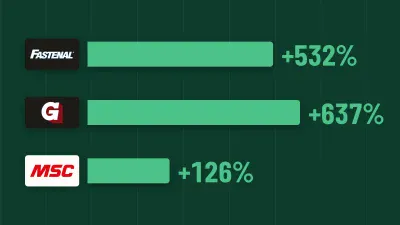
Industrial distributors sell the plain items that keep factories running, including bolts, gloves, drill bits, motors, and filters, and keep them in stock, often inside the customer’s own building, so production lines don’t stop. It is unexciting work, and it has paid off for patient shareholders. Over the past decade, Fastenal (NASDAQ:FAST | FAST Price Prediction) shares rose 532.63% on an adjusted basis, and the company’s 10-year average return on invested capital was approximately 28%. The three names below have built themselves into their customers’ daily routines over many years, making them hard to replace and fairly steady to own.
Fastenal: Bolts, Bins and an Installed Base Customers Rarely Remove
What it does. Fastenal sells fasteners, safety supplies, cutting tools, and other industrial and construction products to manufacturers, contractors, and government buyers. What sets it apart is location. Fastenal keeps inventory at or near customer sites and had 143,878 weighted FASTBin/FASTVend vending and bin devices installed at the end of the third quarter. Customer sites spending $50,000 or more a month grew to 3,288 from 2,771 year over year. Contract customers now make up 76.5% of revenue, up from 73.8%.
Why the reorders keep coming. Once a vending machine is bolted to a factory floor and connected to the customer’s purchasing system, restocking happens automatically. Switching suppliers would mean removing that equipment and retraining the floor staff. The dividend record shows how the business held up in the 2008 to 2009 financial crisis. Fastenal paid semiannually then, and the per-share amounts recorded at the time went from $0.25 in February 2008 and $0.27 in August 2008 to $0.35 in February 2009 and $0.37 in August 2009. Through 2020, it paid $0.25 every quarter and added a $0.40 payment in December 2020.
The company showed clear pricing power. Higher product prices added about 240 basis points to third-quarter sales growth and roughly 290 basis points to second-quarter growth. Operating margin still increased 90 basis points to 21.5% even as customer mix weighed on gross margin. Trailing 12-month return on invested capital was 32.5%. CEO Jeffery Watts described the model this way on the October call: “New customer wins create embedded spend, technology deepens those relationships, and our scale allows us to grow profitably while continuing to invest.”
Returns and dividend. Shares rose 107.51% over five years. The quarterly dividend rose from $0.22 in October 2025 to $0.24 in early 2026 and to $0.26 for the two most recent payments. The annualized forward dividend is $1.04, which is modest. The reason to own Fastenal is the business that funds the dividend.
Risk. Fastenal’s growth is shifting toward large contract accounts, and those customers negotiate harder. Customer mix was about a 50-basis-point year-over-year headwind to gross margin in the third quarter. Management also cut its 2026 device signing goal to 27,000 to 29,000 MEUs, from 28,000 to 30,000.
W.W. Grainger: Restocking the Maintenance Closet for Millions of Customers
What it does. W.W. Grainger (NYSE:GWW) is a broad-line distributor of maintenance, repair, and operating supplies, serving more than 4.6 million customers worldwide. If a hospital’s air handler fails or a utility crew runs out of safety gear, Grainger is often the supplier that gets the replacement there that day. Its High-Touch Solutions segment serves larger North American accounts, while Endless Assortment runs the Zoro and MonotaRO online marketplaces for hard-to-find items.
Why the reorders keep coming. Maintenance spending can be delayed only so long. Broken motors, worn belts, and expired safety equipment still have to be replaced in a weak economy. In the 2020 downturn, Grainger raised its quarterly dividend from $1.44 in the February and May payments to $1.53 in August and November. Its record shows quarterly payments from 1999 through November 2026, rising from $0.15 to $2.49.
The company demonstrated pricing power. In the third quarter, High-Touch Solutions sales rose 13.8% on double-digit volume growth and price increases that passed cost increases on to customers. Management said price and cost were “roughly neutral” in the quarter, helped by September price increases of approximately 1%. Adjusted operating margin rose 90 basis points to 16.1%. CEO D.G. Macpherson stated the goal directly: “Our expectations are that we will be price cost neutral over time.”
Returns and dividend. Shares rose 637.81% over ten years and 215.71% over five. The trailing 12-month dividend is $9.73 per share, and the annualized forward rate is $9.96. With shares near $1,447.96, that yield is small.
Risk. High-Touch Solutions’ gross margin fell 30 basis points to 40.8% because of freight costs and project mix. Management also noted the limits of raising prices: “continued price increases can create friction over time.” Part of the second quarter’s 100-basis-point gross margin gain came from $43M in IEEPA tariff refunds, and that kind of benefit is unlikely to repeat.
MSC Industrial Direct: Cutting Tools That Wear Out on Schedule
What it does. MSC Industrial Direct (NYSE:MSM) is the smallest of the three, with a market cap of about $6.66 billion. It sells about 2.5 million products, mainly metalworking and maintenance supplies such as cutting tools, abrasives, and measuring instruments, to machine shops and manufacturers. It also runs vending machines and in-plant programs on customer sites.
Why the reorders keep coming. Cutting tools wear down every time a machine runs, so any shop still making parts keeps buying them. In the last quarter, MSC’s vending average daily sales grew approximately 20%, and average daily sales per vending machine rose in the low teens. In the Great Recession, MSC kept its quarterly dividend at $0.20 from July 2008 through April 2010, then raised it to $0.22 in July 2010. Through 2020, it paid $0.75 every quarter, plus an additional $3.50 payment in November 2020.
MSC showed clear pricing power. In fiscal 2026, MSC dealt with tungsten and tariff-driven cost inflation. Price added 6.9% to fourth-quarter growth, and gross margin edged up to 40.6% from 40.4%. Adjusted operating margin increased 170 basis points to 10.9%. On tungsten, CEO Martina McIsaac said: “We will not have to reduce any prices until our suppliers reduce their manufacturer’s list price, and none of that is coming in the near future.”
Returns and dividend. MSC has lagged the other two. Shares rose 126.61% over ten years and 68.37% over five, and they fell 7.89% over the past month. The quarterly dividend went from $0.85 in 2025 to $0.87 and now $0.89. The annualized forward rate is $3.56.
Risk. MSC dropped its Digital Core systems program and took a $41.77M asset impairment. As a result, fourth-quarter GAAP EPS was $0.85, compared with $1.45 adjusted. Management also warned of inflationary pressures and tougher comparisons as it faces last year’s price increases. Its first-quarter fiscal 2027 adjusted operating margin guide of 9.5% to 10.1% is below the 10.9% it just reported.
Plain Businesses Built to Last
All three companies earn their money the same way: they become the default supplier for products customers use up and must replace. Their dividend records through 2008 and 2020 show that each kept paying through those downturns, the same multi-decade streak we screened for in our free Dividend Kings guide, which you can download here. Their recent results show they can pass along higher costs without losing customers. For investors building a long-term core holding, the main things to track are margins and contract growth in each earnings report.
Contact [email protected] for any questions or corrections.
Chris Lange is a financial and geopolitical writer with more than a decade of experience covering a myriad of topics. He has published thousands of articles for 24/7 Wall St., with past coverage focused heavily on stocks, IPOs, healthcare, defense, global affairs, and technology.
His work has been quoted, or referenced by a number of outlets including Business Insider, USA Today, Yahoo Finance, MSN, The Motley Fool, and many other publications. A graduate of Southwestern University, he studied business with a focus on investments and has previous experience in banking and startups.
When not reading or writing the news, he is following his passion for Lacrosse, playing chess, or building solar projects with his dad.