Matthew Hornbach Says Falling Unemployment Is the Real Risk to Higher Rates. Here’s Why Retirees Should Care

This post may contain links from our sponsors and affiliates, and Flywheel Publishing may receive compensation for actions taken through them.
Matthew Hornbach is guiding income investors to view the jobs report as the most important signal for interest rates in 2027. Speaking on CNBC on November 10, 2026, he said: “The real risk to dramatically higher interest rates next year is we start to see the unemployment rate trend lower.” For retirees who own bonds, roll over CDs, or collect dividend checks, that comment deserves a close look, because the unemployment trend he describes is already underway.
Why Fewer Jobless Workers Can Push Rates Up
The Federal Reserve has two jobs: keep prices stable and support maximum employment. A rising unemployment rate gives the Fed room to cut rates. A falling one takes that room away. When fewer people are looking for work, employers compete harder for staff, wages climb, and higher pay can feed into prices. Bond investors see that coming and demand higher yields before the Fed acts.
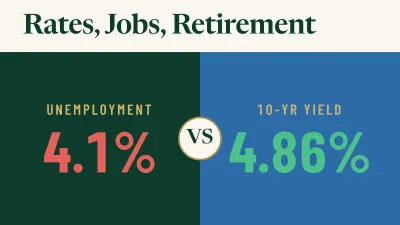
The latest data fits Hornbach’s warning. The U.S. unemployment rate stood at 4.1% for October 2026, down from 4.2% in September and 4.5% in November 2025. Long-term yields have moved sharply over the past year. The 10-year Treasury yield was 4.86% on November 6, 2026, after peaking at 5.31% on October 5. Its 52-week low was 3.97% on February 27.
What Higher Rates Would Mean for Your Retirement Income
- Bond prices: Existing bonds lose value when yields rise. Long-dated bonds and bond funds take the biggest hit.
- CDs and Treasuries: New money makes more. Savers with CDs or T-bills maturing in 2027 could lock in better rates.
- Borrowing costs: Mortgages, home equity lines, and credit card rates typically move higher, which matters for retirees planning to downsize or borrow against a home.
- Dividend stocks: When a Treasury pays close to what a stock yields, investors demand more from the stock, which tends to pressure share prices.
Realty Income Shows Both Sides of the Rate Trade
Realty Income (NYSE:O), the net lease REIT that pays monthly, is a popular retirement holding and a clear example of rate sensitivity. Its dividend yield is about 5.16%, leaving a cushion of roughly 0.3 percentage points over the 10-year Treasury. Higher rates are also showing up in its costs. Third-quarter interest expense rose to $333.6 million from $294.5 million, up about 13.3%, and interest coverage stands near 1.42.
The operating results hold up well. In its third-quarter release, revenue reached $1.62 billion, beating the $1.45 billion estimate and rising 10.3% year over year. AFFO per share, the cash flow measure REIT investors track, rose 3.7% to $1.12. GAAP EPS of $0.43 came in slightly below estimates. Occupancy held at 98.8%, and the company committed $2.6 billion at a 6.8% initial cash yield, a spread of about 170 basis points. Management raised 2026 AFFO guidance to $4.45 to $4.46 per share and announced its 116th consecutive quarterly dividend increase, bringing the annualized payout to $3.258 per share.

CEO Sumit Roy noted the pressure: “As economic and cost of capital volatility persists, we remain focused on capital allocation while staying true to our ethos of delivering reliable, income-oriented returns for our investors.”
Signals to Track Before 2027 Arrives
If Hornbach is right, the monthly jobs report becomes a rate forecast. Each reading at or below 4.1% strengthens the case for higher yields. A 10-year climbing back toward 5.31% would erase Realty Income’s yield cushion over Treasuries. For the REIT, watch whether acquisition yields keep pace with borrowing costs as it pursues its $10.0 billion investment target. Retirees can use these markers to review how much of their income depends on rate-sensitive holdings, and whether laddered CDs or Treasuries could balance that exposure. Company filings and dividend history are available on Realty Income’s investor relations site.
Contact [email protected] for any questions or corrections.
Chris Lange is a financial and geopolitical writer with more than a decade of experience covering a myriad of topics. He has published thousands of articles for 24/7 Wall St., with past coverage focused heavily on stocks, IPOs, healthcare, defense, global affairs, and technology.
His work has been quoted, or referenced by a number of outlets including Business Insider, USA Today, Yahoo Finance, MSN, The Motley Fool, and many other publications. A graduate of Southwestern University, he studied business with a focus on investments and has previous experience in banking and startups.
When not reading or writing the news, he is following his passion for Lacrosse, playing chess, or building solar projects with his dad.