4 Dividend Stocks Behind Products You Buy Every Week. One Yields Over 6%

The foil in your kitchen drawer, the bacon in your fridge, the Coke in your cooler, and the takeout container from last night’s dinner all come from companies that pay their shareholders a dividend. The four Nasdaq-listed names below sell everyday products in very different markets, and their dividends vary widely in safety. Smithfield Foods (NASDAQ:SFD) leads the group with a 6.09% yield. For each company, we look at what it makes, how well the payout is covered, why an income investor might want to own it, and the one risk to keep an eye on.
Reynolds Consumer Products
Reynolds Consumer Products (NASDAQ:REYN | REYN Price Prediction) makes Reynolds Wrap aluminum foil, parchment, oven bags, and slow cooker liners. It also makes Hefty trash bags, storage bags and tableware. The stock yields 3.72%. That comes from a $0.23 quarterly dividend, and the next one is payable November 30.
Dividend safety: Management repeated full-year adjusted EPS guidance of $1.57 to $1.63. The annualized dividend is $0.92, so the payout is well covered. Third-quarter adjusted EPS of $0.39 beat the $0.38 estimate. The balance sheet is tighter than the earnings. Cash fell to $25M as inventory grew to $775M, and the company used its revolving credit line to fund the $110M Owl’s Head Alloys acquisition. Management expects “net leverage to remain within our target range of 2x to 2.5x.” The CFO said the company has “considerable liquidity” and is investing “while maintaining our quarterly dividend.” Reynolds has paid $0.23 per share every quarter since early 2021. That record shows stability, though the dividend hasn’t grown in that time.
Bull case: Foil and trash bags are things people buy no matter what the economy is doing, and Reynolds leads both categories. Pricing rose 9% in the third quarter, and Cooking & Kitchen Essentials sales grew 9% to $337M. The stock trades at a forward P/E of 15 and is up 10.07% this year.
Risk: Commodity costs. Management estimates an additional annualized commodity headwind of roughly $400 million. Price increases helped offset it, but retail sales fell 7% in the quarter.
Smithfield Foods
Smithfield Foods sells Smithfield-branded bacon, ham, sausage, and hot dogs. It added Nathan’s Famous when it closed that acquisition on Oct. 26. At 6.09%, it is the only ultra-high-yield stock in this group. The quarterly dividend is $0.3125, an annual rate of $1.25, and the next payment goes out November 25.
Dividend safety: Most of the dividend’s support comes from the Packaged Meats division. Management expects it to earn $1,090M to $1,140M in adjusted operating profit this year, its fifth straight year above $1B. Cash rose 52.39% to $1,178M, equity stands at $7,015M, and operating cash flow improved by $244 million over the first nine months. Trailing EPS of $2.28 covers the annual rate. Per the CEO, the company has “a strong balance sheet and solid cash generation, giving us the financial flexibility to support our dividend.” Smithfield returned to public markets in January 2025. Its quarterly dividend rose from $0.25 in 2025 to the current $0.3125.
Bull case: Smithfield is the largest U.S. pork producer, and its branded meats business produces steady profits. Packaged Meats margins expanded 80 basis points to 11.6% even as the rest of the company struggled. The stock trades at a trailing P/E of 8 and a price-to-book ratio of 1.096 after falling 11.55% this year.
Risk: Hog and pork prices swing with the commodity cycle. Fresh Pork posted an $89M operating loss in the third quarter. Management cut full-year adjusted operating profit guidance to $900M to $1,000M from $1.23B to $1.38B. Quarterly adjusted EPS came in at $0.26, below the quarterly dividend.
Coca-Cola Europacific Partners
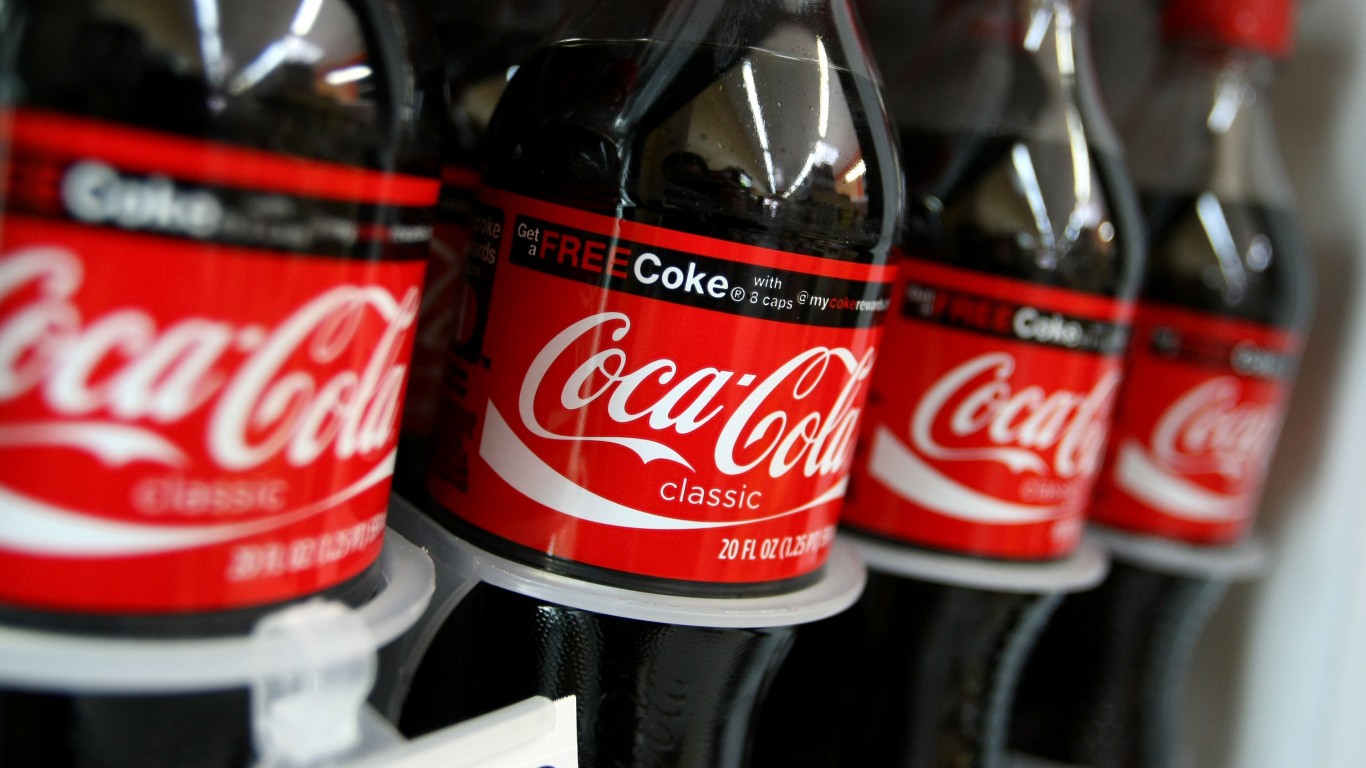
Coca-Cola Europacific Partners (NASDAQ:CCEP) bottles and sells Coca-Cola, Coke Zero Sugar, Diet Coke, Sprite, Fanta, Monster and Powerade in Western Europe, Australia, the Pacific and Southeast Asia. The stock yields 2.05%. It pays twice a year instead of quarterly. The first-half interim dividend of $0.9443 was paid in May. The second-half dividend of $1.5886 goes to holders of record on November 20 and is payable on December 3.
Dividend safety: The company targets a payout of about 50% of comparable earnings. It expects free cash flow of at least €1.7bn, which also funds a €1bn buyback that was roughly €880m completed by late October. It ended the first half with $2.0B of cash and $10.1B of equity. In dollars, the second-half payment has risen every year since 2022: $1.11, $1.23, $1.34, $1.43 and now $1.5886. The full-year dividend is €2.24 per share.
Bull case: Third-quarter revenue of $6.448B beat estimates. Comparable sales rose 3.5%, energy drinks grew 17.3%, and Coke Zero Sugar grew 9.7%. The CEO pointed to “a growing dividend and ongoing share buybacks.” The stock is up 29.81% this year and trades at a trailing P/E of 23, a premium for that steady growth.
Risk: Currency swings. The dividend is set in euros, so the dollar amount U.S. holders receive moves with the exchange rate.
Karat Packaging
Karat Packaging (NASDAQ:KRT) supplies the takeout containers, cups, lids, straws, cutlery, and bags that restaurants hand you. It sells under the Karat and Karat Earth brands to restaurant chains, distributors and online buyers. The stock yields 4.98%. The board raised the quarterly dividend 4.4% to $0.47, and the next payment is due November 27.
Dividend safety: This is the shakiest payout of the four. Third-quarter adjusted EPS of $0.24 fell short of both the $0.46 estimate and the $0.47 quarterly dividend. Cash flow and the company’s financial position provide some support. The quarter produced $9.1 million of free cash flow, liquidity stood at $37 million, and total liabilities of $135M sit against $171M of equity. A consolidated affiliate also paid off an $11.2 million term loan. Karat has paid a quarterly dividend since its 2021 IPO. The amount moved around in 2023 and 2024, held at $0.45 through 2025 and then rose to $0.47.
Bull case: Online sales grew nearly 38%. Karat added four new chain accounts in the third quarter, with shipments starting in the first half of 2027. Karat is also opening a Florida distribution center this month and raising prices. Management guides fourth-quarter sales growth of 9% to 11%. Shares dropped 27.62% over the past week but are still up 74.84% this year.
Risk: Shrinking margins. Resin, import, and freight costs are rising, and average container rates are up 17.0%. The CFO warned that “raw material prices might not come back down to normal anytime soon.”
Everyday Brands, Very Different Dividend Profiles
All four companies sell products people buy every week, but their dividends hold up differently. Coca-Cola Europacific has the strongest coverage thanks to its 50% payout policy and large free cash flow. Reynolds offers a steady, well-covered check that hasn’t grown in years. Smithfield pays the biggest yield, supported by its Packaged Meats profits. Karat’s payout depends on price increases bringing its earnings back above the dividend, the kind of coverage gap that shows up in our free guide to the seven warning signs a big yield is about to be cut.
Contact [email protected] for any questions or corrections.
Chris Lange is a financial and geopolitical writer with more than a decade of experience covering a myriad of topics. He has published thousands of articles for 24/7 Wall St., with past coverage focused heavily on stocks, IPOs, healthcare, defense, global affairs, and technology.
His work has been quoted, or referenced by a number of outlets including Business Insider, USA Today, Yahoo Finance, MSN, The Motley Fool, and many other publications. A graduate of Southwestern University, he studied business with a focus on investments and has previous experience in banking and startups.
When not reading or writing the news, he is following his passion for Lacrosse, playing chess, or building solar projects with his dad.