4 Ultra-High-Yield Dividend Stocks Paying Up to 16.6%. Are They Safe?

This post may contain links from our sponsors and affiliates, and Flywheel Publishing may receive compensation for actions taken through them.

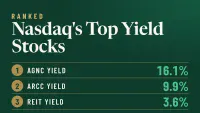
Four widely held income vehicles on U.S. exchanges now yield between 9% and 17%. AGNC Investment (NASDAQ:AGNC) yields 16.6% at a share price of $8.65. The four stocks below cover private credit, agency mortgages, commercial real estate debt, and midstream energy, so each payout depends on a different engine. Each one tops the 6% ultra-high-yield bar. Each one is assessed on dividend safety first and yield second.
Ares Capital: 9.9% Yield With a $1.37 Spillover Cushion
Ares Capital (NASDAQ:ARCC | ARCC Price Prediction) is the largest publicly traded business development company. Its $1.92 annualized dividend yields 9.9% at $19.39.
Dividend safety: Core earnings came in at $0.46 per share in the third quarter, below the $0.48 quarterly dividend and down from $0.47 the quarter before. The gap is covered by $983 million, or $1.37 per share, of taxable income spillover carried into 2026. The balance sheet is conservative. Net leverage is 1.06x debt to equity against a target of 0.9x to 1.25x, and liquidity is about $7 billion. Nonaccruals are held at 2.4% of cost, below the company’s roughly 3% post-financial-crisis average. Every quarterly payment from March 2023 through the upcoming December payout has been $0.48. Management says the regular dividend has been stable or increasing for 69 consecutive quarters.
Bull case: Ares is getting paid more for its loans. The weighted average yield on debt rose to 10.6%, first-lien spreads on new deals widened 50 basis points, and the backlog stands at about $2.5 billion. Management expects the pending MidCap Financial acquisition to be “modestly accretive to core earnings per share.” The stock also trades close to its NAV of $19.31.
Risk: Earnings are running below the dividend, and the loan book is mostly floating rate. Management estimates each 100-basis-point move in base rates is worth about $0.02 per share per quarter. Rate cuts would work against that, and the spillover can only cover shortfalls for so long.
AGNC Investment: 16.6% Monthly Yield and Mortgage Spreads Near Multi-Year Highs
AGNC pays $0.12 a month, or $1.44 a year. That works out to a 16.6% yield, the highest on this list.
Dividend safety: Coverage is tight but intact. Net spread and dollar roll income was $0.37 per common share in the third quarter, compared with $0.36 in dividends declared. Liquidity is solid, with $6.3 billion of unencumbered cash and Agency MBS, equal to 57% of tangible equity. Hedge coverage rose to 90% of funding liabilities from 73%. The payout has held at $0.12 since April 2020. Before that, AGNC cut it several times, from $0.18 to $0.16 and then to the current rate.
Bull case: AGNC’s Agency MBS assets are guaranteed against credit loss, and they now carry better pricing. Current-coupon Agency MBS yielded close to 6.5% at quarter end, with spreads near the top of their multi-year range. Actual prepayments fell to 8.2% CPR from 13.0%. CEO Peter Federico places expected returns on new investments in the “18%–20% range,” and he said tangible book value was up about 3% after quarter end.
Risk: Book value is volatile. Tangible net book value per share fell 16.9% to $7.13 in one quarter, and leverage is 7.9x. The stock trades well above that book value. Another rate shock would put the dividend’s long history of resets back in focus.
Starwood Property Trust: 16.3% Yield on a Dividend Up for Review
Starwood Property Trust (NYSE:STWD) yields 16.3% at $11.78. The stock is down 28.34% year to date.
Dividend safety: This is the weakest payout on the list, and management has said so. Distributable earnings were $0.31 per share against a $0.48 dividend, or $0.41 excluding realized gains and losses on resolutions. CEO Barry Sternlicht said the company will “have to examine what we are going to do with our dividend.” The $0.48 rate has been paid every quarter since 2014, but a reset is a real possibility. If the payout were cut to the $0.41 base earnings rate, the stock would still yield 13.9%. Liquidity is $1.1 billion, debt-to-undepreciated equity is 3.15 times, and the unencumbered asset pool totals $7.2 billion.
Bull case: The stock prices in larger losses than the company is actually taking. Undepreciated book value is $17.22 per share, already net of $1 billion in reserves. Sternlicht says the share price implies a 58% loss on troubled loans and REO. Owned real estate actually sold at 72% of original basis. The infrastructure book has 100% of loans rated 3 or better, and the LNR special servicer stands to benefit from distressed assets coming through.
Risk: A dividend reset looks likely. The four-rated loan balance rose $290 million in the quarter, and the five-rated balance rose $440 million, so credit is still getting worse.
Western Midstream Partners: 9.0% Distribution Covered About 1.4x
Western Midstream Partners (NYSE:WES) pays $3.72 per unit annualized, a 9.0% yield at $41.25 after a 5.97% drop over the past week.
Dividend safety: This is the best-covered payout of the four. CEO Oscar Brown put distribution coverage at “roughly 1.4”. Third-quarter distributable cash flow was $512 million, net leverage is about 3.2x, and liquidity is around $1.8 billion. The distribution has increased from $0.875 in 2024 to $0.91 and now $0.93, and the partnership has met its target of at least $3.70 per unit paid in 2026.
Bull case: Volumes are rising. Natural gas throughput hit a record 5.9 Bcf/d, and Delaware Basin gas rose 20% sequentially. Adjusted EBITDA is tracking above the midpoint of the $2.75B–$2.95B guidance range. Pathfinder begins start-up late in the fourth quarter of 2026, and North Loving II follows late in the first quarter of 2027.
Risk: Margins and spending are both moving the wrong way. Gas margin per Mcf slipped to $1.25 from $1.35, capex is running above the $1.0B top of guidance, and free cash flow after the distribution was a use of about $149 million last quarter. Units also come with a K-1 tax form.
Four Income Engines, Four Different Risk Profiles
Western Midstream and Ares Capital have the strongest dividend coverage of the four. Both have balance sheets and track records that back their roughly 9% to 10% yields. AGNC offers a mid-teens monthly payout that is covered for now but rises and falls with book value. Starwood is a turnaround play, and investors should watch the board’s dividend decision before treating that 16.3% as income they can count on. Double-digit yields usually mean the market is pricing in a cut, and we laid out the seven warning signs that confirm it in a free report.
Contact [email protected] for any questions or corrections.
Chris Lange is a financial and geopolitical writer with more than a decade of experience covering a myriad of topics. He has published thousands of articles for 24/7 Wall St., with past coverage focused heavily on stocks, IPOs, healthcare, defense, global affairs, and technology.
His work has been quoted, or referenced by a number of outlets including Business Insider, USA Today, Yahoo Finance, MSN, The Motley Fool, and many other publications. A graduate of Southwestern University, he studied business with a focus on investments and has previous experience in banking and startups.
When not reading or writing the news, he is following his passion for Lacrosse, playing chess, or building solar projects with his dad.