Move Cash Now: 3 Ultra-High-Yield Nasdaq Stocks Screaming Buys for December

This post may contain links from our sponsors and affiliates, and Flywheel Publishing may receive compensation for actions taken through them.
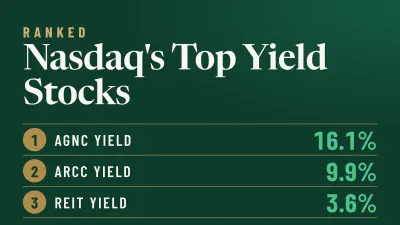
Most investors think of the Nasdaq as a technology index, but the exchange also lists some of the market’s biggest income payers. A mortgage REIT, the largest publicly traded business development company, and an actively managed REIT fund all trade there. The highest yielder of the three, AGNC Investment (NASDAQ: AGNC), yields 16.1% on its $1.44 annualized dividend. We checked coverage first for all these names. A yield only matters if the earnings behind it keep the payments coming.
AGNC Investment: A 16.1% Yield That Earnings Still Cover
At a share price of $8.94, AGNC’s $0.12 monthly dividend works out to an ultra-high-yield 16.1%. Part of that yield comes from a falling share price. The stock is down 6.39% year to date. It trades below its 200-day moving average of $10.42 and sits not far above its 52-week low of $8.27. The cause was a hard third quarter. Interest rates jumped, and tangible net book value per share fell 16.9% to $7.13. AGNC also reported a GAAP net loss of $1.36 billion. This was driven by $5.01 billion in unrealized losses on its Agency mortgage-backed securities.
Dividend Safety Read
The payout is still covered. Third-quarter adjusted EPS came in at $0.37, slightly missing the $0.3735 consensus, and that was enough to pay the $0.36 quarterly dividend. Hedge coverage also rose to 90% of funding liabilities from 73%, protecting the business if rates move sharply again. The dividend has stayed at $0.12 per month since the April 29, 2020 ex-dividend date. AGNC has cut before, though. That 2020 reset lowered the payout from $0.16, and earlier steps took it from $0.22 to $0.20, then to $0.18 and $0.16. A yield that has stepped down this many times deserves a second look, which is why we listed seven warning signs that a big payout is about to be trimmed in a free dividend trap guide.
Bull Case
Management thinks the setup for 2027 is better than the stock price suggests. Mortgage spreads are near the top of their multi-year range, so new purchases lock in wide returns. Prepayment risk has also eased, with CPR (the annualized rate at which borrowers pay off their mortgages early) falling to 8.2% from 13.0%. AGNC sold 97.6 million shares through its at-the-market program for $992 million in net proceeds. Those shares sold at a premium to the tangible book value, so the issue added to book value per share. It was also added to the S&P MidCap 400. CEO Peter Federico said, “Fixed income markets experienced significant pressure in the third quarter,” but the company expects better conditions once Treasury volatility steadies. Analysts are cautious, with a consensus target of $9.47 and 10 hold ratings against 3 buy or strong buy ratings.
Risk to Weigh
Leverage is 7.9x tangible net book value, which amplifies both gains and losses. The net interest spread also narrowed to 1.86% from 2.00% as the cost of funds rose to 3.09%. If rates spike again, book value could drop further, and the payout would come under pressure.
Ares Capital: Ultra-High-Yield Income From the BDC Sector’s Biggest Lender
Ares Capital (NASDAQ: ARCC | ARCC Price Prediction) pays $0.48 per quarter. At $19.44 per share, that’s a yield of 9.9%. Unlike AGNC, Ares Capital’s yield comes with a rising stock. Shares are up 3.73% year to date and 6.34% over the past year. BDCs (business development companies) must pass most of their taxable income to shareholders, which is why their yields stay high.
Dividend Safety Read
Coverage is tight. Third-quarter net investment income was $328 million, or $0.46 per share. That missed the $0.4757 consensus and came in below the $0.48 dividend. Second-quarter core EPS was $0.47. Management still stands behind the payout.
CEO Kort Schnabel pointed to “confidence in the current level of our regular quarterly dividend.” The balance sheet backs him up. Leverage was 1.15x at midyear, and available liquidity stood at about $6.0 billion. The company has paid $0.48 every quarter since the March 14, 2023 ex-dividend date, and its record goes back to December 22, 2004. Management notes “17 years of stable or increasing regular quarterly dividends.” Total recorded payments did slip from $0.42 per quarter in 2019 to $0.40 in 2020.
Bull Case
Ares Capital (NASDAQ: ARCC) is the largest publicly traded BDC by market value. Its portfolio of 619 companies is 71% floating rate. Its debt investments now yield 10.6% on a weighted average basis, up from 10.3%. Deal flow is picking up again.
The investment backlog reached about $2.5 billion, and new commitments after the quarter totaled about $1.1 billion through October 22. The pending acquisition of MidCap Financial, announced October 26, 2026, is expected to strengthen earnings power. For December income, the $0.48 goes ex-dividend on December 15 and pays on December 29. Analysts are positive, with a $21 target, 11 buy or strong buy ratings, and 3 holds.

Risk to Weigh
Credit quality is slipping. Non-accrual loans (loans that have stopped paying interest) rose to 2.4% of the portfolio at cost from 1.8% at year-end 2025. NAV per share fell to $19.31 from $19.94. Borrowing is also getting more expensive. The new $750 million of notes carry a 6.250% coupon and replace maturing 2.150% notes, which raises interest expense.
ALPS Active REIT ETF: Diversified Real Estate Income With Rising Payouts
ALPS Active REIT ETF (NASDAQ: REIT) has the lowest yield of the three. It earns its spot through diversification. Its annualized forward distribution of $1.0894 works out to about 3.6% for $30.27. Based on the past 12 months of payouts, the yield is 2.88%. That yield is lower partly because the fund has done well. Shares are up 17.88% year to date.
Dividend Safety Read
The fund spreads its payout across many companies. As of August 31, 2026, its largest positions were Welltower at 10.1% of net assets, Prologis at 8.9% and Equinix at 8.3%. The rest is spread across healthcare, industrial, data center, tower, residential, self-storage, retail and lodging REITs. Payouts have been rising.
The latest quarterly distribution was $0.27235, up from $0.21092 in June and $0.1817 in March. The fund has paid quarterly since 2021, but the amounts vary. The lowest was $0.06299 in March 2022, and the highest was $1.02648 in December 2021.
Bull Case
The fund balances out the two names above. AGNC depends on interest rates and Ares Capital depends on corporate credit, while this ETF owns physical property, including data centers, healthcare buildings, and industrial space. An active manager can move money between those sectors as conditions change, something an index fund cannot do. The rising quarterly payouts suggest the holdings are generating more cash.
Risk to Weigh
The fund is small, with net assets of about $56.4 million, and its payouts change from quarter to quarter. Investors who need a predictable monthly or quarterly check will find AGNC and Ares Capital easier to plan around.
Three Nasdaq Income Plays Heading Into December
AGNC offers the highest yield, and its earnings still cover the dividend despite a sharp drop in book value. Ares Capital pays nearly 9.9% with a long payout record, though coverage needs to improve as the MidCap deal closes and the backlog turns into loans. ALPS Active REIT ETF adds diversified real estate income with rising payouts. Investors should watch the next AGNC book value update and Ares Capital’s fourth-quarter net investment income against the $0.48 dividend.
Contact [email protected] for any questions or corrections.
Lee Jackson has covered Wall Street analysts' equity and debt research and equity strategy daily for 24/7 Wall St. since 2012. His broad, diverse career, including a stint as creative services director at an NBC affiliate in Austin, Texas, gives him unique insight into the financial industry.
Lee Jackson's journey in the financial industry spans more than 30 years, including nearly two decades as an institutional equity salesperson at Bear Stearns, Lehman Brothers, and Morgan Stanley. His career spanned pivotal sell-side Wall Street events, from the dot-com rise and bubble to the Long-Term Capital Management debacle, 9/11, and the Great Recession of 2008. This reflects his resilience and adaptability amid market volatility.
Lee Jackson’s practical financial industry experience, gained through a career at some of the biggest banks and brokerage firms, is complemented by a lifetime of writing across various platforms. This unique combination allows him to shed light on the intricacies of Wall Street in a way only someone with deep insider experience and knowledge can. Moreover, his extensive network across Wall Street continues to provide direct access for him and 24/7 Wall St., a privilege few firms enjoy.
Since 2012, Jackson’s work for 24/7 Wall St. has been featured in Barron’s, Yahoo Finance, MarketWatch, Business Insider, TradingView, Real Money, The Street, Seeking Alpha, Benzinga, and other media outlets. He attended the prestigious Cranbrook Schools in Bloomfield Hills, Michigan, and has a degree in broadcasting from the Specs Howard School of Media Arts.