Is the AI Trade Broken, or Did Hedge Funds Just Get Squeezed?

This post may contain links from our sponsors and affiliates, and Flywheel Publishing may receive compensation for actions taken through them.

Nishant Kumar, chief correspondent for hedge funds at Bloomberg News, has tracked the industry for 16 years. On Bloomberg’s Odd Lots podcast, Kumar said: “In the last 16 years of covering hedge funds, I never saw a day like last week.” Equity, macro, credit, and stock-picking funds all lost money together. “This was like a perfect storm. Everyone failed together.”
The pressure lands heaviest on Nvidia (NASDAQ:NVDA | NVDA Price Prediction), the leader of the AI infrastructure trade. The stock has fallen 22.6% over the past month to $177.51 in premarket trading on November 11. That price includes a 5.1% premarket bounce from the November 10 close of $168.89. Investors now have to decide whether the AI story broke or crowded positioning reversed.
Shock Absorbers Took the Shock
A multi-strategy hedge fund splits its capital among many independent trading teams across stocks, bonds, currencies, and commodities, all under tight risk limits. Investors pay for steady returns when markets turn rough. Kumar said these funds are valued for “a track record of making money when the downturn hits. And they all failed together and they lost money.” Millennium was down 2.3% for October. At midyear, Millennium also held 12,157,614 Nvidia shares.
Funds concentrated in AI took far bigger losses. Kumar said the AI-focused fund Vara lost 33% in October yet remained up for the year. That gives a sense of how much money the AI trade made before it reversed.
Mechanical Case: Shorts Squeezed, Puts Covered
Michael Ball, macro strategist at Bloomberg News, called the open on the Thursday after the election “a sucker punch because Wednesday you saw people rebuilding positions, you saw volume falling.” He argued that “the AI trade now has become bigger than the Anthropics and Nvidias,” and that the latest bounce “was really the pain trade of everyone getting squeezed out of shorts and covering puts.” He described the recent sessions as “mechanical versus sort of AI narrative shifting.”
Short covering happens when traders who sold borrowed shares buy them back, which adds buying pressure. Dealer hedging happens when market makers who sold options buy or sell the underlying stock to stay neutral, which can make price swings bigger. On November 10, Nvidia contracts expiring the next day traded 995,528 calls against 827,407 puts.
Bear Case: Key-Person Risk Meets a Capex Hangover
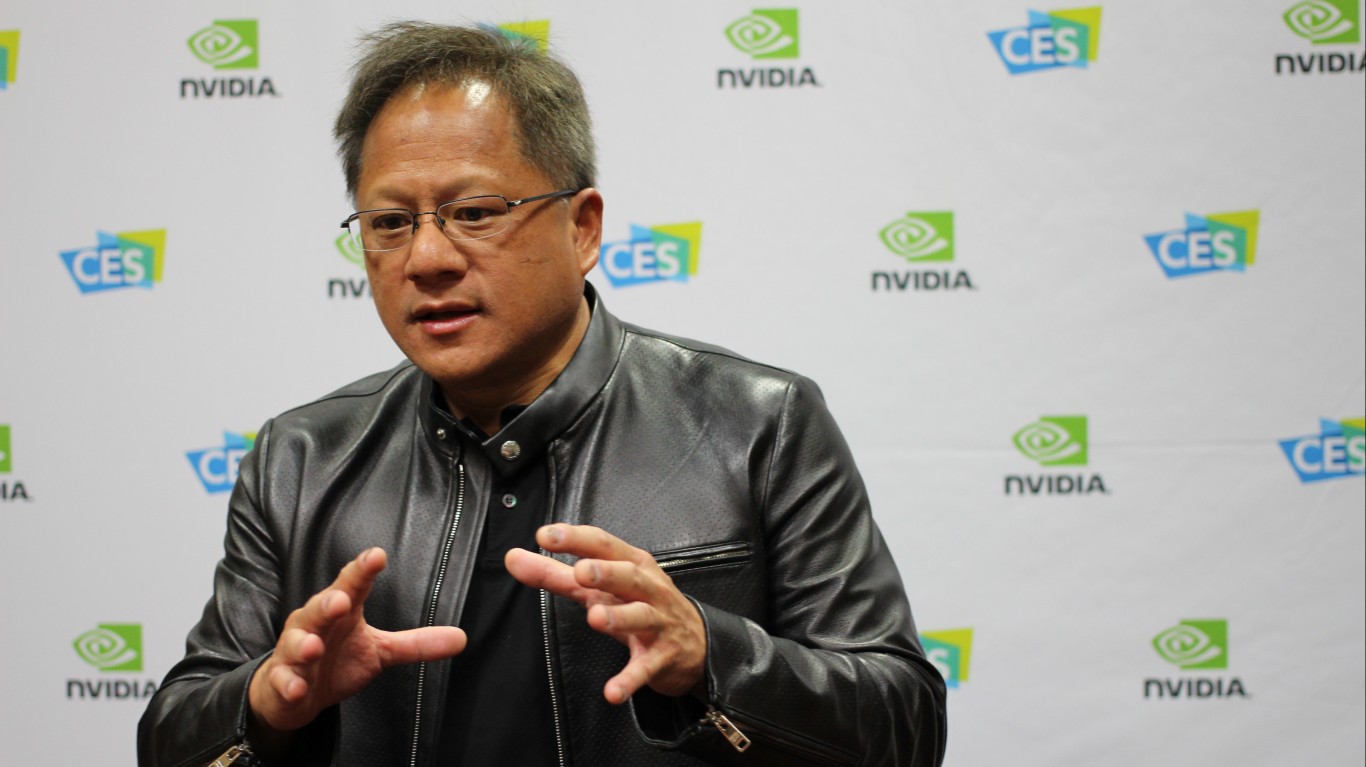
24/7 Wall St. has covered the board probe extensively. On Mad Money on November 10, Jim Cramer said Jensen Huang “admitted to a liaison with a woman who is an alleged Chinese spy.” As of those remarks, Huang was “still CEO, and he still has the support of NVIDIA’s board of directors.”
Cramer warned that “we are going to have to consider owning shares in a Jensen-less NVIDIA,” adding that “no one, not even Jensen, is irreplaceable and the institution must be preserved.” He also cited “a real bench at the company.”
Ball acknowledged a real shift in the narrative as well: “October really saw that shift in the capex narrative where all of a sudden it wasn’t a growth engine anymore and it was about financing, about free cash flow and again about this NIMBYism and electricity problems.” Post-election concerns about the 2028 project pipeline added to the pressure. (The power and cooling suppliers tied to that expansion are the subject of our free AI infrastructure report.)
Nvidia’s Latest Results Point to Accelerating Demand
In its Q2 fiscal 2027 filing, Nvidia reported revenue of $96.221 billion, up 105.8% year over year. Data Center revenue rose 117% to $89.023 billion. Supply obligations grew to $279 billion, and Q3 guidance called for $108.0 billion, plus or minus 2%. On the earnings call, Huang said, “Our demand is much higher than” the roughly 70% fiscal 2028 growth that supply supports. The stock trades at about 23 times trailing earnings.

Verdict: A Squeeze Collided With a Governance Scare
The evidence points mostly to a positioning unwind across the broader AI trade. The extra discount on Nvidia reflects key-person risk that the market cannot yet price. Demand data from August still showed customers asking for more than Nvidia could supply. Those figures are now months old, though, and October’s capex concerns came after them.
Nvidia reports earnings on the 17th. Ball named compute demand growth as the single most important metric to watch and said it remains on a strong S-curve. Investors can test that claim in the report. If Nvidia’s guidance still shows demand exceeding supply, the mechanical explanation holds. A flattening demand curve would confirm the bear case.

Contact [email protected] for any questions or corrections.
Trey has been an editor and author at 24/7 Wall St. for more than a decade, where he has published thousands of articles analyzing corporate earnings, dividend stocks, short interest, insider buying, private equity, and market trends. His comprehensive coverage spans the full spectrum of financial markets, from blue-chip stalwarts to emerging growth companies.
Beyond 24/7 Wall St., Trey has created and edited financial content for Benzinga and AOL's BloggingStocks, contributing additional hundreds of articles to the investment community.
Trey's editorial expertise extends across multiple publishing environments. He served as production editor at Dearborn Financial Publishing and development editor at Kaplan, where he helped shape financial education materials. Earlier in his career, he worked as a writer-producer at SVE. His freelance editing portfolio includes work for prestigious clients such as Sage Publications, Rand McNally, the Institute for Supply Management, the American Library Association, Eggplant Literary Productions, and Spiegel.
Outside of financial journalism, Trey writes fiction and has been an active member of the writing community for years, moderating workshop sessions at regional conventions.