Nvidia is Now Down More Than 25% In 30 Days: This Wall Street Desk Predicts 205% Returns

This post may contain links from our sponsors and affiliates, and Flywheel Publishing may receive compensation for actions taken through them.
Shares of NVIDIA (NASDAQ:NVDA | NVDA Price Prediction) currently trade at $168.89. The average analyst price target stands at $326.92, implying 93.57% upside.
NVIDIA sells the accelerators, networking gear, and software that run most AI data centers. Data Center sales now make up more than 92% of total revenue. The latest quarter brought in $96.221B in revenue, up 105.85%, and EPS of $2.22 against a $2.0887 consensus.
At the top end, Oppenheimer holds the Street-high target of $515.00, which works out to about 205% upside. NVIDIA’s next earnings report is expected in six days.
A Record Quarter Could Not Stop a 26% Slide in One Month
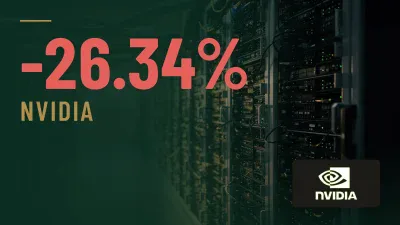
The selling has been sharp and it has sped up. Shares lost 26.34% over the past month. That includes 18.29% in the past week and 5.47% in the latest session, as headlines describe the selloff as accelerating. Over the same month, the S&P 500 slipped only 3.67%. So chip stocks are under pressure as a group, but NVIDIA has taken by far the biggest hit.
The operating results are holding up. Management guided next-quarter revenue to $108.0B ±2%. The worry is on the balance sheet. Supply commitments jumped to $279 billion from $119.0 billion a quarter earlier. Days sales outstanding, a measure of how long customers take to pay, rose to 60 days from 45 days. Guarantee obligations to partners can reach $108.5 billion, and NVIDIA has committed nearly $50 billion in advanced AI labs. CEO Jensen Huang acknowledged that some people call these deals “circular financing.”
Nearly Every Analyst Still Rates NVIDIA a Buy as Estimates Climb
Analysts are sticking with their call. 10 rate the stock Strong Buy, 49 rate it Buy, 2 say Hold, and 1 says Sell. Earnings estimates have been rising. The fiscal 2028 EPS consensus rose to 15.9146 from 12.8148 90 days ago. Over the past 30 days there were 7 upward revisions and 0 downward ones.
Oppenheimer’s $515.00 12-month target rests on three claims. First, the shift from Blackwell to Vera Rubin will lock in hyperscaler spending. Second, sovereign and enterprise buyers will extend demand beyond the big cloud companies. Third, full-rack systems will push margins higher. Other firms set targets of $465.00 (Raymond James) and $400.00 (Bernstein).
Management’s own outlook supports that view. NVIDIA expects revenue to grow about 70% in fiscal 2028, and Huang said “The unconstrained number would be a lot higher.” NVIDIA also makes more with each chip generation. Revenue per gigawatt of capacity rises from $25 billion with Blackwell to $40 billion with Vera Rubin. The expansion also lifts the power, cooling, and networking suppliers feeding those racks, which we profiled in a free report on seven AI infrastructure names that aren’t chipmakers. Price targets are educated guesses, though, and the upcoming earnings report will be the first real test of this thesis.
AMD and Broadcom Fell Too, While NVIDIA Fell Furthest
Every stock in the peer group sold off, but NVIDIA fell the furthest.
Advanced Micro Devices (NASDAQ:AMD) lost 15.28% over the past month, though it is still up 140.57% this year. It trades at $515.21 versus a $657.49 average target, leaving 27.62% implied upside. Of its 55 analysts, 44 rate it Buy or Strong Buy and 11 say Hold. Wall Street sees much less upside here than in NVIDIA.
Shares of Broadcom (NASDAQ:AVGO) slipped 8.18% over the past month. It trades at $331.98 versus a $533.42 average target, leaving 60.68% implied upside. 49 of its 51 analysts rate it Buy or Strong Buy. That upside is large but still trails NVIDIA’s.
Of the three, NVIDIA has the biggest gap between its price and analyst targets. Investors are singling NVIDIA out within the AI chip group.
NVIDIA Trails the S&P 500 by a Wide Margin This Year
At $168.89, NVIDIA has 93.57% implied upside to the $326.92 average target set by 62 analysts. The stock is down 9.23% this year, while the S&P 500 is up 9.99%. Over the past year, NVIDIA is down 14.95% and the index is up 10.06%.
Shares now trade close to the 52-week low of $163.90 and at about 12x forward earnings. That is a low multiple for a company with a 101.5% return on equity.
What Next Week’s Earnings Report Must Prove for NVIDIA
The bull case strengthens if the coming report confirms the Vera Rubin ramp and keeps gross margins near the 71% to 72% low point management expects. That would give analysts a clear path back toward their targets. The bear case gains weight if the $279 billion in supply commitments and NVIDIA’s lending to its own customers start to look like a funding loop that supports up demand. With a beta of 2.247, the stock swings much more than the market in both directions.
The data leans bullish. Forward earnings estimates are rising while the share price falls, so the selloff looks more like fear than a broken business. Still, the $515.00 target reflects one firm’s view.
Contact [email protected] for any questions or corrections.
Alex Sirois is a financial writer with experience spanning both retail and institutional investing. He has written for InvestorPlace and held roles at BNY Mellon and Bernstein, giving him a perspective that bridges Main Street portfolios and Wall Street analysis.
Alex holds an MBA from George Washington University and has built his career across multiple industries, including e-commerce, education, and translation — a breadth of experience that informs how he breaks down complex financial topics for everyday investors. His writing is conversational, actionable, and grounded in long-term, buy-and-hold investing principles.
At 247 Wall St., Alex focuses on delivering analysis that is both accessible and useful, with a clear emphasis on helping readers make more informed decisions with their money.