The 2-Year Treasury Yield Just Had Its Biggest Jump in 19 Months

This post may contain links from our sponsors and affiliates, and Flywheel Publishing may receive compensation for actions taken through them.
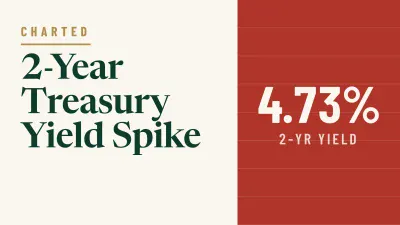
The 2-year Treasury yield rose 17 basis points on Tuesday, November 10, 2026, closing at 4.73% after closing at 4.56% on Monday, November 9. A basis point is one hundredth of a percentage point. In Treasury’s daily data, the last larger one-day rise came on April 9, 2025, when the 2-year rose 20 basis points to 3.91% during the tariff turmoil.
That was about 19 months ago, and according to Treasury data, no daily rise since then was as large. Two things pushed yields up together: a hawkish Fed speech and a core inflation reading that came in above forecasts.
The iShares 1-3 Year Treasury Bond ETF (NASDAQ:SHY) fell 0.33% to $81.32, while the iShares 20+ Year Treasury Bond ETF (NASDAQ:TLT) fell 1.32% to $80.88. The cash bond market was closed for Veterans Day on November 11. In early afternoon trading that day, SHY was down 0.07% at $81.27, and TLT was down 0.03% at $80.86.
What Moved the 2-Year on November 10
Christopher Waller spoke in London before the data came out. The Fed governor said that if October core CPI came in around 0.3% or higher, a “50 basis point hike in the policy rate should be considered” at the December meeting. He added that a quarter-point move alone would put the Fed’s credibility at risk.
October CPI then rose 0.4% after 0.6% in September. Core CPI, which leaves out food and energy, rose 0.3% for a third straight month, missing expectations of 0.2%.
Futures then priced a 91% chance of a 25-basis-point December rise and 9% for a half point. A week earlier, they had priced 77% for a quarter point and 23% for no change.
Why the Short End Took the Hardest Hit
The 2-year reflects where markets expect the Fed to set rates over the next two years, so a shift toward hikes shows up there first. The 1-year rose 18 basis points to 4.56%, while the 10-year rose 10 basis points to 4.98% after only briefly exceeding 5% during the session.
A flatter curve like this one suggests markets are more worried about inflation than about slower growth. Goldman Sachs (NYSE:GS | GS Price Prediction) added a second quarter-point rise to its forecast, most likely in March 2027, which would take the federal funds rate to a peak range of 4.25%-4.5% from the current 3.75%-4.00%.
T-bill, money market and CD yields tend to follow the short end, which helps savers and retirees, while borrowers with HELOCs, credit cards or adjustable-rate loans pay more.
Largest Jump Since April 2025 Still Sits Below the 2026 High
The 2-year closed at 4.81% on October 21 and set its 2026 high of 4.92% on September 28, so the yield is still below its recent peaks. Duration, which measures how much a bond’s price moves when yields change, explains why the two ETFs moved so differently.
SHY’s short-term notes barely move in price, and they mature and get reinvested at higher yields quickly, while TLT holds bonds that mature in 20 years or more, so a smaller rise in long-term yields cost it more. Over one year, TLT has returned -5.45%, while SHY has returned 1.71%.
How SHY Stacks Up Against TLT After the Rate Shock
SHY looks better positioned than TLT right now. If the Fed raises rates as futures now expect, SHY’s holdings will be reinvested at higher yields within months. TLT needs long-term yields to fall before it recovers.
The main risk to this view is a fast cooling in inflation, because TLT would then rise much more than SHY. For money you need within a year, a Treasury bill fund carries even less price risk.
Bonds reopen November 12, and October PPI is due November 13 at 8:30 a.m. ET. The Fed meets December 8-9, and November CPI comes out December 10. Another core CPI reading of 0.3% or higher would likely push the 2-year back toward 4.92%. A reading of 0.2% or lower would likely reverse the November 10 jump.
Contact [email protected] for any questions or corrections.
Omor Ibne Ehsan is a writer at 24/7 Wall St. He is a self-taught investor with a focus on growth, cyclical, and dividend equities that have strong fundamentals, value, and long-term potential. He also has an interest in high-risk, high-reward investments such as penny stocks.