Fed’s Goolsbee Says AI Data Centers Look Like ‘Old-Fashioned Overheating’

This post may contain links from our sponsors and affiliates, and Flywheel Publishing may receive compensation for actions taken through them.
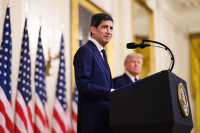
Chicago Fed President Austan Goolsbee told a Leadership Greater Chicago audience on November 9, 2026, that the AI data center build-out is starting to look like “old-fashioned overheating.” The Fed has not released a transcript of the moderated Q&A, so the phrase comes from reports of what he said.
Stocks rallied the same day. The S&P 500 rose 2.35% to 7,549.94, and the SPDR S&P 500 ETF Trust (NYSEARCA:SPY) gained 2.36% to $752.69.
Short-term bonds moved the other way. The iShares 1-3 Year Treasury Bond ETF (NASDAQ:SHY) slipped 0.05% to $81.59. The two-year Treasury yield ended at 4.56%, and futures put the odds of a quarter-point December hike at 84% by the close.
If you hold SPY near retirement, this split is significant. The AI spending that raises chip stocks is the same spending a Fed official now links to inflation, and the usual fix for inflation driven by too much demand is higher rates, which tend to lower stock valuations.
All of that AI spending has to be powered and cooled by somebody, and the suppliers doing that work are the subject of a free report we put together on seven companies behind the data center expansion: here.
What Goolsbee Said and What He Left Out
Goolsbee called employment and growth fairly stable and said inflation is the Fed’s big problem. He said officials have to face up to their failure. He argued inflation was supposed to be gone by now, yet it is showing up in services beyond areas tied to oil and tariffs.
That distinction matters because a tariff or oil shock tends to fade on its own. Demand overheating, meaning spending that exceeds what the economy can supply, keeps going until the Fed cools it with higher rates.
He made the same case on October 13, 2026. He said the AI investment boom was pushing prices up beyond data center components and closely related industries, and that overheated demand is harder to reverse than a supply shock.
He did not say which way he leans on a December hike, although he said current conditions could call for action. He has no vote on rates in 2026 but gets one in 2027, so the way he frames the problem will shape the debate over next year’s rate path.
How SPY and SHY Absorb the Warning
SPY depends heavily on the AI trade. NVIDIA (NASDAQ:NVDA | NVDA Price Prediction) made up 7.58% of the fund and Microsoft (NASDAQ:MSFT) 4.91% on its March 17, 2026 fact sheet.
The semiconductor index jumped 6.9% on November 9 after falling more than 12% the week before, and NVIDIA was its only decliner. Swings that large show how much of SPY’s direction now depends on investor views of AI spending.
SHY acts differently. Its price barely moves, but a higher policy rate pushes its yield up, and the Fed already raised the upper bound of its target range to 4.00% from 3.75% in September.
Reality Check on the Overheating Call
Richmond Fed President Tom Barkin said in prepared remarks in South Carolina that the risks lie on the inflation side and that firms are trying to pass on higher costs. He also called for officials to move carefully, and he did not blame data centers.
September CPI (the consumer price index) rose 0.6% on the month, and core CPI, which leaves out food and energy, rose 0.3%. Those readings support Goolsbee’s concern, but he gave no estimate of how much AI spending adds to inflation, so his diagnosis is still a judgment call.
What October CPI Could Mean for SPY and SHY
The bond market’s signal deserves more weight than the stock rally. On November 9, stocks priced in relief while short-term bonds priced in tighter policy, and the bond market’s read matches what two Fed presidents said. SHY makes short-term rates that would stay high if the economy keeps overheating, and it carries little price risk if a December hike arrives.
October CPI comes out November 10 at 8:30 a.m. ET. Forecasters expect a 0.3% monthly rise in headline prices and 0.2% in core. The government will not publish a year-over-year rate for October, but one major bank estimates 3.8% for headline and 2.7% for core.
This view is wrong if core CPI prints at or below 0.2% and December hike odds drop below about 80% before Goolsbee speaks again on November 12 at 11:15 a.m. ET. If neither happens, expect a hike at the December 8-9 meeting.
Contact [email protected] for any questions or corrections.
Omor Ibne Ehsan is a writer at 24/7 Wall St. He is a self-taught investor with a focus on growth, cyclical, and dividend equities that have strong fundamentals, value, and long-term potential. He also has an interest in high-risk, high-reward investments such as penny stocks.