The Banks Behind Your Neighborhood Branch Pay Dividends Too: $120,000 Across These 3 Regional Banks Yields $4,478 a Year

This post may contain links from our sponsors and affiliates, and Flywheel Publishing may receive compensation for actions taken through them.
Most people walk past a regional bank branch on the way to work without thinking of it as a business they could own a piece of. A regional bank operates across a group of states instead of the whole country. It takes in deposits from checking and savings customers, loans that money out for homes, cars, and companies at higher rates, and keeps the difference. That gap, called net interest income, is the main profit engine, and part of the profit goes to shareholders as dividends.
Our recent bank piece looked at the savings rates these institutions pay depositors. This one looks at who owns the branches and what that ownership pays. Here’s what putting $40,000 into each of these three high-yield names would generate: $120,000 invested in total, producing $4,478 in annual passive income. The prices come from the Nov. 10, 2026 close, and each figure is a forward yield based on the latest quarterly payout.
Fifth Third Bancorp
- Stock #3: Fifth Third Bancorp (NYSE:FITB | FITB Price Prediction)
- Yield: 3.1%
- Shares for $40,000: 738.14
- Annual Passive Income: ~$1,240
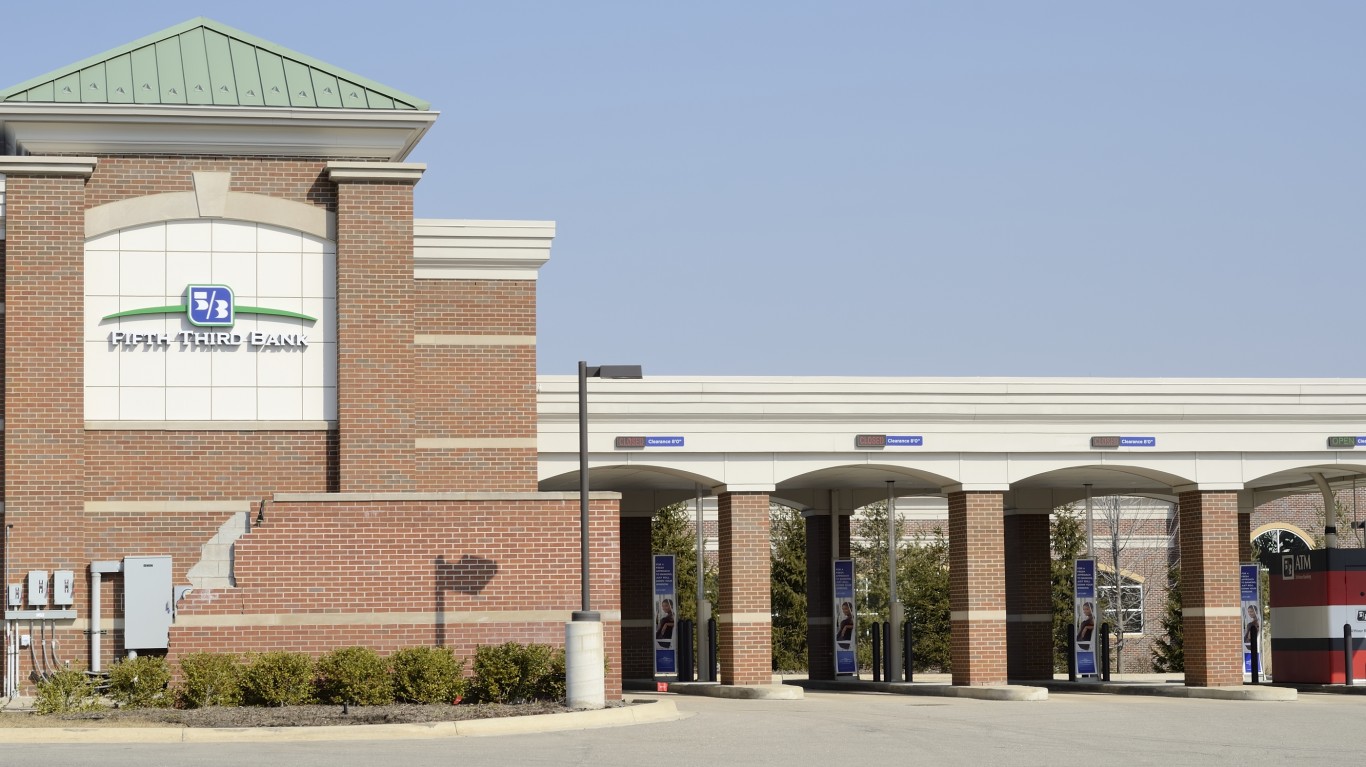
Cincinnati-based Fifth Third operates about 1,429 banking centers and 2,549 ATMs following its Comerica acquisition, with a significant presence across the Southeast, Midwest, Michigan, Texas, and California as of its third-quarter 2026 report. It holds about $301 billion in total assets.
Fifth Third raised its quarterly dividend to $0.42 from $0.40 in September 2026. Third-quarter adjusted EPS of $1.13 covers that quarterly payout with room to spare. Chief Financial Officer Bryan Preston said on the October call, “Our capital return priorities are unchanged: pay a strong dividend, support organic growth to deliver the best long-term returns for our shareholders, and then share repurchases.” The bank did cut during the financial crisis, from $0.44 a quarter in March 2008 to $0.01 by December 2008.
Interest rate swings are the plain risk here. When longer-term rates rise, the bonds a bank holds lose value on paper, and higher rates reduced Fifth Third’s accumulated other comprehensive income, the running count of those paper gains and losses, by $1.6 billion in the third quarter.
Huntington Bancshares
- Stock #2: Huntington Bancshares (NASDAQ:HBAN)
- Yield: 3.91%
- Shares for $40,000: 2,525.25
- Annual Passive Income: ~$1,566
Columbus, Ohio-based Huntington runs about 1,400 branches across 21 states, with its presence expanded by acquisitions of Cadence Bank and Veritex Holdings, according to its third-quarter 2026 disclosures.
Huntington has held its quarterly dividend flat at $0.155 since late 2021, for an annual rate of $0.62. Third-quarter adjusted EPS of $0.38 covers that payout, and the bank still bought back $100 million of stock in the quarter. Huntington also cut during the crisis, from $0.265 a quarter in early 2008 to $0.01 starting in March 2009.
Loan losses and commercial real estate are the risks to track. Net charge-offs, the loans a bank writes off as bad, rose to 0.31% annualized from 0.25%. Steve Steinour, chairman and CEO at the time of the October call, said Huntington is “making a strategic credit and capital allocation decision in terms of commercial real estate.”
Regions Financial
- Stock #1: Regions Financial (NYSE:RF)
- Yield: 4.18%
- Shares for $40,000: 1,393.73
- Annual Passive Income: ~$1,672
Birmingham, Alabama-based Regions operates more than 1,200 banking offices and about 1,750 ATMs across the South, Midwest and Texas, with roughly $161 billion in assets as of its first-quarter 2026 disclosures.
Regions raised its quarterly dividend to $0.30 from $0.265 starting with the Sept. 1, 2026 ex-dividend date. Third-quarter adjusted EPS of $0.73 covers that payout, and the company targets paying out 40% to 50% of earnings. Regions cut during the crisis too, from $0.38 a quarter in mid-2008 to $0.01 by June 2009.
Office real estate and capital rules are the risks here. At the end of 2025, 11.4% of its office real estate loans were nonperforming. Its CET1 ratio, the regulator-watched measure of loss-absorbing capital, stood at an estimated 10.8%, above its 9.25% to 9.75% target range, while proposed Basel III endgame rules would change how that ratio is calculated.
Income Breakdown for All Three Banks
| Name | Yield | Annual Dividend Income |
|---|---|---|
| Fifth Third Bancorp | 3.1% | $1,240 |
| Huntington Bancshares | 3.91% | $1,566 |
| Regions Financial | 4.18% | $1,672 |
| Total | 3.73% | $4,478 |
What $120,000 in Regional Banks Can Produce
Together, these three holdings produce $4,478 in annual passive income on a $120,000 investment, a combined yield of 3.73%. Regions contributes $1,672, Huntington adds $1,566, and Fifth Third rounds out the group with $1,240.
The combination worth checking each quarter is net charge-offs alongside CET1 ratios, since rising loan losses and thin capital are what pushed all three banks to a $0.01 quarterly dividend in 2009. These payouts can change with bank earnings and capital levels. They deliver cash four times a year from businesses with branches on ordinary streets, in shares that can be sold on any trading day, offering more liquidity than a rental property.
Contact [email protected] for any questions or corrections.
David Beren has been a Flywheel Publishing contributor since 2022. Writing for 24/7 Wall St. since 2023, David loves to write about topics of all shapes and sizes. As a technology expert, David focuses heavily on consumer electronics brands, automobiles, and general technology. He has previously written for LifeWire, formerly About.com. As a part-time freelance writer, David’s “day job” has been working on and leading social media for multiple Fortune 100 brands. David loves the flexibility of this field and its ability to reach customers exactly where they like to spend their time. Additionally, David previously published his own blog, TmoNews.com, which reached 3 million readers in its first year. In addition to freelance and social media work, David loves to spend time with his family and children and relive the glory days of video game consoles by playing any retro game console he can get his hands on.