‘My son says I’ll be in the hospital before she is’: I’m 67 with $850,000 saved and caring for my wife full time. My kids want me to hire help. Can we afford it?

This post may contain links from our sponsors and affiliates, and Flywheel Publishing may receive compensation for actions taken through them.

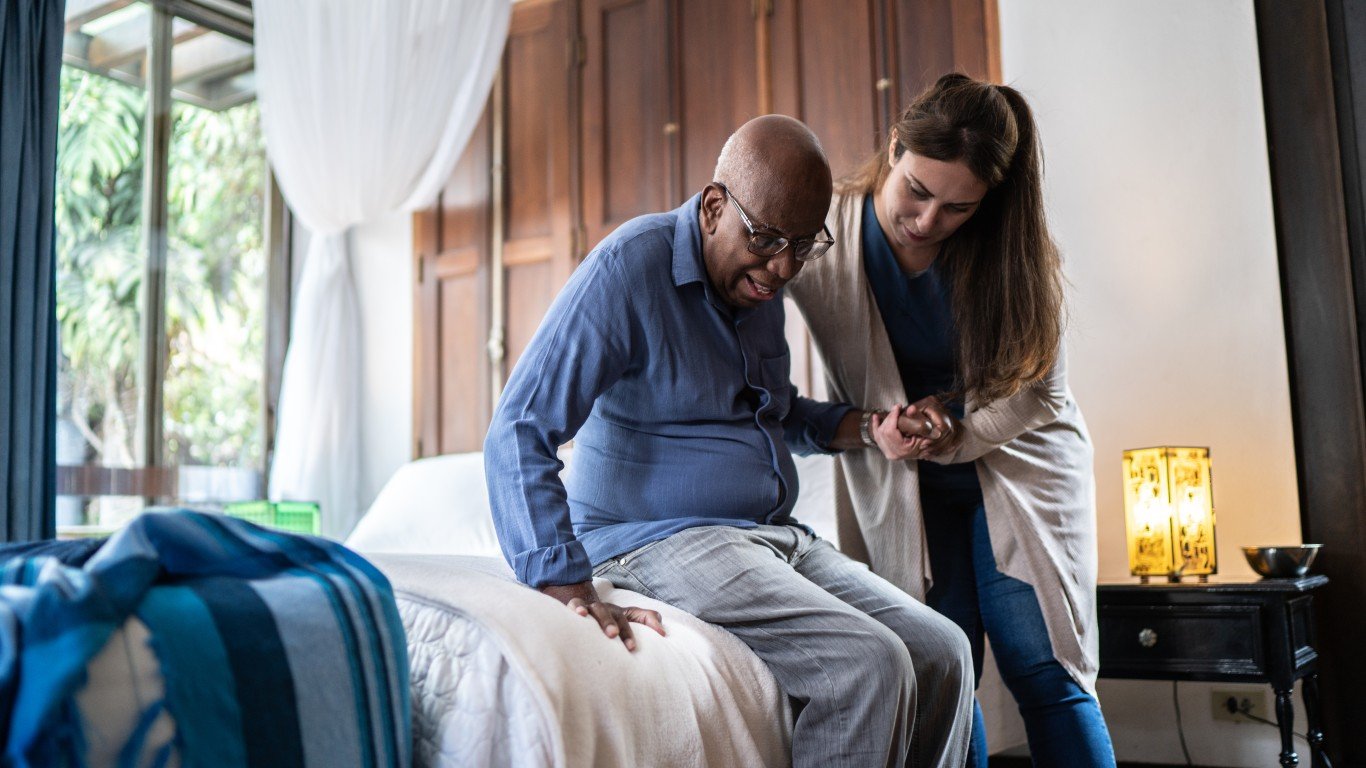
My wife had a stroke in March. She came home in May with a walker, a hospital bed in our living room and a list of things she can no longer do by herself: get out of a chair, get into the shower, button a blouse. She is 66. I’m 67. We have been married 43 years, and I promised her I’d never put her in a home. I meant it.
So I do it all. I sleep in the recliner next to her bed because she wakes up needing the bathroom twice a night. I haven’t slept a full night since March. She kept the checkbook for 43 years, and now I am learning where the money goes along with her pill schedule.
Here is the money. We have $850,000 saved, $700,000 of it in my IRA and $150,000 in a brokerage account. Social Security pays us $2,900 and $1,700 a month, $55,200 a year. The house is paid off. Our living costs run about $58,000 a year, so we barely touch the savings.
Our daughter is a nurse. Last Sunday she left an agency’s rate sheet on the kitchen table: a licensed aide, 30 hours a week, $35 an hour, $4,550 a month. My son says I’ll be in the hospital before she is. I did the math. That is $54,600 a year, almost our whole Social Security, and every dollar of it comes out of savings. In 15 years the money is gone, she goes into a home anyway, and I will have broken my word. My kids want me to hire help. Can we afford it?
Start with what the help really costs after tax
You can afford it, and the arithmetic is kinder than your version of it. Your daughter’s plan costs $54,600 a year. Because your wife can no longer bathe, dress or get out of a chair without help, the aide’s wages count as medical care under the tax code, as long as a doctor, a registered nurse or a licensed social worker certifies that she is chronically ill (unable to do at least two of six daily activities for 90 days or more) and writes a plan of care. Get that letter now.
Only medical costs above 7.5% of adjusted gross income count, and you have to itemize. Here is your year with the aide. You draw $60,555 from the IRA: the aide, the $2,800 gap you already run, and the tax. That makes $43,532 of your Social Security taxable and puts your adjusted gross income at $104,086, so the floor is $7,806. The aide, your Part B premiums and your Medigap and drug coverage come to $64,270, so $56,463 of it is deductible. Add $5,200 of property tax and you itemize $61,663 against a $35,500 standard deduction. Both of you also get the $6,000 senior deduction that runs through 2028. Taxable income: $30,423. Federal tax: $3,155. Without the medical deduction it would be $7,185, so the deduction is worth $4,030 a year. Real money, and 7% of the aide’s cost, so the deduction is a help rather than the answer.
How long $850,000 lasts
| Option | Cost a year | IRA withdrawal | Federal tax | Savings last |
|---|---|---|---|---|
| No paid help (today) | $0 | $2,800 | $0 | Indefinitely |
| Aide, 20 hours a week | $36,400 | $39,968 | $768 | 27 years |
| Aide, 30 hours a week (the kids’ plan) | $54,600 | $60,555 | $3,155 | 16 years |
| Aide, 44 hours a week | $80,080 | $86,800 | $3,920 | 11 years |
| Assisted living | $74,400 | $81,061 | $3,861 | 12 years |
| Nursing home, private room | $129,575 | $137,373 | $4,998 | 6 years |
Withdrawals come from your $850,000 earning 5% a year, with every cost rising 3% a year. Care prices are CareScout’s 2025 national medians, published in March.
Your 15-year estimate was close: at 30 hours a week the money lasts about 16 years, to your age 83 and hers 82. That is 7.1% of your savings in the first year, a lot, and it buys 16 years of sleep. At 20 hours a week, four hours on five afternoons, it lasts 27 years.
What your kids are right about
Your son has the research on his side. AARP and the National Alliance for Caregiving counted 63 million family caregivers in 2025, averaging 27 hours a week; one in four put in more than 40. One in five reported fair or poor health, and nearly one in four said they struggle to look after their own. You are doing the round-the-clock version at 67 on broken sleep. If you land in the hospital, your wife goes into a facility that week, and the private-room median is $10,798 a month, $129,575 a year, more than double the plan on your kitchen table. The surest way to break your promise is to wear yourself out.
What you are right about
The money does have a limit. Round-the-clock aides at $35 an hour cost $305,760 a year, 2.4 times a private nursing home room, and no $850,000 covers that. If her needs ever reach that level, money alone cannot keep the promise, and that will be a conversation with her as much as with the kids. Medicare covers short stretches of skilled nursing or therapy at home, never daily bathing and dressing. And if the savings ever run down, Medicaid’s 2026 rules let the spouse at home keep up to $162,660 (each state sets its own line, at least $32,532), the house with up to $752,000 of equity, and income of up to $4,066.50 a month. That is the floor under you. It is a long way down.
The verdict
Hire the help. Start at 20 hours if 30 feels like too much, and put the first hours where you are losing the most: the nights, so you sleep, and the shower, where she is most likely to fall. Use the agency. It carries the payroll and the insurance, and you avoid becoming a household employer, which starts the moment you pay one person $3,000 in a year, about three weeks at 30 hours. Ask the doctor for the chronic-illness letter before the first shift.
You promised her she would never be put in a home. An aide in your own living room is the opposite of that. It is how the promise gets kept.
Contact [email protected] for any questions or corrections.
I've spent more than 15 years inside enterprise software, working alongside the finance, sales operations, and HR leaders who run the revenue engines at some of the largest tech companies in the country.
My day job is helping enterprise executives make smarter decisions about retention, compensation, and growth. These are the same operational levers that show up in every earnings report investors actually read. That perspective shapes my writing for 24/7 Wall St.
The headline numbers are easy. The interesting stuff is underneath: how companies make money, what executives are worried about, and what any of it means for the person checking their 401(k) on a Sunday afternoon. I write about personal finance and business as someone who has spent her career inside the rooms where these decisions get made.