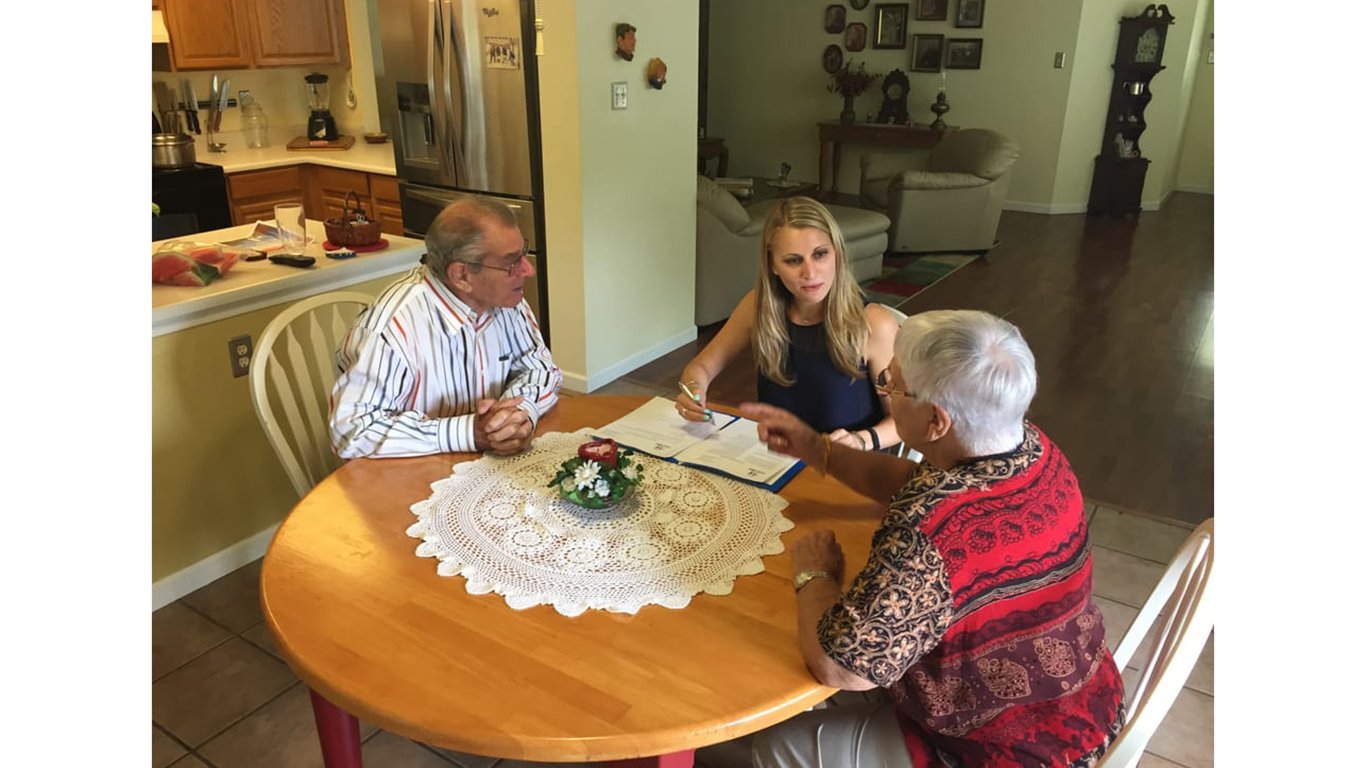
Nobody Plans to Need Care in The Villages. Here’s What It Costs When It Happens
The Villages sells active retirement better than anywhere else in America, but seven in ten people who reach 65 will eventually need long-term care, and almost nobody in that golf cart has priced out what happens when that day arrives.

This post may contain links from our sponsors and affiliates, and Flywheel Publishing may receive compensation for actions taken through them.
Anyone who has driven through The Villages knows the pitch: pickleball at eight, golf at ten, a town square band at seven, and a golf cart in the garage instead of a second car. It is the largest 55-plus community in the country by a wide margin, and the people who move there are moving toward a specific idea of retirement. Active. Social. Engineered to keep you upright and out on the courts for as long as possible.
The problem is that active retirement has an end. Roughly seven in ten people who reach 65 will need some form of long-term care in their lifetime, and the villa two doors down does not come with a care plan. This is the scenario a lot of Villages households quietly avoid pricing out: what happens to the budget, and to the portfolio, when one spouse crosses from pickleball to memory care. Here is what that transition actually costs, and what you would need behind it.
What Care Really Costs Around Sumter County
Start with the everyday floor. Independent living in The Villages runs cheaper than the Florida average because the community is huge, competitive, and built around low-maintenance patio villas. That cost advantage disappears the moment someone needs help with bathing, medication management, or supervision.
Assisted living inside and immediately around The Villages runs roughly $5,500 to $6,500 a month, in line with the CareScout national median of $6,200 a month, or $74,400 a year. Memory care sits higher, closer to $7,900 a month, or about $95,000 a year. Villages-area providers price at or above that level because demand is dense and family caregivers are often a plane ride away. Skilled nursing is another step up: the national median is $315 a day for a semi-private room and $355 a day for a private room, working out to roughly $115,000 and $130,000 a year respectively.
Aging in place inside your villa costs far more than people assume. Non-medical caregivers run $35 an hour nationally, which works out to about $80,000 a year for 44 hours a week. Around-the-clock coverage at home routinely clears $200,000. Medicare does very little of this: Part A covers the first 20 days of skilled nursing after a qualifying hospital stay, then charges $217 a day in coinsurance for days 21 through 100, and pays nothing past day 100. The $202.90 monthly Part B premium and a decent supplement handle doctors and hospitals. Neither touches custodial care, which is the expensive part.
Running the Math When One Spouse Needs Memory Care
Take a common Villages profile: a couple in their mid-70s, still in the villa, spending roughly $78,500 a year on everything from amenity fees to grandkids’ flights. One spouse develops dementia and moves into memory care nearby. The healthy spouse stays in the villa.
The at-home budget does not drop much. Property taxes, HOA and amenity fees, insurance, utilities, and food for one still run $55,000 to $60,000 once you keep the car, the golf membership, and travel to see the kids. Add memory care at $95,000 and the household is spending close to $155,000 a year in current dollars, before federal taxes on IRA withdrawals.
Social Security for a two-earner household in this cohort typically delivers $50,000 to $60,000 combined. With the 2027 COLA now tracking around 3.5%, benefits keep some pace with inflation, but memory care costs have consistently outrun the broader CPI. Call the annual portfolio gap $100,000.
At a 4% withdrawal rate, closing that gap requires $2.5 million in invested assets. At a more defensive 3.5%, which is what most planners use once one spouse is in care and the healthy spouse could live another 15 or 20 years alone, the target moves to roughly $2.85 million (the full case for an income-first approach is laid out in a free report here). A shorter care horizon of three years might be survivable on $1.5 million to $1.8 million, but the average memory care stay runs closer to four to five years, and no one gets to pick.
Florida Medicaid Trapdoor Nobody Talks About
Here is the piece most Villages families miss until they are already inside it. Florida’s long-term care Medicaid program will pay for skilled nursing, but the eligibility math is severe, and it interacts in ways that catch couples off guard.
In 2026, the applying spouse can hold no more than $2,000 in countable assets and $2,982 a month in income. The community spouse, the one still living in the villa, can keep up to $162,660 in countable assets plus the home. Crucially, when a community spouse remains in the residence, the home carries no equity cap at all under Florida’s spousal impoverishment protections. The $752,000 home equity limit applies only to single applicants with no spouse in the property. A married couple can hold a villa worth considerably more without triggering a Medicaid asset problem, as long as the healthy spouse continues to live there.
The more common trap is different. Medicaid pays for nursing homes and a limited waiver program, not the assisted living or memory care setting most Villages families actually want. That means the household pays privately for the years between needing help and needing a nursing bed, which can easily run three to five years at $95,000 or more per year.
The workable version of this scenario combines roughly $2.5 to $2.9 million in invested assets by the time care begins, Social Security claimed to maximize the survivor benefit for whichever spouse lives longest, and a 3.5% withdrawal discipline once care starts. Long-term care insurance helps in the middle wealth band, but for households already at that portfolio level, self-funding typically wins on the math. The number that matters is the second, invisible budget line the brochure never mentions, well beyond the sticker price of the villa, and the households that price it accurately are the ones who get to stay.
Editor’s note: This article has been updated to reflect the 2027 Social Security COLA projection of 3.5% based on September 2026 estimates from The Senior Citizens League, independent analyst Mary Johnson, and AARP. The Florida Medicaid home equity cap explanation has been corrected: the $752,000 limit applies to single applicants only; married couples where the community spouse resides in the home face no equity cap under Florida’s spousal impoverishment protections.
Contact [email protected] for any questions or corrections.
David Beren has been a Flywheel Publishing contributor since 2022. Writing for 24/7 Wall St. since 2023, David loves to write about topics of all shapes and sizes. As a technology expert, David focuses heavily on consumer electronics brands, automobiles, and general technology. He has previously written for LifeWire, formerly About.com. As a part-time freelance writer, David’s “day job” has been working on and leading social media for multiple Fortune 100 brands. David loves the flexibility of this field and its ability to reach customers exactly where they like to spend their time. Additionally, David previously published his own blog, TmoNews.com, which reached 3 million readers in its first year. In addition to freelance and social media work, David loves to spend time with his family and children and relive the glory days of video game consoles by playing any retro game console he can get his hands on.