Ray Dalio Just Warned the Coming Debt Fight Could Make America’s $40 Trillion Problem Worse

This post may contain links from our sponsors and affiliates, and Flywheel Publishing may receive compensation for actions taken through them.

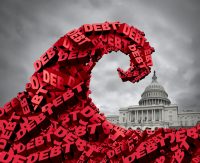
America’s national debt has become so large that another trillion dollars barely registers in Washington’s budget debates. Yet the cost of carrying that debt is becoming harder to ignore. Higher interest rates mean more tax dollars go toward paying creditors rather than funding government services. Meanwhile, political battles over spending threaten to make borrowing even more expensive.
According to the Congressional Joint Economic Committee’s Nov. 6 report, the national debt reached $40.55 trillion, up $2.46 trillion in just one year.
Billionaire investor Ray Dalio believes Washington’s next fiscal showdown could make a bad situation worse — and investors may feel the consequences well beyond the Treasury market.
Dalio Sees Three Debt Deadlines Approaching
In a Nov. 9 essay, the Bridgewater Associates founder warned that the midterm elections did nothing to resolve America’s underlying financial problems. Instead, he expects political divisions to deepen as Washington confronts three approaching deadlines:
- December 11, 2026: Temporary federal government funding expires.
- March 2027: Federal debt is projected to reach its borrowing limit.
- Fall 2027: Treasury could exhaust its remaining financing options.
Dalio expects the resulting political battles to be “brutal,” potentially driving short-term Treasury yields higher as investors seek to avoid uncertainty over government payments.
That’s a particularly troubling development because Dalio has long warned that government debt could trigger the next financial crisis. The danger isn’t necessarily that America suddenly cannot pay its bills. It’s that investors begin demanding higher yields to compensate for the possibility of delayed payments.
Ironically, politicians fighting over how to control federal debt could make that debt more expensive to finance.
The Numbers Reveal an Expensive Problem
The government’s borrowing costs have already been climbing.The Joint Economic Committee reports that the average interest rate on marketable federal debt reached 3.57% in October, compared with 3.39% a year earlier and just 1.46% five years ago.
That increase carries enormous consequences for a government with trillions in obligations.
A one-percentage-point increase in borrowing costs, applied across the $32.77 trillion in publicly held federal debt, would eventually add roughly $328 billion annually in interest expenses, assuming the entire balance repriced.
Of course, existing fixed-rate bonds don’t immediately reset. But as Treasury securities mature, the government must refinance them at prevailing rates.
The Treasury Department’s Nov. 2 borrowing estimates underscore the challenge. Washington expects to borrow $618 billion during the October–December quarter and another $800 billion in the first three months of 2027.
That’s $1.42 trillion in planned net marketable borrowing across six months. The burden is already visible. America’s national debt crossed $40 trillion in August, with annual interest payments reaching approximately $1.25 trillion. The Congressional Budget Office projects net interest will account for approximately 14.25% of federal spending in fiscal 2027, rising to 14.94% in 2028.
Why Investors Should Pay Attention
Treasury yields influence borrowing costs throughout the economy. Higher yields can pressure mortgage rates, increase corporate financing expenses, and make bonds more competitive with stocks.
There’s an important counterpoint, however. In its Nov. 4 report, the Treasury Borrowing Advisory Committee found no evidence that massive technology-sector borrowing was crowding out Treasury demand. It attributed recent yield increases primarily to economic growth, monetary policy expectations, and energy prices.
That suggests America’s bond market isn’t experiencing the crisis Dalio fears — at least not yet. Indeed, higher interest rates could add $6 trillion to federal deficits through 2036 while squeezing corporate profit margins and making bonds more competitive with stocks.
Dalio’s warning is ultimately about confidence. Once investors begin questioning the reliability of Treasury payments, political dysfunction becomes a financial expense.
Key Takeaway
In short, America’s $40 trillion debt isn’t an immediate reason to abandon stocks. But investors shouldn’t assume Treasury yields will remain stable simply because government bonds have historically been considered safe.
The prudent approach is to avoid excessive leverage, favor companies with manageable debt, and dependable cash flow, and consider shorter-duration bonds to reduce sensitivity to rising interest rates.
Washington may eventually resolve its political disputes. Until then, investors should prepare for the possibility that arguing about the national debt makes financing it even more costly.
Contact [email protected] for any questions or corrections.
After two decades of patrolling the dark corners of suburbia as a police officer, Rich Duprey hung up his badge and gun to begin writing full time about stocks and investing. For the past 20 years, he’s been cruising the markets looking for companies to lock up as long-term holdings in a portfolio while writing extensively on the broad sectors of consumer goods, technology, and industrials. Because his experience isn’t from the typical financial analyst track, Rich is able to break down complex topics into understandable and useful action points for the average investor. His writings have appeared on The Motley Fool, InvestorPlace, Yahoo! Finance, Money Morning, and, of course, 24/7 Wall St. He has been featured in both U.S. and international publications, including MarketWatch, Financial Times, Forbes, Fast Company, and USA Today.