Seagate’s Legitimacy as a Play on AI Hardware Demand is About To Be Tested

This post may contain links from our sponsors and affiliates, and Flywheel Publishing may receive compensation for actions taken through them.
Seagate Technology (NASDAQ:STX | STX Price Prediction) trades at $551.72. The stock jumped 9.99% in a single session on CoreWeave-driven storage optimism tied to CoreWeave (NASDAQ:CRWV), yet it sits 51.7% below its 52-week high of $1,143.27.
Seagate builds mass-capacity hard drives for hyperscale clouds. Data center sales reached $3.4 billion, or 81% of revenue. Its HAMR-based Mozaic platform is the growth engine, and Microsoft (NASDAQ:MSFT) recently qualified a Mozaic-based solution. Even so, shares fell 20.19% in the week after a fiscal first-quarter beat.
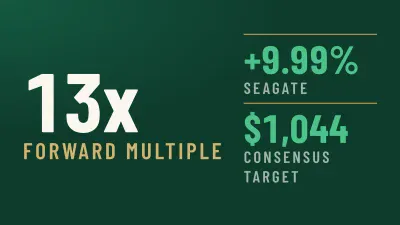
A 13x Forward Multiple on Earnings Still Being Revised Higher
Fiscal Q1 revenue rose 61.0% to $4.233 billion. Non-GAAP EPS of $7.68 topped the $7.40 consensus. That was the sixth straight beat. Gross margin hit 57.8%, and free cash flow reached $1.479 billion.
Guidance calls for $4.80 billion in revenue and $9.20 in EPS. Most nearline supply is allocated under long-term agreements through calendar 2028. Analysts made 18 upward fiscal 2027 revisions in 30 days against one cut. Even so, the stock trades at about 13 times forward earnings.
Record Margins Look Like a Cyclical Peak to Skeptics
The core bear argument mirrors the debate around Micron (NASDAQ:MU). Bears question whether HDDs are a durable AI play or sit at the peak of a cyclical bubble. Price-to-book stands at 33.65, and beta is 2.201.
Customer concentration is a risk because the growth story rests on hyperscaler spending on storage, power, and networking (we covered seven of the non-chip suppliers riding that expansion in a free report here). On the call, management noted higher external component costs, along with scrap and yield pressure during HAMR transitions. The filing also lists tariffs and Commerce Department settlement obligations as risks.
Calendar 2028 Pricing Talks Will Decide the Multiple
Management plans to finalize pricing on allocated calendar 2028 supply over the next few quarters. HAMR should reach about 50% of the nearline exabyte run rate ending calendar 2026. A larger buyback step-up starts in the March quarter. Those milestones will show whether pricing power holds.
Wall Street Sees 89% Upside as Shares Slide Below Trend
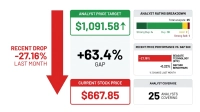
The consensus target of $1,044.83 means 89.4% upside from $551.72. Targets reflect analyst estimates and can change. The ratings break down across 26 analysts this way:
- Strong Buy: 4
- Buy: 18
- Hold: 4
- Sell: 0
Shares are up 92.71% over one year, while the S&P 500 gained 11.24%. Over the past month, Seagate fell 26.75% and the index slipped 2.36%. The trailing P/E is 26, and the stock trades below its 50-day average of $756.58.
December-Quarter Shipments Could Confirm the Exabyte Step-Up
At $551.72, Seagate faces several near-term tests.
Management promised “another big step” in December-quarter shipments. Results at or above $9.20 in EPS would support the optimistic view. Higher calendar 2028 pricing locked in on schedule would strengthen that case.
Concerns would mount if hyperscalers delay deployments or product swaps return. Management says it sees “none of that right now.” Rising component costs that stall margin gains would also add to those worries.
The stock already rose 9.99% in a single day. Even so, a 20.19% drop after a clean beat shows how quickly sentiment can reverse. Investors should track exabyte shipments, gross margin and contract pricing each quarter.
Seagate’s earnings power is established, but its AI credibility is still being tested, and one more quarter of evidence should help clarify where things stand.
Contact [email protected] for any questions or corrections.
Alex Sirois is a financial writer with experience spanning both retail and institutional investing. He has written for InvestorPlace and held roles at BNY Mellon and Bernstein, giving him a perspective that bridges Main Street portfolios and Wall Street analysis.
Alex holds an MBA from George Washington University and has built his career across multiple industries, including e-commerce, education, and translation — a breadth of experience that informs how he breaks down complex financial topics for everyday investors. His writing is conversational, actionable, and grounded in long-term, buy-and-hold investing principles.
At 247 Wall St., Alex focuses on delivering analysis that is both accessible and useful, with a clear emphasis on helping readers make more informed decisions with their money.