Seagate Technology Got Hammered By Multiple Compression, Falling 40% in 3 Months: This Renowned Wall Street Desk Targets 185% Gains Following Earnings

This post may contain links from our sponsors and affiliates, and Flywheel Publishing may receive compensation for actions taken through them.
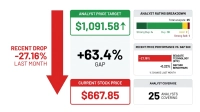
Seagate Technology (NASDAQ:STX | STX Price Prediction) currently trades at $472.33, while the average analyst price target sits at $1,022.75. That gap implies 116.5% upside.
Seagate is the dominant maker of mass-capacity hard drives. Its HAMR-based Mozaic platform supplies hyperscale cloud and AI data centers, and that demand has driven rapid growth (the same expansion we mapped across power, cooling, and networking suppliers in a free report on AI infrastructure stocks). Fiscal Q1 2027 revenue rose 61.0% year over year to $4.233 billion[1]. When a business growing that fast trades at less than half its consensus target, one side of the trade is badly wrong.
Record Earnings Could Not Stop a 42% Multiple Reset
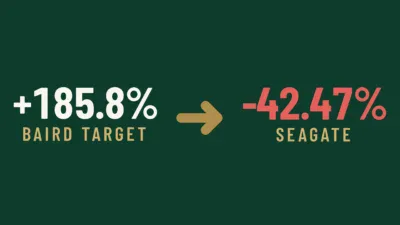
Seagate lost 42.47% over the past three months, falling from $821 to $472.33, as investors cut the multiple they pay for storage hardware. The decline is speeding up: the stock is down 26.68% over one month and 8.45% in the past week. The S&P 500 slipped 6.34% over that same month, so broad weakness explains only a slice of the damage.
The latest earnings report beat expectations, though by less. Non-GAAP EPS of $7.68[1] topped the $7.40 consensus by 3.74%, the smallest surprise in a six-quarter streak that peaked at 16.94%. Bears cite slower exabyte growth, multiple compression across storage and chip stocks, and rival Western Digital (NASDAQ:WDC), with Western Digital scaling its own HAMR roadmap.
Why 22 of 26 Analysts Still Back Seagate
The bull case rests on locked-in demand. Seagate says “the vast majority of our Nearline Exabyte supply is now allocated under long-term supply agreements through calendar 2028”[2], with some cloud deals running to 2030. The CEO added that “everything we can make above and beyond our plans is being spoken for.”[2] That tightness supports pricing, which pushed non-GAAP gross margin to 57.8%[1].
Fiscal Q2 guidance calls for revenue of $4.80 billion plus or minus $100 million[1] and non-GAAP EPS of $9.20. Management expects HAMR to reach roughly 50%[2] of nearline exabyte shipments exiting calendar 2026, expects to be net cash positive by year-end, and plans to “significantly increase share purchases starting in calendar 2027” against a $4.4 billion authorization.
Revisions have been trims, with no downgrades. Robert W. Baird holds the Street-high $1,350.00 target, implying 185.8% upside. BNP Paribas sits near $1,275.00, Barclays at $1,250.00, and Bank of America at $1,200.00. Morgan Stanley trimmed to $1,148.00 from $1,200, and Rosenblatt cut from $1,400 to $1,100. Price targets are estimates, and several were set when the stock traded far higher.
Storage Peers Sold Off Together, and One Screens Even Cheaper
The selloff hit the whole storage group, so Seagate moved with its closest peers.
Western Digital fell 23.5% over one month to $272.45, against an average target of $600.46. That implies 120.4% upside, slightly above Seagate’s, with 21 of 26 analysts at Buy or Strong Buy and 5 at Hold.
NetApp (NASDAQ:NTAP) dropped 25.7% over one month to $165, versus a $208.56 target. The implied 26.4% upside is far smaller, and only 8 of 21 analysts rate it a Buy.
Western Digital offers the most implied upside, with Seagate a close second. The pure-play hard drive makers carry the largest discounts, which points to a sector-wide derating.
Seagate Still Leads the S&P 500 by a Wide Margin This Year
At $472.33, Seagate has 116.5% implied upside to the $1,022.75 consensus target from 26 analysts. The ratings break down as follows:
- Strong Buy: 4
- Buy: 18
- Hold: 4
- Sell: 0
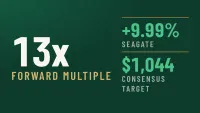
Despite the three-month decline, the stock is up 72.09% year to date, while the S&P 500 has gained 5.12%. It sits between a 52-week low of $249.06 and a high of $1,143.27, and trades at roughly 12 times forward earnings.
Locked-In Contracts Make Seagate Look More Like Opportunity Than Trap
The optimistic scenario improves if pricing holds as customers settle calendar 2028 terms and the company delivers near its $9.20[1] EPS guide. In that case, increasing buybacks and a net cash balance sheet give the stock a credible path back toward four digits. The bear case gains weight if the market reads this as peak-cycle pricing. Western Digital’s HAMR ramp could relax supply discipline, and rising component costs could squeeze margins, which would make that forward multiple a classic cyclical trap.
The evidence leans toward the optimists. Contracted supply through 2028 gives Seagate more visibility than past storage cycles offered. With a beta of 2.201, though, the path back up will be volatile. The fiscal Q2 earnings report and the next round of pricing commentary are the key things to watch.
Contact [email protected] for any questions or corrections.
Alex Sirois is a financial writer with experience spanning both retail and institutional investing. He has written for InvestorPlace and held roles at BNY Mellon and Bernstein, giving him a perspective that bridges Main Street portfolios and Wall Street analysis.
Alex holds an MBA from George Washington University and has built his career across multiple industries, including e-commerce, education, and translation — a breadth of experience that informs how he breaks down complex financial topics for everyday investors. His writing is conversational, actionable, and grounded in long-term, buy-and-hold investing principles.
At 247 Wall St., Alex focuses on delivering analysis that is both accessible and useful, with a clear emphasis on helping readers make more informed decisions with their money.