4 Healthcare Dividend Stocks for Retirees. One Yields Over 4%

This post may contain links from our sponsors and affiliates, and Flywheel Publishing may receive compensation for actions taken through them.

Retirees who want income from healthcare stocks care about two things more than a big starting yield: dividends that keep rising and checks that keep clearing during a recession. These four blue chips all increased their dividends during 2026, and all four trade with low volatility. Bristol-Myers Squibb (NYSE:BMY | BMY Price Prediction) has a beta of 0.186, and Johnson & Johnson (NYSE:JNJ) has one of 0.2. Starting yields range from 4.03% at Bristol to 1.87% at J&J, and that gap is the trade-off income investors need to understand before choosing between them.
| Stock | Price | Annual Dividend | Forward Yield | Payout vs. Adjusted EPS Outlook |
|---|---|---|---|---|
| Bristol-Myers Squibb | $62.47 | $2.52 | 4.03% | 39% |
| Medtronic | $103.05 | $2.88 | 2.79% | 48% |
| AbbVie | $294.17 | $7.28 | 2.47% | 52% |
| Johnson & Johnson | $285.98 | $5.36 | 1.87% | N/A (GAAP: 81%) |
Bristol-Myers Squibb: Top Yield at a Single-Digit Forward P/E
Yield: At $62.47, Bristol’s $2.52 annualized dividend works out to a forward yield of 4.03%. That is the highest in this group.
Dividend safety: The dividend uses about 39% of the midpoint of management’s non-GAAP EPS guidance of $6.35 to $6.55[1], and 56% of trailing GAAP EPS of $4.51. The full-year dividend bill comes to roughly $5.15 billion. That compares with $4.2 billion[1] of operating cash flow in the third quarter alone, although that figure fell 33.45% from a year earlier. Bristol’s total debt of about $42.9 billion[1] is the main weak spot in its financial profile. The payout record is steady: the quarterly dividend rose from $0.38 in 2016 to $0.63 in 2026, and the payment history goes back to 1999. The raises have been small, though. The latest one went from $0.62 to $0.63.
Bull case: Third-quarter revenue rose 6.93%[1] to $13.07 billion, and non-GAAP EPS of $1.35 beat the $1.23 estimate. The Growth Portfolio climbed 12% to $7.66 billion[1], Eliquis grew 25% to $4.69 billion, and eight medicines are now running at more than $1 billion a year. Management raised revenue guidance to $49.75 to $50.25 billion. The stock trades at about 9x forward earnings, so investors are paying very little for that pipeline.
Risk: Generic competition is eroding older drugs. Revlimid sales fell 47%,[1] and Pomalyst sales fell 81%. The Legacy Portfolio is expected to shrink 3% to 5%, and management lowered non-GAAP EPS guidance from $6.75 to $7.00 because of in-process R&D charges. Analysts are cautious: the ratings stand at 17 holds, 6 buys and 4 strong buys.
Medtronic: 49 Straight Years of Raises Backed by Rising Free Cash Flow
Yield: Medtronic (NYSE:MDT) pays a $0.72 quarterly dividend, or $2.88 a year. With shares at $103.05, the forward yield is 2.79%.
Dividend safety: Medtronic’s coverage looks the clearest of the four. The company has declared its 49th consecutive year[2] of dividend increases, and its dividend records show a higher quarterly payout every year back to 2001. The annual dividend costs roughly $3.68 billion, well below fiscal 2026 free cash flow of $5.43 billion[2]. In the first quarter of fiscal 2027, free cash flow rose 120.89% to $1.29 billion[3], ahead of the $921 million paid in dividends. The payout equals about 48% of the midpoint of non-GAAP EPS guidance, compared with 71% of trailing GAAP EPS.
Bull case: Cardiac ablation is driving growth. Cardiac Ablation Solutions grew 88%[3], Electrophysiology Therapies grew 29.5%, and total first-quarter revenue rose 13.73% to $9.76 billion. Management raised fiscal 2027 organic growth guidance to 7.25% to 7.75%[3] and non-GAAP EPS guidance to $5.94 to $6.00. The stock trades at about 17x forward earnings. Analysts lean positive, with 17 buys, 3 strong buys, and a $105 target.
Risk: The first-quarter growth was partly a calendar effect. An extra 53rd fiscal week added about $570 million[3], so year-over-year comparisons will get harder. Margins are also under pressure: tariffs cut 80 bps[2] from fourth-quarter fiscal 2026 operating margin. The planned Diabetes separation will also change the business mix.
AbbVie: Dividend Aristocrat With a Fresh Raise
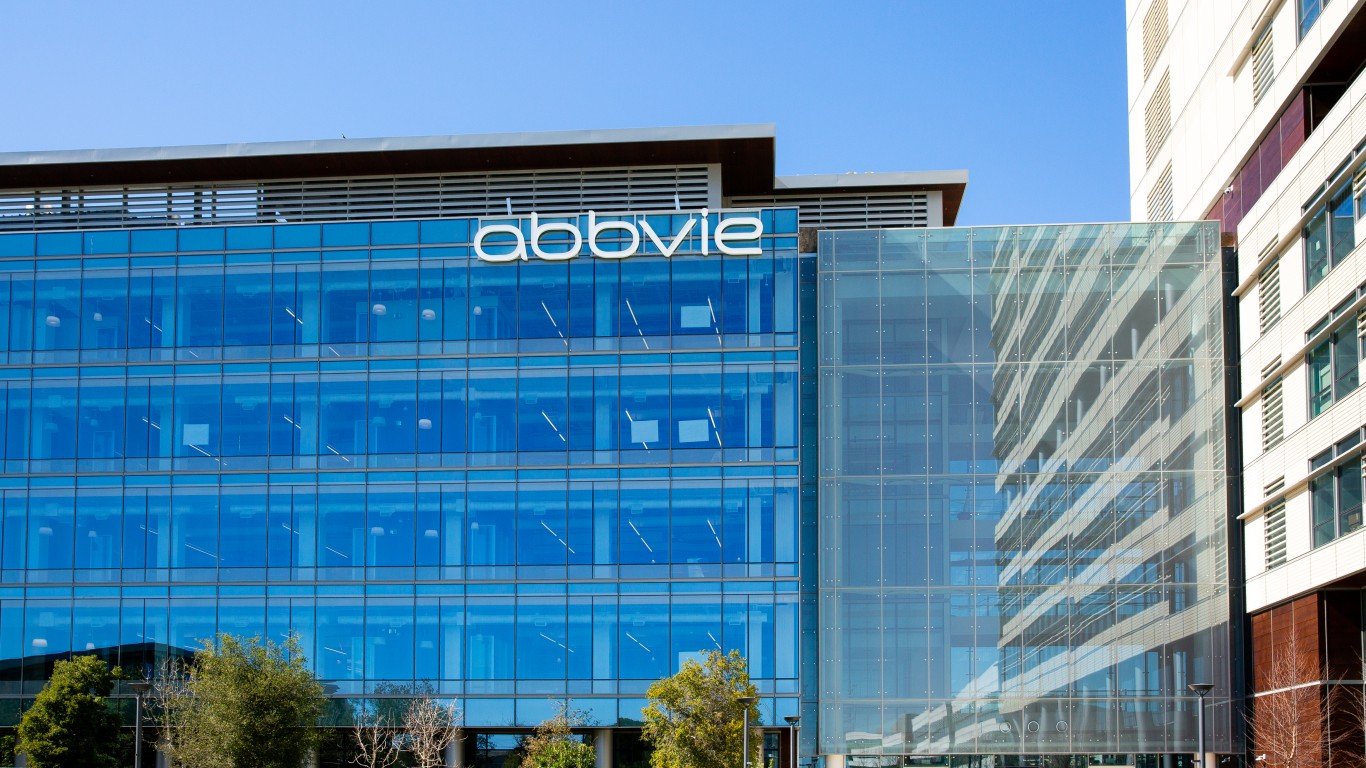
Yield: AbbVie (NYSE:ABBV) raised its quarterly dividend from $1.73 to $1.82, which brings the forward annual rate to $7.28. At $294.17, the forward yield is 2.47%. A 32.59% gain this year has pushed the yield down. The $1.73 payment is due November 16, and the higher rate starts with the February 16, 2027 payment.
Dividend safety: AbbVie belongs to the S&P Dividend Aristocrats Index, and its quarterly payout has grown from $0.40 in 2013 to $1.82. The dividend equals about 52% of the midpoint of adjusted EPS guidance of $13.95 to $13.99. On a GAAP basis, the payout runs 125% because acquired IPR&D charges have cut $0.69 per share from earnings so far this year. The free cash flow yield of 3.42% is higher than the dividend yield, and interest coverage stands at 6.94x. Book value is negative, at -$2.593 per share.
Bull case: AbbVie has replaced Humira’s sales. Skyrizi grew 22.7% to $5.78 billion, Rinvoq grew 23.9% to $2.71 billion, and neuroscience grew 19.4% to $3.39 billion. Third-quarter revenue rose 10.32% to $17.40 billion with an adjusted operating margin of 48.7%. The completed Apogee Therapeutics deal adds to the immunology pipeline.
Risk: Older products are still shrinking. Humira fell 31.2% to $683 million, and Imbruvica fell 26.1%. Most revenue comes from the U.S., so drug pricing policy in Washington could hit AbbVie harder than most.
Johnson & Johnson: 64-Year Dividend King With Upcoming Ex-Dividend Date
Yield: J&J’s $5.36 forward dividend yields 1.87% at $285.98, the lowest yield of the four. The stock has gained 40.41% this year, and that run has pushed the yield down. The next $1.34 payment goes ex-dividend November 24 and is paid December 8.
Dividend safety: No company on this list has a longer record. The April raise from $1.30 to $1.34[4] was J&J’s 64th consecutive year of dividend increases. The payout takes 81% of trailing GAAP EPS of $6.59, which is high. On an adjusted basis, coverage is stronger: second-quarter adjusted EPS of $2.90[5] covered the quarterly dividend about twice over. J&J also has an AAA credit rating and generates $34.5 billion in EBITDA. One weak spot: first-quarter free cash flow dropped 55.4% to $1.5 billion[4].
Bull case: Oncology is driving growth, up 17.3% to $7.41 billion[5] in the second quarter. DARZALEX rose 18.9% to $4.21 billion,[5] and TREMFYA rose 72.5% to $2.05 billion. J&J raised its full-year outlook again in October and remains on track to spin off its orthopedics unit in mid-2027, according to CNBC.
Risk: At 24x forward earnings, the stock already sits above the $279.41 analyst target. Biosimilars cut STELARA sales by 55.2%[5], and MedTech sales missed Wall Street estimates for a second straight quarter as international demand moderated, CNBC reported.
Income Mix: Bristol’s Yield Meets Steady Dividend Growers
Bristol-Myers Squibb pays the most income today and costs the least relative to earnings. Medtronic has the strongest free cash flow coverage. AbbVie and Johnson & Johnson yield less, but they have long records of raising their dividends. Together, the four give retirees a mix of current yield and rising dividends, each paid out of adjusted earnings with room to spare.
Contact [email protected] for any questions or corrections.
Chris Lange is a financial and geopolitical writer with more than a decade of experience covering a myriad of topics. He has published thousands of articles for 24/7 Wall St., with past coverage focused heavily on stocks, IPOs, healthcare, defense, global affairs, and technology.
His work has been quoted, or referenced by a number of outlets including Business Insider, USA Today, Yahoo Finance, MSN, The Motley Fool, and many other publications. A graduate of Southwestern University, he studied business with a focus on investments and has previous experience in banking and startups.
When not reading or writing the news, he is following his passion for Lacrosse, playing chess, or building solar projects with his dad.