Here’s Who’s Getting Dragged Down Further as Huang Exits: CoreWeave Vs. Super Micro Computer

This post may contain links from our sponsors and affiliates, and Flywheel Publishing may receive compensation for actions taken through them.
CoreWeave (NASDAQ:CRWV) and Super Micro Computer (NASDAQ:SMCI | SMCI Price Prediction) both just reported surging AI quarters. Then the Jensen Huang scandal hit both stocks. Huang’s immediate resignation as Nvidia (NASDAQ:NVDA) CEO shook every company that depends on its GPUs. A DOJ probe that links Super Micro to Alice Huang put one of the two in direct legal focus.
Leased GPUs Lift CoreWeave. Record Rack Shipments Lift Super Micro.
CoreWeave rents out Nvidia-powered compute, and demand still runs ahead of supply. Q3 revenue reached $3.66 billion, up 168.3%. Adjusted operating margin hit 10%, a quarter ahead of plan, so the business is starting to turn a profit at the operating line. Pricing on older Ampere and Hopper chips rose 30% to 50% from the prior quarter. Customers still pay up for any GPU they can get.
Super Micro makes the server racks. Fiscal Q1 revenue reached $19.9 billion, up 298%, and AI products made up 71% of sales. Charles Liang called its Data Center Building Block Solutions “central to this growth.” Gross margin slipped to 12.8% from 17.6% as large hyperscale deliveries reduced the mix. One customer supplied 44% of revenue. That much reliance on a single buyer worries me.
| Business Driver | CoreWeave | Super Micro |
|---|---|---|
| Revenue Model | Multi-year GPU cloud contracts | Server and rack sales |
| Visibility | ~$132.5B backlog | FY27 guide raised to $72B to $82B |
| Pressure Point | $846M quarterly interest expense | Customer concentration |
Huang’s Exit Bruises CoreWeave. A DOJ Probe Targets Super Micro.
CoreWeave’s risk comes through its ties to Nvidia. Nvidia invested $2B in its Class A equity, and CoreWeave was the first cloud to put Vera Rubin into production. After Huang resigned, the stock reportedly fell 14%. That came one day after Michael Intrator said he saw “no reason” for the partnership to change. Nobody has tested that promise under new Nvidia leadership yet.
Super Micro faces a legal problem. Bloomberg reported that US officials are looking into whether Alice Huang helped smuggle Nvidia-powered servers through the company. Officials say there is no indication that Nvidia or Huang will face criminal charges at this stage. The probe adds to an existing board review of export-control transactions.
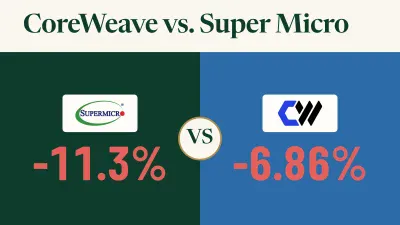
On Thursday, Super Micro fell 11.3% to $26.99, while CoreWeave slipped 6.86% to $56.60.
| Lens | CoreWeave | Super Micro |
|---|---|---|
| Scandal Link | Indirect, through Nvidia leadership | Direct, through the DOJ smuggling probe |
| Debt/Equity | 8.94 | 0.60 |
Prepayments and Probe Headlines Set the Next Move
Watch whether CoreWeave takes in the ~$9B in customer prepayments it expects over the next three months. Q4 interest expense guidance of $1.05 to $1.15 billion leaves little room for delays. For Super Micro, keep an eye on whether the probe names any customers. Its Q2 guidance of $19.5 billion to $21.5 billion assumes deliveries go smoothly.
Why I See Super Micro Taking the Deeper Hit
CoreWeave already carried heavy debt and depended on how investors feel about Nvidia before Huang left. Its contracts and management’s claim of 10 times more qualified demand than capacity through 2027 give me something concrete to consider. Questions from regulators about where Super Micro’s racks ended up could weigh on the stock quickly. On signed demand, CoreWeave carries the cleaner story today. Super Micro’s lower debt load stands out, but the DOJ probe leaves its outlook open. If CoreWeave’s prepayments fall short, I would change my view.
Contact [email protected] for any questions or corrections.
Alex Sirois is a financial writer with experience spanning both retail and institutional investing. He has written for InvestorPlace and held roles at BNY Mellon and Bernstein, giving him a perspective that bridges Main Street portfolios and Wall Street analysis.
Alex holds an MBA from George Washington University and has built his career across multiple industries, including e-commerce, education, and translation — a breadth of experience that informs how he breaks down complex financial topics for everyday investors. His writing is conversational, actionable, and grounded in long-term, buy-and-hold investing principles.
At 247 Wall St., Alex focuses on delivering analysis that is both accessible and useful, with a clear emphasis on helping readers make more informed decisions with their money.