NVIDIA Rises 2% Despite Michael Burry Adding to Chip Shorts; AMD Retreats 3%, Broadcom Slides 2%

This post may contain links from our sponsors and affiliates, and Flywheel Publishing may receive compensation for actions taken through them.

Michael Burry is stepping up his push against chip stocks, and the name most exposed to that push is bouncing anyway. NVIDIA (NASDAQ:NVDA | NVDA Price Prediction) stock is at $169.80, up 2% in morning trading. The bounce comes while the company absorbs a leadership shock and rising scrutiny in Washington.

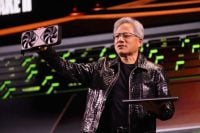
Over the past month, NVIDIA stock has fallen 26%. Jensen Huang resigned as NVIDIA’s CEO on November 12, which sent the stock lower and lifted its closest rivals. Chip rival Advanced Micro Devices (NASDAQ:AMD) is now pulling back 3% to $569.11. Custom-chip designer Broadcom (NASDAQ:AVGO) is slipping 2% to $355.70.
Michael Burry Doubles His Nasdaq 100 Puts
In a Substack post on November 12, Burry shared his move. He said he used a bounce in the Nasdaq 100 off the 27,000 level to double his put position on the index. Puts are options contracts that gain value when the underlying price falls, so a slide in index giants such as NVIDIA would work in Burry’s favor. Those contracts carry an early 2027 strike. Burry estimates it sits 20% out of the money, meaning the index would need a steep drop for them to pay off.
Burry also disclosed that he bought back 25% of a previously reduced put position expiring in June on the VanEck Semiconductor ETF (NASDAQ:SMH). NVIDIA is the fund’s largest holding. He stated that chip valuations “still have a ways to fall” and that he expects earnings to decline over the next couple of years.
AMD and Broadcom Slip Despite Burry’s Nod
That same post named Broadcom and AMD as potential beneficiaries if NVIDIA’s power is weakened. AMD stock is at $575.60, down 2%. Shares of the GPU challenger had rallied as traders rotated toward NVIDIA’s rivals after the leadership news, a shift Barron’s highlighted on November 12.
Broadcom stock is at $358.86, down 2%. Like AMD, Broadcom had gained in the sessions after Huang’s exit, and the pullback may reflect profit taking.
NVIDIA’s gain runs directly against Burry’s thesis. Meanwhile, the two rivals he favored are giving back ground, which reverses part of the trade that dominated the days after Huang’s resignation.
How NVIDIA, AMD and Broadcom Compete for AI Spending
At its core, NVIDIA sells general-purpose graphics processing units (GPUs) and full accelerated-computing platforms, from Blackwell to Vera Rubin, while CUDA, the company’s software ecosystem, keeps developers and hyperscalers building on NVIDIA hardware.
As the challenger in both GPUs and central processing units (CPUs), AMD pairs its Instinct accelerators and Helios rack-scale systems with EPYC server processors. That combination gives cloud buyers a credible alternative to NVIDIA’s stack.
Broadcom takes a different approach, designing custom AI accelerators, known as application-specific integrated circuits (ASICs), for a limited set of large cloud customers. The company also sells networking silicon and runs an infrastructure software segment that includes VMware.
NVIDIA Faces Washington and a Rotation Test
Washington’s scrutiny of NVIDIA is widening. Huang has agreed to testify in a closed-door House session before Thanksgiving. Commerce Secretary Howard Lutnick agreed to appear voluntarily before the Senate Banking Committee on December 10 over oversight of NVIDIA chip exports to China.
Reuters reported that it identified more than $3 billion in Chinese computing projects built around restricted NVIDIA processors. For NVIDIA, the question now is whether the testimony calms those export concerns and whether the chip rally shifts away from the company toward AMD and Broadcom.
The bulls can argue that NVIDIA’s platform lead remains intact and that the month-long decline already reflects much of the leadership turmoil. On the other side, the bears have ample ammunition. Burry’s valuation warning, a leadership transition and rising regulatory heat give them plenty to work with (riding a mania is one thing, knowing when to step aside is the other, and we covered both halves in a free bubble survivor’s handbook).
One near-term signal to watch for is a renewed climb in AMD and Broadcom shares, while a conservative approach could make sense until Washington’s review of NVIDIA’s chip exports concludes.
Contact [email protected] for any questions or corrections.
David Moadel is financial writer specializing in stocks, ETFs, options, precious metals, and Bitcoin. David has written well over 1,000 articles for leading online publications, helping investors understand markets, income strategies, and risk. His work has appeared in 24/7 Wall St., The Motley Fool, InvestorPlace, U.S. News & World Report, TipRanks, ValueWalk, Benzinga, Market Realist, MarketScreener, TalkMarkets, Finmasters, and others. With a master’s degree in education, David has taught at the elementary, high school, and college levels. That teaching background shapes his writing style: clear, educational, and practical. David has also built a loyal social-media audience by providing trustworthy financial content on YouTube, X/Twitter, and StockTwits.