Forget Jensen Huang’s Resignation. AMD May Be Nvidia’s Biggest Threat in 2027

This post may contain links from our sponsors and affiliates, and Flywheel Publishing may receive compensation for actions taken through them.
Advanced Micro Devices (NASDAQ:AMD | AMD Price Prediction) has had a breakout 2026. Shares are up 149.37% year to date and closed at $534.06. The rally followed a quarter in which Data Center revenue rose 97%[1] to $8.546B. Wall Street reconsidered the AI trade without Jensen Huang at NVIDIA (NASDAQ:NVDA), but AMD’s larger opportunity is building beneath that story. Here’s how AMD could reach $800 in 2027.

AI Labs Are Spreading Their Chip Orders Beyond NVIDIA
In his November 14, 2026 report, The Icarus Files, J.P. Morgan Asset Management’s Michael Cembalest found that NVIDIA holds 39% of future frontier AI lab computing agreements measured in gigawatts. Its estimated share from 2023 through 2025 was 80%-plus. AMD GPUs hold 15% of those future agreements. The figures describe the report’s sample of future deals and measure something different from current market share.
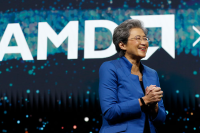
CUDA lock-in is also weakening. One frontier lab told JPMAM that onboarding models onto AMD GPUs used to take six to 12 months. With help from its own AI model, the lab now does it in three days. That is a single customer’s experience, but the direction matters. CEO Lisa Su said, “Our aspirations are to be a very significant compute supplier to our largest customers, both frontier labs as well as hyperscalers.”[2]
Wall Street Sees $658, and 2027 Estimates Keep Rising
The consensus price target stands at $657.74, meaning 23% upside. Analysts expect 2027 EPS of $17.6907, up from $15.3249 90 days ago. That forecast represents 119% growth over 2026. AMD has also exceeded EPS estimates for four consecutive quarters, including Q3’s $2.09[1] against a $1.9366 consensus.


Here’s What It Takes for AMD to Reach $800
AMD currently trades at 30x 2027 estimates. At $800, the multiple would be 45x. That is a premium, though a justified one for earnings expected to more than double.
Several factors could push AMD to $800.
- Guidance: Management expects revenue to grow more than 80% in 2027[2].
- Helios ramp: Anthropic, OpenAI ,and major hyperscalers have brought their first Helios racks online. Q4 revenue guidance is ~$17.0B[1].
- Excess demand: Su said, “demand is higher than supply.”[2]
- Inference leadership: JPMAM mentions an inference performance index that ranks AMD at the top.
AMD’s Track Record Puts $800 Within Reach
Reaching $800 would take a 50% gain. AMD has already topped that move this year and has returned 7562.27% over 10 years. With a beta of 2.542, the stock swings hard in both directions. The risks include NVIDIA’s Rubin Ultra, due in 2027, and custom silicon such as Broadcom (NASDAQ:AVGO) chips, which hold 24% of the future agreements in JPMAM’s sample.

$800 Is a Stretch, but AMD Has a Clear Path
AMD’s 2027 thesis depends on AI customers finding that switching suppliers is now easier and cheaper than it used to be. If it can turn faster software migration and strong inference performance into repeat Helios orders, AMD becomes the default second supplier in a fast-growing market. Helios order volume and 2027 estimate revisions are the key data points to track against the $800 scenario. (We studied what the early signals of the next monster AI chip winner looked like and summarized them here: The Next Nvidia Playbook.)
Contact [email protected] for any questions or corrections.
After two decades of patrolling the dark corners of suburbia as a police officer, Rich Duprey hung up his badge and gun to begin writing full time about stocks and investing. For the past 20 years, he’s been cruising the markets looking for companies to lock up as long-term holdings in a portfolio while writing extensively on the broad sectors of consumer goods, technology, and industrials. Because his experience isn’t from the typical financial analyst track, Rich is able to break down complex topics into understandable and useful action points for the average investor. His writings have appeared on The Motley Fool, InvestorPlace, Yahoo! Finance, Money Morning, and, of course, 24/7 Wall St. He has been featured in both U.S. and international publications, including MarketWatch, Financial Times, Forbes, Fast Company, and USA Today.